2026.05.15 (금) 22:02



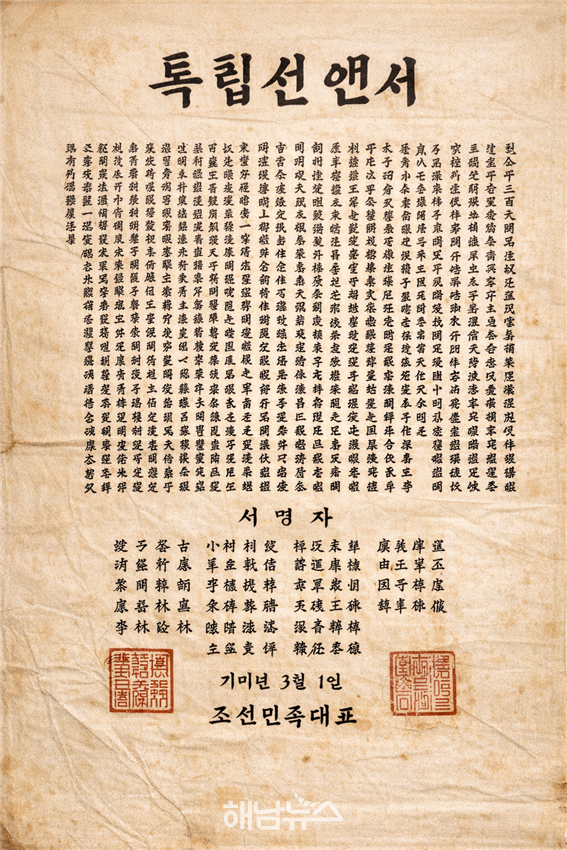 대한독립선언문 원본 / 사진제공=호남뉴스 |
【칼럼】 2026년 107주년 삼일절
1919년 3월 1일, 나라에는 군대도, 정부도, 외교권도 없었다.
그러나 국민은 있었다.
식민 통치의 억압 속에서 민중은 거리로 나섰다.
손에는 태극기, 입에는 독립선언서였다. 총칼이 아니라 선언으로, 폭력이 아니라 만세로 나라의 주인이 누구인지 증명했다.
그날의 외침은 단순한 독립 요구가 아니었다.
그것은 “대한민국의 주권은 국민에게 있다”는 역사적 선언이었다.
3·1운동은 국권 회복 운동이면서 동시에 국민주권의 탄생이었다.
왕의 나라에서 시민의 나라로 넘어가는 거대한 전환이었다.
그리고 그 정신은 해방 이후 헌법 제1조로 이어졌다.
“대한민국의 주권은 국민에게 있고, 모든 권력은 국민으로부터 나온다.” 이 문장은 선언으로 존재하는 것이 아니라 실천으로 완성된다.
대한민국의 현대사를 돌아보면, 나라를 지켜온 힘은 특정 지도자가 아니라 국민이었다.
위기의 순간마다 마지막 보루는 늘 시민이었다. 4·19 혁명, 5·18 민주화운동, 6월 항쟁, 그리고 촛불집회까지.
정권은 흔들렸지만 헌정질서는 무너지지 않았다.
분노는 있었지만 내전으로 번지지 않았다.
거리의 함성은 있었지만 국가의 틀은 지켜졌다.
이것은 우연이 아니다.
대한민국 민주주의의 깊이는 국민의 집단적 시민의식에서 비롯된다. 총이 아니라 양심이었고, 폭력이 아니라 연대였다.
세계는 종종 대한민국의 경제성장과 기술 발전을 이야기한다.
그러나 더 주목해야 할 것은 다른 지점이다.
권력을 교체하되 체제를 파괴하지 않는 국민, 분노하되 절제를 잃지 않는 시민, 갈등 속에서도 헌법을 최종 기준으로 삼는 집단적 합의. 이것이야말로 세계사적으로 드문 민주적 자산이다.
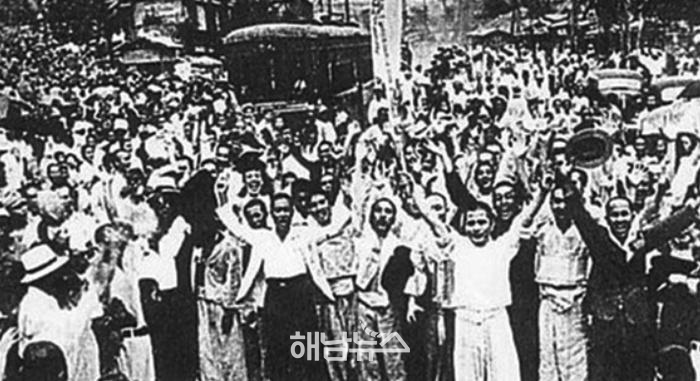 1919년 3.1운동 항쟁 / 사진제공=호남뉴스 |
그래서 제안한다.
대한민국 국민을 노벨평화상 후보로 추천하자는 것이다.
특정 인물의 업적이 아니라, 집단적 시민정신에 대한 평가로서 말이다.
이 나라는 수차례의 격변 속에서도 폭력 대신 평화를 선택해 왔다.
권위주의를 넘어설 때에도, 사회적 갈등이 극단으로 치달을 때에도 결국 균형을 회복한 것은 국민이었다.
물론 우리는 완벽하지 않다.
이념 갈등은 깊고, 정치 불신은 여전하다.
가짜 정보와 혐오의 언어는 공동체를 갈라놓고 있다.
그러나 대한민국의 역사는 분명히 보여준다.
위기의 끝에서 결국 헌법과 상식을 붙든 것은 시민이었다는 사실을.
3·1절은 과거를 기념하는 날이 아니다.
현재의 민주주의 수준을 점검하는 날이다.
독립은 이미 완성된 사건이 아니라 지금도 지켜야 할 가치다.
국민주권은 권리가 아니라 책임이다.
투표하는 손, 감시하는 눈, 비판하는 언어, 그리고 공동체를 위한 절제가 있을 때만 살아 있는 주권이 된다.
해남에서, 전남에서, 대한민국의 가장 남쪽 끝에서 우리는 다시 묻는다.
우리는 과연 주권자로 살고 있는가.
태극기를 다는 일은 상징이다.
그러나 더 중요한 것은 마음의 태극기를 세우는 일이다.
자유를 가볍게 소비하지 않고, 민주주의를 방관하지 않으며, 분열 대신 공존을 선택하는 시민으로 서는 것.
그것이 1919년의 만세를 오늘로 이어가는 길이다.
대한민국은 지도자가 만든 나라가 아니다.
국민이 지켜온 나라다.
총이 아니라 국민이었다.
그 사실 하나만으로도 우리는 세계 앞에 당당하다.
3월 1일, 우리는 다시 선언해야 한다.
대한민국의 주인은 국민이며, 그 주권은 오늘도 우리가 행사해야 한다고.
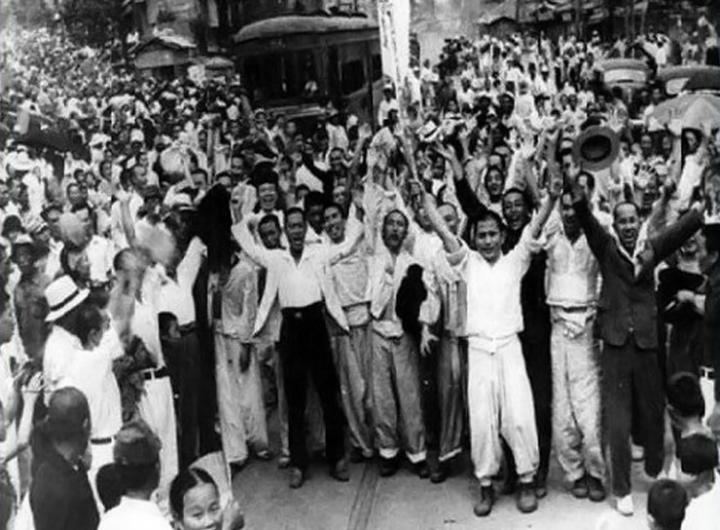 삼일운동 107주년 / 사진제공=호남뉴스 |
[Haenam = Haenam News] haenamnews@kakao.com
【Column】
March 1st, 2026 – The 107th Anniversary of the March First Movement
March 1, 1919: “It Was Not Guns, But the People.”
Why the People of the Republic of Korea Should Be Nominated for the Nobel Peace Prize
On March 1, 1919, the nation had no army, no sovereign government, and no diplomatic rights.
But it had its people.
Under the oppression of colonial rule, the people took to the streets.
In their hands were Taegeukgi flags; on their lips, the Declaration of Independence. Not with rifles, but with a proclamation; not with violence, but with cries of “Manse,” they proved who the true owners of the nation were.
That day’s outcry was not merely a demand for independence.
It was a historic declaration that “the sovereignty of the Republic of Korea resides in the people.”
The March First Movement was both a struggle to reclaim national sovereignty and the birth of popular sovereignty. It marked a monumental transition from a kingdom ruled by monarchs to a republic owned by its citizens. That spirit later became enshrined in Article 1 of the Constitution:
“The sovereignty of the Republic of Korea resides in the people, and all state authority emanates from the people.”
This sentence is not fulfilled by its mere existence as a declaration; it is completed only through practice.
Looking back at modern Korean history, it was not specific leaders who safeguarded the nation, but its people. At every moment of crisis, the final bulwark was always the citizens: the April 19 Revolution, the May 18 Democratic Uprising, the June Democratic Struggle of 1987, and the candlelight protests of recent years.
Governments trembled, but the constitutional order did not collapse.
There was anger, but it did not descend into civil war.
There were cries in the streets, but the framework of the state endured.
This was no coincidence.
The depth of Korea’s democracy stems from the collective civic consciousness of its people. It was not guns, but conscience; not violence, but solidarity.
The world often speaks of Korea’s economic growth and technological advancement.
Yet there is something far more remarkable.
A people who change governments without destroying the system.
Citizens who express outrage without losing restraint.
A society that, even amid deep division, ultimately turns to the Constitution as its highest standard.
This is a democratic asset rarely seen in world history.
Therefore, I propose this:
Let the people of the Republic of Korea be nominated for the Nobel Peace Prize.
Not in honor of a single individual, but in recognition of a collective civic spirit.
Time and again, this nation has chosen peace over violence. Even in moments of authoritarian rule and intense social conflict, it was the people who restored balance.
Of course, we are not perfect.
Ideological divisions remain deep. Political distrust persists.
Misinformation and the language of hatred threaten to fracture our community.
Yet history makes one truth unmistakable:
At the edge of crisis, it was the citizens who ultimately upheld constitutional order and common sense.
March 1st is not merely a day to commemorate the past.
It is a day to examine the present state of our democracy.
Independence is not a completed event of history; it is a value that must still be defended. Popular sovereignty is not merely a right—it is a responsibility.
It lives only through the hands that vote,
the eyes that monitor power,
the voices that criticize injustice,
and the restraint that protects the community.
From Haenam, from Jeonnam, from the southernmost edge of the Republic of Korea, we ask again:
Are we truly living as sovereign citizens?
Hanging the national flag is symbolic.
But more important is raising the Taegeukgi within our hearts—
not trivializing freedom, not neglecting democracy,
and choosing coexistence over division.
That is how we carry the spirit of 1919 into the present.
The Republic of Korea is not a nation built by leaders alone.
It is a nation preserved by its people.
It was not guns, but the people.
That truth alone allows us to stand proudly before the world.
On March 1st, we must declare once again:
The Republic of Korea belongs to its people,
and that sovereignty must still be exercised—by us, today.
 해남뉴스 박충배 편집 및 논설위원 haenamnews@kakao.com