2026.03.19 (목) 05:31




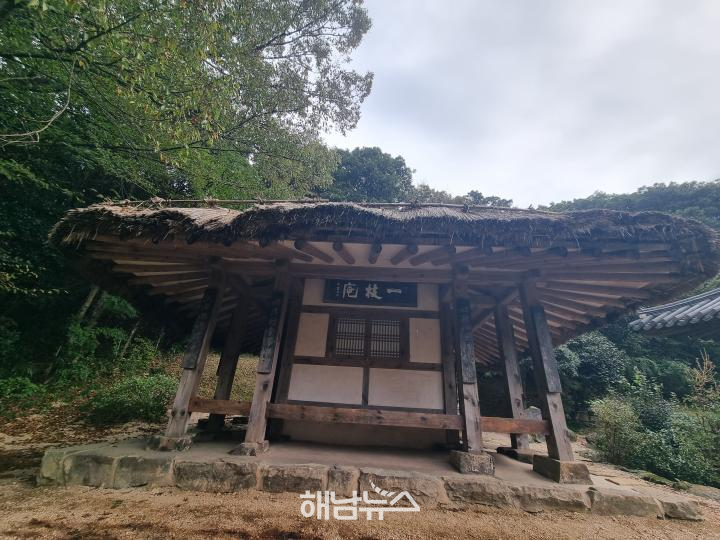 대흥사 일지암 / 사진제공=해남뉴스 |
박충배/편집/칼럼/논설
Ⅰ. 서론
조선 후기 사찰 기록인 『대둔사지(大芚寺志)』는 대흥사를 단일한 사찰 경내로 한정하지 않고, 두륜산 전역을 수행과 교화의 질서 속에 조직된 산중 불교 세계로 인식한 문헌이다.
이 문헌은 사찰을 중심으로 한 폐쇄적 공간 인식이 아니라, 산 전체를 수행 단계에 따라 구조화된 공간으로 이해하고 있다는 점에서 주목된다.
본 논문은 『대둔사지』에 나타난 암자 기록의 서술 방식과 그 문헌적 맥락을 분석함으로써, 일지암(一枝庵) 이 차지하는 공간적·사상적 위상을 규명하는 것을 목적으로 한다.
특히 본 연구는 일지암을 건축사적 대상이나 관광 자원으로 다루지 않고, 문헌에서 ‘어떻게 기록 되었는가.’라는 존재 방식 자체를 분석 대상으로 삼아, 일지암이 어떤 성격의 공간으로 인식되었는지를 해명하고자 한다.
Ⅱ. 『대둔사지』의 산중 공간 인식 구조
『대둔사지』는 대흥사를 중심 사찰로 두면서도, 그 기능을 사찰 경내에 국한하지 않는다.
문헌은 두륜산 일대를 수행 단계와 수행 성격에 따라 사찰–암자–은거 공간으로 층위화하여 인식한다.
이러한 인식은 다음의 원문 구절에서 명확히 드러난다.
內院在兜率峰之外,爲修行之深處也。
非徒寺院之屬,乃兜率世界之所象焉。
주석
이 구절은 ‘내원(內院)’을 물리적 사찰 부속 공간이 아니라, 수행이 가장 깊어지는 영역으로 규정한다.
특히 “非徒寺院之屬(단순히 사찰에 속한 것이 아니다)”라는 표현은, 두륜산 산중 공간이 행정적·제도적 사찰 질서와 구별되는 수행 중심의 세계임을 분명히 한다.
이러한 인식 속에서 암자는 단순한 말사(末寺)가 아니라, 수행자의 근기(根機), 수행 단계, 생활 방식에 따라 분화된 공간으로 이해된다.
즉 『대둔사지』의 암자 서술은 공간의 위계라기보다 수행 성격에 따른 기능적 구분에 가깝다.
Ⅲ. 암자 기록의 서술 방식과 ‘침묵의 의미’
『대둔사지』에 수록된 암자들은 동일한 방식으로 기록되지 않는다.
일부 암자는 창건 연혁, 중창 내역, 전각 구성 등이 비교적 상세히 기술되는 반면, 일부 암자는 명칭만 언급되거나 특정 인물의 수행 맥락 속에서만 간접적으로 등장한다.
이러한 서술 방식의 차이는 도솔봉 체계에 대한 다음 기록에서도 확인된다.
兜率峰之下,
分爲上兜率、中兜率、下兜率。
各隨其根器而居之。
주석
이 구절은 두륜산 산중 공간을 상·중·하 도솔로 구분하면서, 그 기준을 공간의 격이나 규모가 아닌 ‘근기(根器)’에 두고 있다.
즉, 암자는 고정된 위계 공간이 아니라 수행자의 상태에 따라 선택되는 유동적 수행 거처이다.
일지암은 이러한 암자 서술 중에서도 상세한 설명이 생략된 범주에 속한다.
이는 일지암이 대중 법회나 사찰 운영의 거점이 아니었음을 시사하며, 동시에 개인 수행에 종속된 공간이었음을 암시한다.
기록의 간략함은 공간의 중요성 결여가 아니라, 오히려 『대둔사지』가 일지암을 제도적 관리 대상이 아닌 수행의 배경으로 인식했음을 보여준다.
다시 말해, 기록의 ‘침묵’은 비중의 문제가 아니라 공간 성격의 차이를 반영한다.
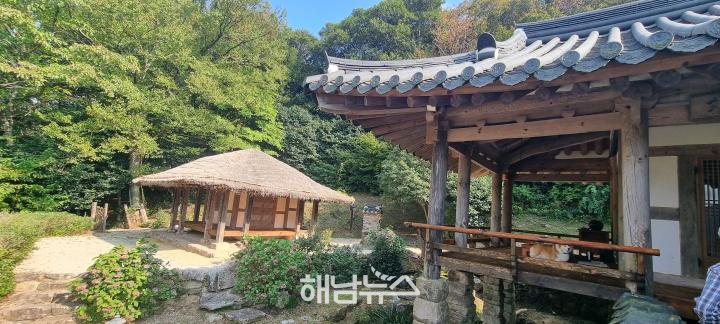 대흥사 일지암 / 사진제공=해남뉴스 |
Ⅳ. 일지암의 명칭과 공간 상징성
‘일지암(一枝庵)’이라는 명칭은 『대둔사지』가 전제한 산중 수행 인식과 깊이 연결된다.
‘一枝’라는 표현은 다수의 분기에서 벗어나 하나의 길로 집중하는 수행 태도를 상징한다.
이는 다중 기능을 수행하는 사찰 공간과 명확히 대비되는 개념이다.
이 명칭은 일지암이 교화의 공간이 아니라, 수행의 심화 공간이며, 공동체보다 개인의 내면을 전제로 한 장소였음을 함축한다.
따라서 일지암은 대흥사의 외연을 확장하는 공간이 아니라, 산중 수행 세계의 내밀한 층위를 구성하는 암자로 이해할 수 있다.
Ⅴ. 초의선사의 수행 맥락과 일지암
『대둔사지』 자체는 초의선사의 일지암 거주를 장황하게 서술하지 않는다.
그러나 초의의 수행 이력과 산중 암자 활용 방식은 문헌 전체에 나타난 수행 인식과 구조적으로 일치한다.
초의선사는 대중 강설보다 은거 수행, 독서와 사유, 장기 체류형 수행을 중시한 인물로 평가된다.
이러한 수행 방식은 일지암과 같은 은거형 암자의 존재 이유를 설명해 준다.
일지암은 초의의 수행 이력 속에서 단순한 일시적 거처가 아니라, 사유가 축적되는 단계적 수행 공간으로 기능했을 가능성이 크다.
Ⅵ. 결론
『대둔사지』의 암자 서술 체계와 원문 인용을 종합할 때, 일지암은 다음과 같은 역사적 성격을 지닌다.
대흥사 산중불교 체계 속 은거형 수행 암자 제도·행정 중심 사찰과 구별되는 개인 수행 공간, 기록의 간결성은 공간 위상의 낮음이 아니라 공간 성격의 특수성, 초의선사의 수행 경향과 구조적으로 부합하는 장소, 사찰사보다 수행사·사상사 연구에 유효한 공간, 결국 일지암은 하나의 건축물로서가 아니라, 『대둔사지』가 전제한 산중 수행 세계의 논리 속에서만 온전히 이해될 수 있는 공간이다.
이 점에서 일지암은 두륜산 불교의 외형이 아니라, 그 내적 구조를 드러내는 좌표라 할 수 있다.
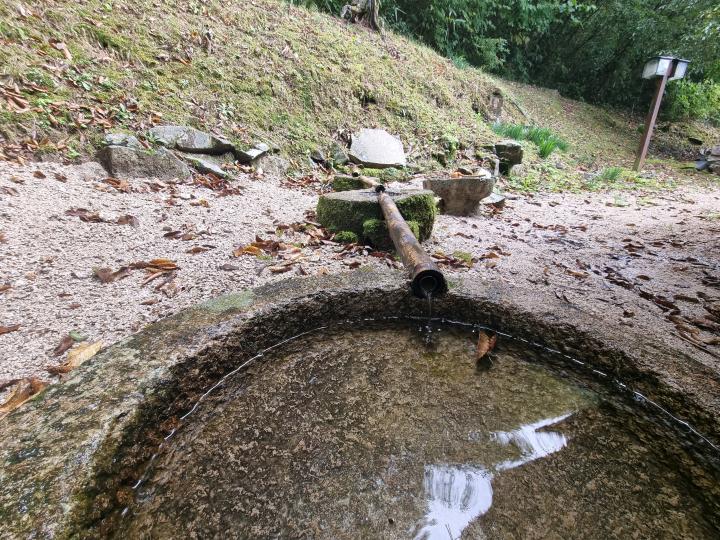 대흥사 일지암 초의샘 / 사진제공=해남뉴스 |
[Haenam = Haenam News]
haenamnews@kakao.com
Park Chung-bae
Editor / Columnist / Editorial Writer
The Spatial Character and Historical Significance of Iljiam (一枝庵)
— A Cross-Section of the Mountain-Based Buddhist Practice System of Duryunsan —
I. Introduction
Daedunsaji (大芚寺志), a late Joseon-period monastic record, does not confine Daehungsa to the physical boundaries of a single temple compound. Instead, it conceptualizes the entire Duryunsan mountain range as a Buddhist world systematically organized according to the principles of practice and religious cultivation. In this respect, the text is noteworthy for its departure from a closed, temple-centered spatial perception, presenting instead a comprehensive understanding of the mountain as a structured field of Buddhist practice arranged by stages of cultivation.
The purpose of this study is to examine the spatial and ideological position occupied by Iljiam (一枝庵) through an analysis of the descriptive methods and contextual framework used in Daedunsaji’s treatment of hermitages. In particular, this research does not approach Iljiam as an object of architectural history or a touristic resource, but rather takes as its object of analysis the mode of its textual existence—that is, how Iljiam is recorded and situated within the document—in order to clarify how the space itself was understood.
II. The Structure of Mountain-Space Perception in Daedunsaji
While Daedunsaji places Daehungsa at the center of the monastic system, it does not restrict the temple’s function to its immediate precincts. The text perceives the Duryunsan region as a stratified landscape of practice, organized into temples, hermitages, and secluded retreat spaces according to both the stage and character of religious cultivation. This spatial perception is clearly expressed in the following original passage:
內院在兜率峰之外,爲修行之深處也。
非徒寺院之屬,乃兜率世界之所象焉。
Annotation
This passage defines the inner precinct (內院) not as a physical appendage of a temple, but as a domain in which practice reaches its deepest level. The phrase “非徒寺院之屬” (“not merely something belonging to a temple”) clearly distinguishes the mountain space of Duryunsan from an administrative or institutional temple order, emphasizing instead a world centered on religious practice.
Within this conceptual framework, hermitages are not regarded as simple branch temples. Rather, they are understood as differentiated spaces according to the practitioner’s spiritual capacity (根機), stage of practice, and mode of daily life. Thus, the hermitage descriptions in Daedunsaji reflect not a spatial hierarchy, but a functional classification based on the nature of practice.
III. Descriptive Variation in Hermitage Records and the Meaning of “Silence”
The hermitages recorded in Daedunsaji are not described in a uniform manner. While some hermitages are documented in considerable detail—covering their founding histories, reconstruction records, and architectural layouts—others are mentioned only by name or appear indirectly within the context of a particular practitioner’s activities. This variation in description is also evident in the following account of the Duryunsan Dosol Peak system:
兜率峰之下,
分爲上兜率、中兜率、下兜率。
各隨其根器而居之。
Annotation
Here, the mountain space beneath Dosol Peak is divided into upper, middle, and lower Dosol zones. Crucially, this division is based not on physical scale or rank, but on the spiritual capacity (根機) of the practitioners. Hermitages, therefore, are not fixed hierarchical spaces, but fluid dwellings selected according to the practitioner’s condition.
Iljiam belongs to the category of hermitages for which detailed explanation is omitted. This suggests that it did not function as a center for public rituals or institutional administration, but rather as a space subordinated to individual practice. The brevity of its record does not indicate insignificance; instead, it reveals that Daedunsaji regarded Iljiam not as an object of institutional management, but as a background space for practice. In this sense, the “silence” of the record reflects not a lack of importance, but a difference in spatial character.
IV. The Name “Iljiam” and Its Spatial Symbolism
The name Iljiam (一枝庵) is deeply connected to the mountain-based practice framework presupposed by Daedunsaji. The term ilji (“one branch”) symbolizes a withdrawal from multiple dispersions toward concentration on a single path of practice. This concept stands in clear contrast to temple spaces that accommodate multiple functions.
The name thus implies that Iljiam was not a place of propagation or communal instruction, but a space for intensified practice, oriented toward the inner life of the individual rather than the collective. Accordingly, Iljiam should be understood not as an extension of Daehungsa’s institutional reach, but as a hermitage constituting the most intimate stratum of the mountain-based practice world.
V. Cho-ui Seonsa’s Practice Context and Iljiam
Daedunsaji itself does not provide an extensive account of Cho-ui Seonsa’s residence at Iljiam. Nevertheless, Cho-ui’s known practice history and his use of mountain hermitages align structurally with the broader practice framework presented in the text. Cho-ui is generally regarded as a figure who valued secluded practice, reading and contemplation, and long-term residential cultivation over public lectures or mass instruction.
Such a practice orientation explains the necessity of hermitages like Iljiam. Within Cho-ui’s life of practice, Iljiam was likely not a temporary shelter, but a stage-based space in which contemplation and insight accumulated over time.
VI. Conclusion
When considered through the hermitage narrative structure and original textual passages of Daedunsaji, Iljiam exhibits the following historical characteristics:
A secluded practice hermitage within the mountain-based Buddhist system of Daehungsa
A personal practice space distinct from institutionally or administratively oriented temples
A site whose brief documentation reflects not a low status, but a specialized spatial character
A location structurally consistent with the practice orientation of Cho-ui Seonsa
A space more suitable for the study of practice history and religious thought than for conventional temple history
Ultimately, Iljiam cannot be fully understood as a mere architectural structure. It is a space that becomes intelligible only within the logic of the mountain-based practice world presupposed by Daedunsaji. In this sense, Iljiam is not an external feature of Duryunsan Buddhism, but a coordinate revealing its internal structure.
 해남뉴스 박충배 편집 및 논설위원 haenamnews@kakao.com