2026.10.02 (금) 07:10




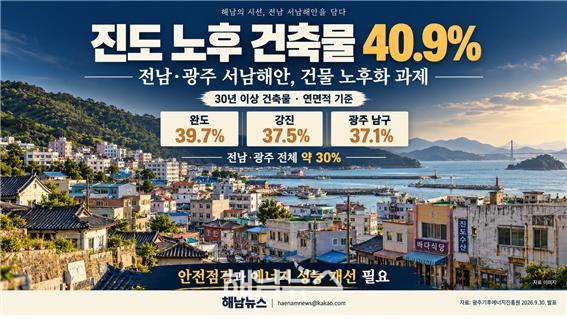 진도 노후 건축물 / 사진제공=ai이미지 |
진도군의 30년 이상 노후 건축물 비율이 연면적 기준 40.9%로 전남·광주 27개 시·군·구 가운데 가장 높은 것으로 나타났다. 완도와 강진 등 서남해안 지역에서도 노후 건축물 비중이 높아 기존 건물의 안전 상태와 주거환경, 냉난방 성능을 함께 살피는 관리가 과제로 떠올랐다.
광주기후에너지진흥원이 9월 30일 공개한 건축물 현황 자료에 따르면 노후 건축물 비율은 진도군 40.9%, 완도군 39.7%, 강진군 37.5%, 광주 남구 37.1% 순으로 높았다.
전남·광주 전체 건축물 연면적은 3억 52만 5,140㎡이며, 이 가운데 30년 이상 된 건축물의 연면적은 9,015만 7,542㎡로 약 30%를 차지했다. 진도군의 노후 비율은 이보다 약 10.9%포인트 높다.
이번 통계는 건물 수가 아닌 각 층의 바닥면적을 합산한 ‘연면적’ 기준이다. 진도군의 40.9%는 전체 건축물 바닥면적 가운데 해당 비율이 30년 이상 된 건물에 속한다는 의미다.
전국적으로도 건축물 노후화는 진행되고 있다. 국토교통부의 ‘2025년 전국 건축물 현황’을 인용한 보도에 따르면 지난해 말 전국 건축물은 743만 8,642동이며, 사용승인 후 30년 이상 지난 건축물은 동수 기준 46.3%였다. 전년 44.4%보다 1.9%포인트 상승했다.
다만 전국의 46.3%는 건물 수 기준이고, 진도의 40.9%는 연면적 기준이어서 두 수치를 직접 비교해 지역별 노후 정도나 전국 순위를 판단할 수는 없다.
주택만 따로 집계한 통계에서는 전남의 노후화가 더욱 뚜렷하다. 국가데이터처가 발표한 ‘2025년 인구주택총조사’에 따르면 지난해 11월 1일 기준 전남의 30년 이상 된 주택 비율은 45.6%로 전국에서 가장 높았다. 전국 평균 30.6%보다 15.0%포인트 높은 수준이다.
전국 주택 유형별로는 단독주택의 60.3%, 아파트의 22.2%가 건축 후 30년 이상 경과한 것으로 조사됐다. 이 통계는 주택을 ‘호’ 단위로 집계한 것으로, 상가와 공장 등을 포함한 전체 건축물 통계와 구분된다.
광주에서도 오래된 주거용 건물의 관리 필요성이 확인됐다. 광주기후에너지진흥원의 노후주택 연구에 따르면 2022년 기준 광주 주거용 건축물 가운데 30년 이상 된 건물은 동수 기준 50.0%였다. 진흥원은 소규모 주택의 구조와 에너지 사용 특성을 고려한 단열·창호·냉난방 설비 개선과 고령자·취약계층 우선 지원을 제안했다.
노후 건축물 관리에서는 건축연령과 실제 안전 상태를 구분해야 한다. 건축공간연구원은 경과연수만으로 건물의 안전과 노후 상태를 해석하는 데 한계가 있다고 지적했다.
따라서 30년 이상 된 건물이라는 이유만으로 위험 건물이나 철거 대상으로 단정하기보다, 실제 상태와 이용 여건을 조사해 보수·성능 개선·정비 방향을 정할 필요가 있다.
“40.9% of Jindo’s Building Floor Area Is in Aging Buildings”…Southwestern Jeonnam and Gwangju Face Building Maintenance Challenges
Wando at 39.7%, Gangjin at 37.5%, and Gwangju’s Nam-gu at 37.1%…Regional share stands at approximately 30% by gross floor area
Jeonnam has the nation’s highest share of homes aged 30 years or older at 45.6%…Safety inspections and energy performance improvements needed
[Jindo — Haenam News] haenamnews@kakao.com
Buildings aged 30 years or older account for 40.9% of Jindo County’s total gross floor area, the highest proportion among the 27 cities, counties, and districts in Jeonnam and Gwangju. Other southwestern coastal areas, including Wando and Gangjin, also recorded high proportions of aging buildings, highlighting the need to assess structural safety, living conditions, and heating and cooling performance.
According to building data released by the Gwangju Climate and Energy Agency on September 30, the share of aging buildings by gross floor area was highest in Jindo County at 40.9%, followed by Wando County at 39.7%, Gangjin County at 37.5%, and Gwangju’s Nam-gu district at 37.1%.
The total gross floor area of buildings in Jeonnam and Gwangju was 300,525,140 square meters. Of this, buildings aged 30 years or older accounted for 90,157,542 square meters, or approximately 30%. Jindo’s proportion was about 10.9 percentage points higher.
These figures are based on gross floor area—the combined floor area of all stories in a building—rather than the number of buildings. Jindo’s figure of 40.9% therefore means that this proportion of the county’s total building floor area is in buildings aged 30 years or older.
Building aging is also a nationwide trend. According to reports citing the Ministry of Land, Infrastructure and Transport’s “2025 National Building Statistics,” South Korea had 7,438,642 buildings at the end of last year. Buildings that had received occupancy approval at least 30 years earlier accounted for 46.3% of the total building count, up 1.9 percentage points from 44.4% the previous year.
However, the national figure of 46.3% is based on building count, while Jindo’s 40.9% is based on gross floor area. The two figures cannot be directly compared to assess relative building age or determine nationwide rankings.
Statistics covering housing alone show a particularly high level of aging in Jeonnam. According to the “2025 Population and Housing Census” released by the Ministry of Data and Statistics, 45.6% of homes in Jeonnam were aged 30 years or older as of November 1 last year—the highest proportion in the country. This was 15.0 percentage points above the national average of 30.6%.
By housing type nationwide, 60.3% of detached houses and 22.2% of apartments were aged 30 years or older. These statistics count housing units and are distinct from statistics covering all buildings, including commercial premises and factories.
The need to manage older residential buildings has also been identified in Gwangju. A study by the Gwangju Climate and Energy Agency found that, as of 2022, buildings aged 30 years or older accounted for 50.0% of Gwangju’s residential building count. The agency recommended improvements to insulation, windows, and heating and cooling equipment tailored to the structural characteristics and energy use of smaller homes, with priority support for older residents and vulnerable households.
Building age must be distinguished from actual safety conditions when managing aging properties. The Architecture & Urban Research Institute has pointed out that elapsed years alone provide a limited basis for assessing a building’s safety and deterioration.
Rather than automatically classifying buildings aged 30 years or older as dangerous or requiring demolition, their actual condition and use should be examined to determine appropriate repairs, performance improvements, or redevelopment measures.
 해남뉴스 박충배 편집/논설 news@hbcnews.kr