2026.03.18 (수) 05:30




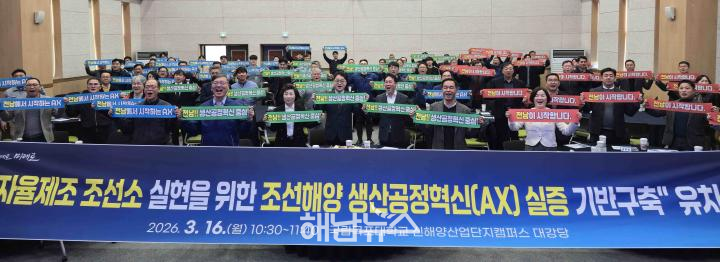 전남 조선기자재산업 미래발전 포럼 / 사진제공=전라남도 |
전라남도가 조선산업의 인공지능 전환(AX)을 통해 산업 구조 혁신에 본격적으로 나섰다. 전통적인 노동집약 산업으로 인식되던 조선업이 데이터와 인공지능 기반의 첨단 산업으로 재편되는 흐름 속에서, 전남이 그 중심 거점으로 도약하겠다는 전략이다.
전남도는 16일 영암 신해양산업단지캠퍼스에서 ‘전남 조선기자재산업 미래발전 포럼’을 열고 조선산업의 AI 기반 생산공정 혁신 방향과 정책 과제를 논의했다.
이번 포럼은 국립목포대학교가 주관했으며, 전남도와 조선·기자재 기업, 대학, 연구기관 관계자 등 80여 명이 참석해 산업 전환의 필요성과 실행 전략을 공유했다.
이날 포럼에서는 AI를 활용한 생산공정 혁신이 핵심 의제로 제시됐다. 천광산 목포대 교수는 발표를 통해 조선산업이 설계부터 가공, 조립, 물류까지 전 공정을 데이터로 연결하고, 이를 기반으로 공정을 최적화하는 방향으로 나아가야 한다고 강조했다.
이는 단순한 자동화를 넘어 생산 전 과정이 실시간으로 연결되고 제어되는 ‘자율운영 조선소’로의 전환을 의미한다.
자율운영 조선소는 강재 입고에서부터 가공·조립·물류에 이르기까지 모든 공정을 데이터로 통합 관리하는 미래형 생산체계다.
인공지능과 로봇 기술이 결합된 이 시스템은 생산 효율을 높이고 공정 오류를 최소화하며, 작업자의 안전을 강화하는 데에도 기여할 것으로 기대된다.
포럼에서는 산업 전환과 함께 해결해야 할 현실 과제들도 함께 논의됐다. 해상풍력 하부구조물 운송 문제를 비롯해 해외 기능인력 양성 방안, 국민성장펀드 활용을 통한 투자 확대 등 산업 생태계 전반에 걸친 다양한 의견이 제시됐다.
특히 참석자들은 산업통상자원부의 ‘조선해양 생산공정혁신(AX) 지원 기반구축사업’ 유치 필요성에 공감하며, 이를 위한 공동 대응 의지를 확인했다.
전남도는 이러한 흐름에 맞춰 대불산단을 중심으로 AI 자율운영 조선소 구축을 추진하고 있다.
이를 위해 AI·로봇 기반 생산공정 기술을 개발하고, 실증과 검증을 거쳐 현장에 단계적으로 적용할 계획이다.
지난달에는 관련 기반 구축을 위한 산업통상자원부 공모사업에도 참여하며 정책적 기반 확보에도 나섰다.
이번 산업 전환은 단순한 기술 도입을 넘어 조선업의 구조 자체를 변화시키는 계기가 될 것으로 전망된다.
전남도는 AI 기반 공정 혁신을 통해 생산성을 높이는 동시에 산업재해를 줄이고, 고숙련 인력을 중심으로 한 일자리 구조 전환도 기대하고 있다.
김기홍 전남도 전략산업국장은 “글로벌 조선시장 경쟁이 갈수록 치열해지는 상황에서 자동화와 AI 기반 생산체계로의 전환은 필수적인 과제”라며 “대불산단을 중심으로 자율운영 조선소를 구축해 전남을 대한민국 조선산업 혁신의 거점으로 만들겠다.”고 밝혔다.
전남의 이번 시도는 조선산업이 더 이상 단순 제조업에 머물지 않고, 데이터와 기술 중심의 미래 산업으로 전환되는 흐름을 상징적으로 보여준다.
산업의 중심축이 인력에서 기술로 이동하는 지금, 전남이 그 변화를 선도할 수 있을지 주목된다.
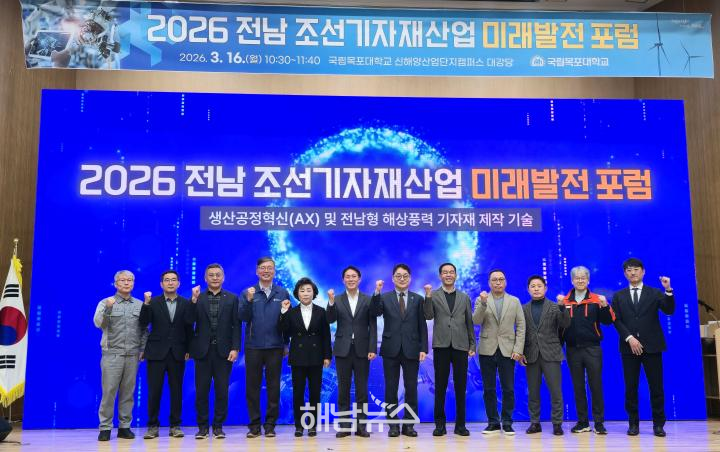 전남 조선기자재산업 미래발전 포럼 / 사진제공=전라남도 |
“From Steel Plates to Data”… Jeonnam Launches AI-Driven Transformation of Shipbuilding Industry
[Jeonnam = Haenam News] haenamnews@kakao.com
Jeollanam-do Province has begun a full-scale push to restructure its shipbuilding industry through an Artificial Intelligence Transformation (AX), aiming to shift from a traditionally labor-intensive sector to a high-tech industry driven by data and AI. The province seeks to position itself as a central hub in this industrial transition.
On the 16th, Jeonnam held the “Future Development Forum for the Shipbuilding Equipment Industry” at the New Marine Industry Complex Campus in Yeongam, where discussions focused on AI-based innovation in production processes and key policy directions for the industry.
Hosted by Mokpo National University, the forum brought together around 80 participants, including officials from Jeonnam Province, shipbuilding and equipment companies, academia, and research institutions, to share insights on the necessity and strategies for industrial transformation.
A key topic of the forum was innovation in production processes using AI. Professor Cheon Gwang-san of Mokpo National University emphasized that the shipbuilding industry must evolve toward integrating all processes—from design and fabrication to assembly and logistics—through data, enabling optimized operations.
This goes beyond simple automation, representing a transition to “autonomous shipyards,” where the entire production process is interconnected and controlled in real time.
An autonomous shipyard is a next-generation production system that manages all processes—from steel intake to processing, assembly, and logistics—through integrated data systems.
By combining AI and robotics, such systems are expected to enhance productivity, minimize errors, and improve workplace safety.
The forum also addressed key challenges accompanying this industrial shift. Discussions included solutions for transporting offshore wind substructures, strategies for training and securing overseas skilled workers, and expanding investment through the National Growth Fund.
Participants particularly expressed strong support for attracting the Ministry of Trade, Industry and Energy’s “Shipbuilding and Marine Production Process Innovation (AX) Infrastructure Development Project,” reaffirming their commitment to joint efforts.
In line with these initiatives, Jeonnam Province is promoting the development of AI-driven autonomous shipyards centered around the Daebul Industrial Complex.
The province plans to develop AI and robotics-based production technologies, establish testing and validation systems, and gradually apply these innovations in real industrial settings.
Last month, Jeonnam also applied for the related national infrastructure project to secure policy support.
This transformation is expected to go beyond the adoption of new technologies and fundamentally reshape the structure of the shipbuilding industry.
Jeonnam anticipates improvements in productivity, reductions in industrial accidents, and a shift toward a workforce centered on highly skilled domestic labor.
Kim Gi-hong, Director General of Strategic Industries at Jeonnam Province, stated,
“As global competition in the shipbuilding market intensifies, transitioning to automated and AI-based production systems is no longer optional but essential. We will build autonomous shipyards centered on the Daebul Industrial Complex and establish Jeonnam as a national hub for shipbuilding innovation.”
Jeonnam’s initiative symbolically reflects the broader transformation of shipbuilding from a traditional manufacturing sector into a data- and technology-driven future industry.
As the industry’s core shifts from labor to technology, attention is now focused on whether Jeonnam can lead this change.
 해남뉴스 박충배 편집 및 논설위원 haenamnews@kakao.com