2026.09.16 (수) 18:05



 서산대사 추계제향1 / 사진제공=ai호남뉴스 |
조선 정조대왕이 사액하고 조정에서 예관을 보내 제향했던 해남 대흥사 표충사의 역사적 전통이 올가을 다시 이어진다.
‘2026 서산대제 추계향례’가 오는 10월 31일 오전 10시 전남 해남군 대흥사 표충사에서 봉행된다.
이번 추계향례는 임진왜란 당시 승군을 일으켜 나라를 지키는 데 앞장선 서산대사 청허 휴정을 비롯해 그의 제자인 사명대사 유정과 뇌묵당 처영의 충의와 호국정신을 기리고, 조선 후기 국가 차원에서 이어졌던 표충사 제향의 역사적 의미를 계승하는 데 뜻을 두고 있다.
■ 정조가 사액한 표충사…조정에서 예관까지 파견
대흥사 표충사는 일반적인 사찰 전각과는 다른 역사적 의미를 지니고 있다.
표충사는 임진왜란 당시 호국의승을 이끌었던 서산대사와 그 제자들의 충의를 기리기 위해 건립됐으며, 1788년 정조 12년 국왕이 ‘표충사(表忠祠)’라는 사액을 내렸다.
이어 1789년에는 조정에서 예관을 파견해 제향을 올리도록 하면서 표충사 제향은 사찰 내부의 불교의식을 넘어 국가가 공식적으로 인정하고 시행하는 제향의 성격을 갖게 됐다.
1794년에는 정조가 직접 지은 ‘서산대사화상당명’과 서문을 내려보내는 등 서산대사의 호국정신을 국가 차원에서 기렸다.
특히 대흥사는 서산대사의 의발과 관련 유물이 전해져 내려오는 곳으로, 조선 후기 서산종의 중심 사찰로 성장하면서 서산대사의 법맥과 호국불교 정신을 계승해 왔다.
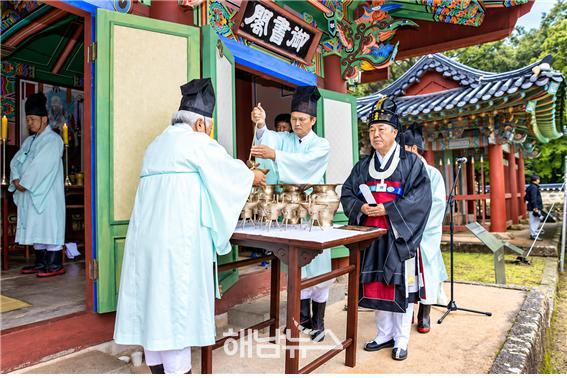 서산대사 추계제향1 / 사진제공=ai호남뉴스 |
■ 서산대사 한 사람만의 제향 아니다…‘3위’ 모시는 표충사
표충사 향례의 또 다른 특징은 서산대사 한 사람만을 기리는 제향이 아니라는 점이다.
표충사에는 서산대사 휴정과 사명대사 유정, 뇌묵당 처영 등 세 분의 진영이 봉안돼 있어 이들 3위의 충의와 호국정신을 함께 기리는 것이 역사적 의미의 핵심이다.
이에 따라 추계향례 역시 세 분의 신위를 중심으로 제향 공간과 제물을 마련하고 전통적인 절차에 따라 봉행하는 것이 중요하다.
특히 일반적인 가정 제사의 진설 방식과 달리 표충사 향례는 국가제향의 전통을 갖고 있는 만큼 역사자료에 나타난 제기와 제물, 위치와 순서를 최대한 충실하게 반영할 필요가 있다.
■ 전폐례부터 삼헌례까지…전통 제향 절차 재현
2026년 추계향례에서는 역사적으로 전승된 표충사 ‘향례홀기’, ‘춘추시향축문’, ‘진설도’ 등 관련 자료를 토대로 전통 제향의 의미를 살리는 것이 핵심이다.
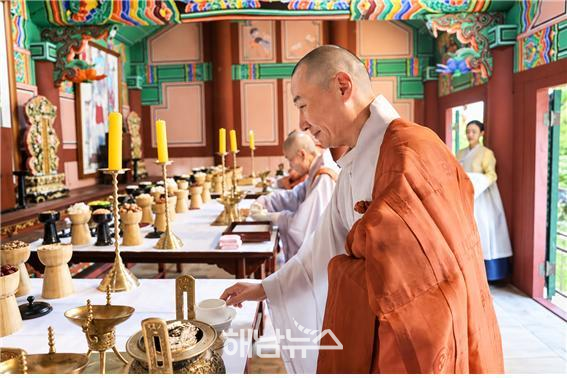
향례는 제물을 정해진 위치에 올리는 진설을 마친 뒤 제관들이 전통 복식을 갖추고 입장하는 것으로 본격 시작한다.
찬자와 대축, 알자, 찬인, 봉향, 봉로 등 집사관이 먼저 정해진 위치에 서는 ‘집사취위’를 하고, 이어 초헌관·아헌관·종헌관 등 헌관이 취위한다.
헌관과 제관들이 신위를 향해 예를 올린 뒤 향과 폐백을 올리는 전폐례(奠幣禮)가 진행된다.
이어 첫 번째 술잔을 올리는 초헌례(初獻禮)가 시작되고 대축이 축문을 읽는 독축이 이어진다.
두 번째 잔을 올리는 아헌례(亞獻禮), 세 번째 잔을 올리는 **종헌례(終獻禮)**가 차례로 진행되면서 삼헌례가 완성된다.
이후 제향에 올린 술과 음식을 나누는 의미의 음복례와 축문 등을 처리하는 망료례를 거쳐 집례자가 제향이 모두 끝났음을 고하는 예필로 국가제향 형식의 향례를 마무리하게 된다.
■ 조선시대에는 예조정랑이 초헌관 맡아
표충사 제향은 제관 구성에서도 당시 국가제향의 성격을 확인할 수 있다.
전해지는 기록에 따르면 조선시대 표충사 제향에서는 예조정랑이 초헌관을 맡고 장흥부사와 경양찰방, 흥양현감, 해남현감, 진도군수, 낙안군수 등 지방관들이 제향의 주요 직책을 담당했던 것으로 알려져 있다.
이는 표충사 제향이 특정 사찰이나 지역만의 행사가 아니라 조정과 지방관이 참여했던 공식적인 제향이었다는 사실을 보여주는 대목이다.
현대의 서산대제에서도 초헌관·아헌관·종헌관을 중심으로 봉향·봉로·봉작·전작 등 제관과 집사관을 구성해 전통 향례를 재현해 왔다.
따라서 2026년 추계향례에서도 단순히 주요 인사가 차례로 술잔을 올리는 행사 방식에서 벗어나 각 제관의 역할과 동선, 복식, 홀기에 따른 행동까지 체계적으로 구성할 경우 국가제향으로서의 역사성을 더욱 살릴 수 있을 것으로 보인다.
서산대사 추계제향1 / 사진제공=ai호남뉴스 |
■ ‘기념식’보다 ‘제향’이 먼저…역사성 살리는 행사 구성 필요
이번 서산대제에서 특히 중요한 부분은 일반적인 현대식 기념행사와 전통 제향을 명확히 구분하는 것이다.
표충사 향례의 역사적 가치를 살리기 위해서는 내빈소개와 축사, 기념사 등을 향례 중간에 배치하기보다는 전통 제향을 처음부터 끝까지 하나의 완결된 의식으로 봉행한 뒤 기념행사와 불교식 추모의례 등을 별도로 진행하는 방식이 의미를 살릴 수 있다.
오전 10시 제향을 시작할 경우 집사취위와 헌관취위, 전폐례, 초헌례와 독축, 아헌례, 종헌례, 음복례, 망료례, 예필까지 약 40~50분 동안 전통 향례를 집중적으로 봉행하는 방식이다.
이후 불교식 다례와 법요식, 호국의승 추모의례 등을 별도 순서로 진행하면 표충사가 지닌 ‘유교식 국가제향과 불교 호국정신이 만나는 역사적 공간’이라는 특성을 보다 분명하게 보여줄 수 있다.
■ “정조가 예관 보내 올렸던 제향”…문화콘텐츠 가치도 주목
서산대제 추계향례는 한 사찰의 연례행사를 넘어 해남이 보유한 중요한 역사문화 콘텐츠라는 평가를 받을 수 있다.
임진왜란이라는 국가적 위기에서 일어난 호국의승의 역사와 서산대사, 정조의 사액, 국가제향, 대흥사와 표충사라는 역사적 공간이 하나의 이야기로 연결되기 때문이다.
특히 표충사의 역사적 가치를 국민들에게 알리기 위해서는 제향을 단순히 재현하는 데 머물지 않고 왜 정조가 표충사를 사액했는지, 왜 조정에서 예관을 파견했는지, 서산대사와 사명대사·처영이 나라를 위해 어떤 역할을 했는지를 함께 설명하는 역사문화 프로그램으로 확대할 필요성도 제기된다.
향례에 앞선 제관 행렬을 비롯해 전통 제복과 제기, 진설, 홀기, 축문 등을 충실하게 복원한다면 관람객들이 조선시대 국가제향의 모습을 직접 확인할 수 있는 살아있는 역사교육의 장으로 발전시킬 가능성도 크다.
■ “정조가 사액하고 조정이 예관을 보내 제향했던 표충사.”
오는 10월 31일 봉행되는 2026 서산대제 추계향례는 400여 년 전 나라를 지키기 위해 일어섰던 호국의승의 정신과 230여 년 전 국가가 그 충의를 기렸던 제향의 전통을 오늘에 다시 잇는 자리가 될 전망이다.
해남 대흥사 표충사의 추계향례가 단순한 재현행사를 넘어 대한민국 호국불교와 국가제향의 역사를 후대에 전하는 대표적인 역사문화유산으로 자리매김할 수 있을지 주목된다.
“Continuing the State Memorial Rite Once Conducted by Royal Envoys of King Jeongjo”…2026 Seosan Daeje Autumn Ancestral Rite to Be Held at Pyochungsa on October 31
Ceremony to begin at 10 a.m. at Pyochungsa Shrine, Daeheungsa Temple in Haenam, honoring the loyalty of Seosan Daesa, Samyeong Daesa, and Noemukdang Cheoyeong
King Jeongjo bestowed the royal name “Pyochungsa (表忠祠)” in 1788…The royal court dispatched a ceremonial official the following year to conduct a state-sanctioned memorial rite
Traditional ritual to be reconstructed based on historical materials including the Hyangnye Holgi ritual manual, Chunchu Sihyang Chukmun ceremonial prayer, and Jinseoldo offering arrangement diagram
Solemn proceedings to follow the sequence of Jeonpyerye → Choheollye and ceremonial prayer → Aheollye → Jongheollye → Eumbongnye → Mangnyorye
“More than a memorial ceremony—a historical and cultural heritage preserving the spirit of the patriotic monk-soldiers of the Imjin War and the tradition of state memorial rites”
[Haenam = AI Honam News] aihnnews@kakao.com
A historic tradition dating back to the reign of King Jeongjo—when the Joseon royal court dispatched an official to conduct a state-sanctioned memorial rite at Pyochungsa Shrine of Daeheungsa Temple in Haenam—will be continued this autumn.
The 2026 Seosan Daeje Autumn Ancestral Rite will be held at 10 a.m. on October 31 at Pyochungsa Shrine, Daeheungsa Temple, Haenam, South Korea.
The ceremony will honor the loyalty and patriotic spirit of Cheongheo Hyujeong, better known as Seosan Daesa, who mobilized Buddhist monk-soldiers to defend the country during the Japanese invasions of Korea in the late 16th century, together with his disciples Samyeong Daesa Yujeong and Noemukdang Cheoyeong.
It will also seek to preserve the historical significance of the Pyochungsa memorial rites that were officially recognized and conducted under the authority of the Joseon state.
Pyochungsa Received a Royal Plaque from King Jeongjo
Pyochungsa at Daeheungsa Temple holds a historical significance that distinguishes it from an ordinary Buddhist temple hall.
The shrine was established to commemorate Seosan Daesa and his disciples for their loyalty and their role in organizing monk-soldiers during the Imjin War.
In 1788, the 12th year of King Jeongjo’s reign, the king bestowed the name “Pyochungsa (表忠祠),” meaning “Shrine Honoring Loyalty.”
In 1789, the royal court dispatched a ceremonial official to conduct a memorial rite at the shrine. This elevated the Pyochungsa ceremony beyond an internal Buddhist observance, giving it the character of an officially sanctioned state memorial rite.
In 1794, King Jeongjo also sent the inscription and preface he had personally composed for the portrait hall of Seosan Daesa, further demonstrating the royal court’s recognition of the monk’s service to the nation.
Daeheungsa is also closely associated with Seosan Daesa through relics and personal effects traditionally handed down at the temple. During the late Joseon period, the temple developed into an important center of Seosan’s Buddhist lineage and continued to preserve his legacy of patriotic Buddhism.
Not Only Seosan Daesa—Three Eminent Monks Are Honored
One of the defining characteristics of the Pyochungsa rite is that it does not commemorate Seosan Daesa alone.
Portraits of Seosan Daesa Hyujeong, Samyeong Daesa Yujeong, and Noemukdang Cheoyeong are enshrined at Pyochungsa. Honoring the loyalty and patriotic spirit of all three therefore forms an essential part of the ceremony’s historical meaning.
Accordingly, the autumn rite should be conducted around the three enshrined figures, with ritual spaces and offerings prepared according to traditional ceremonial procedures.
Unlike an ordinary Korean family ancestral rite, the Pyochungsa ceremony follows the tradition of an official state memorial rite. The ritual vessels, offerings, their placement, and the sequence of proceedings should therefore reflect historical records as faithfully as possible.
From Jeonpyerye to the Three Libation Rites
A key objective of the 2026 autumn ceremony is to preserve traditional ritual procedures based on historical materials associated with Pyochungsa, including the Hyangnye Holgi, a manual specifying the sequence and commands of the ceremony; the Chunchu Sihyang Chukmun, containing ceremonial prayer texts; and the Jinseoldo, which illustrates the arrangement of ritual offerings.
The ceremony begins after the offerings and ritual vessels have been placed in their prescribed positions.
Ceremonial officials wearing traditional attire then enter the shrine.
Officials responsible for guiding and conducting the ceremony—including the chan-ja, dae-chuk, al-ja, chan-in, bong-hyang, and bong-ro—first take their designated positions. They are followed by the three principal officiants: the Choheongwan, Aheongwan, and Jongheongwan, who perform the first, second, and third libations.
After the officiants pay their respects before the enshrined figures, Jeonpyerye (奠幣禮) is conducted, during which incense and ceremonial offerings are presented.
The Choheollye (初獻禮) follows, with the first officiant presenting the first cup of wine. The ceremonial prayer is then formally recited.
This is followed by Aheollye (亞獻禮), the second libation, and Jongheollye (終獻禮), the third and final libation, completing the traditional three-stage offering ceremony.
The rite then proceeds to the ceremonial sharing of blessed food and drink, followed by Mangnyorye, during which ceremonial texts and offerings are ritually concluded or disposed of according to tradition.
Finally, the presiding ritual official announces the completion of the ceremony.
Joseon Court Official Served as the First Officiant
The historical composition of the ritual officials provides further evidence of the state-sanctioned character of the Pyochungsa ceremony.
According to surviving accounts, an official from the Joseon Ministry of Rites served as the principal first officiant, while regional government officials—including those associated with Jangheung, Haenam, Jindo, Heungyang, Nagan, and other jurisdictions—were assigned important ceremonial responsibilities.
This demonstrates that the Pyochungsa rite was not merely an event conducted by a single Buddhist temple or local community, but a formal memorial ceremony involving officials representing both the royal government and regional administration.
Modern Seosan Daeje ceremonies have also sought to reconstruct the traditional rite by appointing the three principal officiants and supporting ritual officials responsible for incense, ritual vessels, wine offerings, and other ceremonial duties.
For the 2026 ceremony, carefully defining each official’s role, movements, traditional attire, and actions in accordance with the historical Holgi would further reinforce the authenticity of the state memorial rite.
The Ritual Should Come Before the Modern Commemorative Ceremony
A central consideration for the 2026 Seosan Daeje is maintaining a clear distinction between the traditional rite and a modern commemorative event.
To preserve the historical integrity of the Pyochungsa ceremony, introductions of dignitaries, congratulatory remarks, commemorative speeches, and similar modern proceedings should not interrupt the traditional ritual.
Instead, the historical rite can be conducted continuously from beginning to end, with commemorative speeches and Buddhist memorial ceremonies held separately afterward.
If the state-style memorial rite begins at 10 a.m., the traditional proceedings—from officials taking their positions through Jeonpyerye, the three libation rites, the ceremonial prayer, Eumbongnye, Mangnyorye, and the formal conclusion—would take approximately 40 to 50 minutes.
A separate Buddhist tea offering, memorial Dharma ceremony, and tribute to the patriotic monk-soldiers could then follow.
Such a format would highlight the distinctive identity of Pyochungsa as a historical space where the Confucian ceremonial tradition of Joseon state memorial rites meets the patriotic Buddhist legacy of Korea’s monk-soldiers.
From a Memorial Rite to a Major Historical and Cultural Heritage Asset
The Seosan Daeje Autumn Ancestral Rite has significance extending beyond an annual temple ceremony.
The event brings together several important chapters of Korean history: the national crisis of the Imjin War, the mobilization of Buddhist monk-soldiers, Seosan Daesa and his disciples, King Jeongjo’s royal recognition, the tradition of state memorial rites, and the historic setting of Daeheungsa and Pyochungsa.
To communicate this heritage more effectively to the public, the ceremony could develop beyond the simple reconstruction of a historical ritual.
Historical and cultural programs could explain why King Jeongjo bestowed a royal plaque on Pyochungsa, why the royal court dispatched a ceremonial official, and how Seosan Daesa, Samyeong Daesa, and Cheoyeong contributed to the defense of the nation.
Faithful reconstruction of the procession of ritual officials, traditional ceremonial robes, ritual vessels, offering arrangements, ritual commands, and ceremonial prayers could also transform the event into a living history program through which visitors can experience the ceremonial culture of the Joseon Dynasty.
Pyochungsa is a shrine upon which King Jeongjo bestowed a royal name and to which the Joseon court dispatched an official to conduct a memorial rite.
The 2026 Seosan Daeje Autumn Ancestral Rite on October 31 will connect the present day with the patriotic spirit of Buddhist monk-soldiers who rose to defend the nation more than four centuries ago, as well as the state memorial tradition established more than two centuries ago to honor their loyalty.
Attention is now focused on whether the autumn rite at Pyochungsa, Daeheungsa Temple in Haenam, can develop beyond a reconstructed historical ceremony into a representative Korean cultural heritage event that preserves and passes on the history of patriotic Buddhism and Joseon state memorial rites to future generations.
 해남뉴스 박충배 편집/논설 news@hbcnews.kr