2026.09.16 (수) 18:04



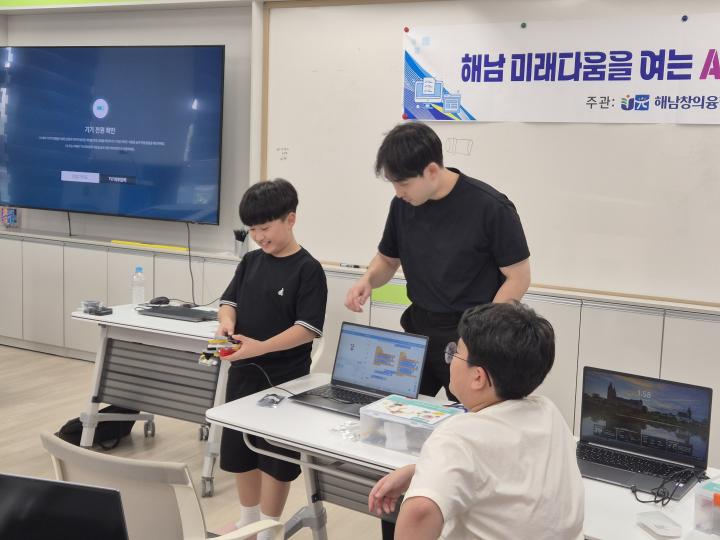
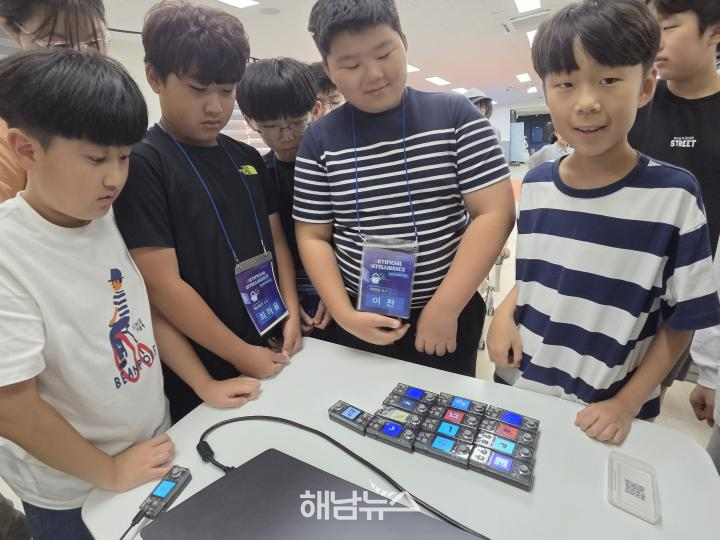 해남 학생들, AI로봇 만들기에 푹 빠졌다 / 사진제공=해남교육지원청 |
“내가 생각한 로봇을 직접 만들고, AI를 학습시켜 움직여 본다.”
해남지역 학생들이 인공지능(AI)의 원리를 배우는 데서 한발 더 나아가 자신이 상상한 AI로봇을 직접 설계하고 움직여 보는 프로젝트형 교육에 참여했다.
특히 앞선 1기 교육에 참여했던 학생들이 2기 과정에도 다수 다시 참여하면서 지역 학생들의 AI·소프트웨어(SW) 교육에 대한 높은 관심을 보여줬다.
해남교육지원청 해남창의융합교육관은 지난 12일부터 13일까지 이틀간 관내 초등학교 5학년부터 중학교 3학년 학생을 대상으로 ‘2026 AI-프로젝트 과정 2기’를 운영했다.
이번 교육은 ‘우리 생활을 변화시키는 AI로봇 만들기’를 주제로 총 12차시에 걸쳐 진행됐다.
첫날 학생들은 인공지능의 기본 개념과 AI가 데이터를 통해 학습하고 판단하는 과정을 익혔다.
음성·이미지·감정 인식 기능과 머신러닝을 직접 체험하고, AI 번역기와 디지털 펫을 만들어보면서 인공지능 기술이 일상생활에서 어떻게 활용되는지도 살펴봤다.
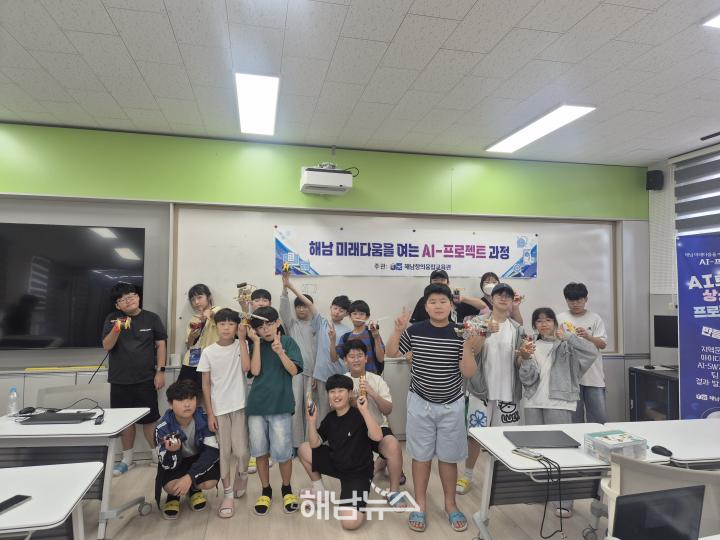 해남 학생들, AI로봇 만들기에 푹 빠졌다 / 사진제공=해남교육지원청 |
둘째 날에는 학생들이 직접 ‘생활을 변화시키는 AI로봇’ 제작에 나섰다.
교사가 정해준 로봇을 그대로 따라 만드는 방식이 아니라 학생들이 일상생활에서 해결하고 싶은 문제를 먼저 찾고, 이를 해결하기 위해 로봇이 어떤 기능과 동작을 해야 하는지를 스스로 구상하도록 했다.
이어 블록과 구동부 등을 활용해 각자의 아이디어를 실제 로봇으로 구현했다.
학생들은 특히 인공지능이 실제 로봇과 결합해 주변 환경을 인식하고 행동하는 ‘피지컬 AI(Physical AI)’에 높은 관심을 보였다.
자신이 원하는 대로 로봇이 움직이지 않으면 동작을 다시 시험하고 프로그램을 수정하는 과정을 반복하면서 문제 해결 방법을 스스로 찾아갔다.
마지막 과정에서는 손동작과 포즈 등의 데이터를 AI에 직접 학습시킨 뒤 이를 활용해 자신이 제작한 로봇을 조종하고 주어진 미션을 수행했다.
학생들은 완성한 AI로봇의 기능과 제작 과정, 적용된 AI 원리를 친구들 앞에서 발표하고 서로의 아이디어를 공유했다.
이번 프로그램은 단순히 AI 프로그램을 사용해 보는 체험교육에서 벗어나 학생들이 ‘문제 발견→아이디어 구상→AI 학습→로봇 제작→실험·수정→결과 공유’의 전 과정을 직접 수행했다는 점에서 의미가 있다.
특히 1기 과정에서 AI·SW 활동의 재미를 경험한 학생 상당수가 2기에도 다시 참여하면서 일회성 체험을 넘어 학생들의 자발적인 후속 학습으로 이어지고 있다는 점도 눈길을 끌었다.
조연주 해남교육지원청 교육장은 “1기에 참여했던 학생들이 다시 2기 과정에 참여한 것은 AI·SW 교육이 학생들에게 재미와 배움의 즐거움을 함께 주고 있다는 점에서 의미가 크다”고 말했다.
이어 “앞으로도 학생들이 AI 기술에 흥미를 갖고 생활 속 문제를 창의적으로 해결할 수 있도록 다양한 프로젝트형 AI·SW 교육 기회를 확대해 나가겠다.”고 밝혔다.
 해남 학생들, AI로봇 만들기에 푹 빠졌다 / 사진제공=해남교육지원청 |
“The Robot I Imagined Comes to Life”… Haenam Students Dive into Building AI Robots
Haenam Creative Convergence Education Center runs second AI Project Program for students from Grade 5 through Grade 9
Students explore AI principles through voice, image and emotion recognition, as well as machine learning
From AI translators and digital pets to robots designed to solve everyday problems
Students train robots using hand gestures and poses, experiencing “Physical AI” that combines artificial intelligence with real-world robotics
Many participants from the first program return for the second session, demonstrating strong interest in AI and software education
Superintendent Cho Yeon-joo: “We will expand project-based AI and software education that encourages creative problem-solving”
[Haenam = Haenam News] haenamnews@kakao.com
“The robot I imagined can actually move after I build it and train it with AI.”
Students in Haenam have gone beyond simply learning the principles of artificial intelligence (AI), taking part in a project-based program where they designed, built and operated AI-powered robots based on their own ideas.
Notably, many students who participated in the first AI Project Program returned for the second session, reflecting strong interest among local students in AI and software (SW) education.
The Haenam Creative Convergence Education Center, operated by the Haenam Office of Education, held the 2026 AI Project Program – Session 2 over two days, from September 12 to 13, for local students ranging from fifth grade in elementary school to third grade in middle school.
The 12-session program was conducted under the theme “Building AI Robots That Can Change Our Daily Lives.”
On the first day, students learned basic concepts of artificial intelligence and explored how AI systems learn from data and make decisions.
They experienced voice, image and emotion recognition technologies as well as machine learning. Students also created AI translators and digital pets, gaining firsthand experience of how artificial intelligence can be applied in everyday life.
On the second day, students took on the challenge of creating their own AI robots designed to improve daily life.
Rather than simply following instructions to build a predetermined robot, students first identified problems they wanted to solve in their everyday lives. They then decided for themselves what functions and movements their robots would need to address those problems.
Using building blocks, actuators and other components, the students transformed their ideas into working robots.
They showed particular interest in Physical AI, which combines artificial intelligence with real-world robotic systems capable of perceiving their surroundings and taking physical action.
When their robots did not move as intended, students repeatedly tested their designs, modified their programs and tried again, learning to find solutions through experimentation and iteration.
During the final stage of the program, students trained AI systems using data such as hand gestures and body poses. They then used the trained AI to control the robots they had built and complete assigned missions.
Students presented the functions of their completed AI robots, explained how they had built them and shared the AI principles behind their designs with their classmates.
The program went beyond simply allowing students to experience AI applications. It was structured as project-based learning in which students completed the entire process themselves — identifying a problem → developing an idea → training AI → building a robot → testing and refining it → sharing the results.
Another notable aspect was that many students who had enjoyed learning about AI and software during the first program voluntarily returned for the second session, indicating that their initial experience had developed into continued, self-motivated learning rather than ending as a one-time activity.
Cho Yeon-joo, Superintendent of the Haenam Office of Education, said, “The fact that students who participated in the first session returned for the second is especially meaningful because it shows that AI and software education can provide students with both enjoyment and the pleasure of learning.”
She added, “We will continue to expand opportunities for diverse, project-based AI and software education so that students can develop an interest in AI technology and creatively solve problems they encounter in everyday life.”
 해남뉴스 박충배 편집/논설 news@hbcnews.kr