2026.03.24 (화) 05:31




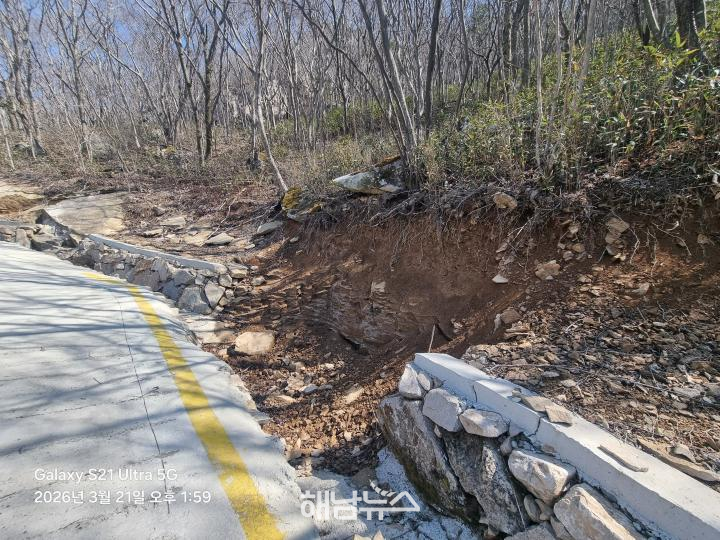 만일암지 가는 길 옹벽 붕괴 /사진제공=해남뉴스 |
[해남=해남뉴스] haenamnews@kakao.com
www.hbcnews.kr
두륜산 도립공원에서 진행된 소방도로 개설은 단순한 기반시설 사업의 범위를 넘어, 행정의 판단과 책임을 근본적으로 묻게 하는 사안으로 번지고 있다.
전라남도와 도립공원관리사무소는 이를 재난 대응과 안전 확보, 그리고 만인람지 복원이라는 공익적 목적 아래 추진된 사업이라고 설명하고 있지만, 현장에서 드러난 모습은 그 명분과 쉽게 연결되지 않는다.
두륜산은 이미 등산로와 임도가 촘촘하게 형성된 산이다.
오랜 시간에 걸쳐 축적된 이 길들은 탐방 기능뿐 아니라 관리와 접근성 측면에서도 일정한 역할을 수행해 왔다.
이러한 상황에서 새로운 도로를 개설하기 위해 산림을 절개한 선택이 과연 불가피했는지에 대한 의문이 제기되는 것은 자연스러운 일이다.
특히 이번 사업이 ‘만일암지 복원’이라는 목적과 결합되면서 논란은 더욱 커지고 있다.
역사적 공간의 복원 자체는 의미 있는 일일 수 있다.
그러나 그 복원을 위해 또 다른 천년 산림을 훼손하는 방식이 선택되었다면, 이는 복원의 취지와 충돌하는 문제를 안고 있다.
복원을 위해 자연을 희생시키는 방식이 과연 정당한가에 대한 질문이 제기되는 이유다.
법적으로 보면 도립공원 내 소방도로 개설은 「자연공원법」에 따라 공익적 필요가 인정될 경우 제한적으로 허용될 수 있다.
또한 「소방기본법」과 「재난 및 안전관리 기본법」 역시 산불 대응과 긴급 접근로 확보를 국가와 지방자치단체의 책무로 규정하고 있어, 일정한 조건 아래에서는 사업 추진의 근거가 될 수 있다.
그러나 이러한 법적 근거는 동시에 분명한 기준을 요구한다.
훼손은 최소화되어야 하고, 기존 시설을 우선 활용해야 하며, 불가피한 경우에 한해 제한적으로 시행되어야 한다는 점이다.
이 기준에 비추어 볼 때, 이미 등산로와 임도가 존재하는 두륜산에서 추가적인 도로 개설이 최선의 선택이었는지에 대해서는 충분한 검토가 있었는지 의문이 남는다.
더 큰 문제는 공사 이후의 관리 상태다.
벌채 과정에서 발생한 잔목과 가지, 뿌리 등이 제대로 처리되지 않은 채 방치되고 있는 모습은 단순한 미관상의 문제가 아니다.
이는 산불 위험을 높이고 병해충 확산과 토사 유출을 유발할 수 있는 잠재적 위험 요소로 작용한다.
「산림자원의 조성 및 관리에 관한 법률」은 벌채 이후 조림과 복구 의무를 명확히 규정하고 있으며, 이를 이행하지 않을 경우 행정 명령과 제재가 뒤따를 수 있다.
즉, 벌채 행위가 허용되었다 하더라도, 사후 관리와 복구 책임까지 면제되는 것은 아니다.
이러한 상황 속에서 주민과 등산객들의 반응은 점점 더 격앙되고 있다.
“두륜산을 다 버렸다”, “대흥사 숲길이 아니라 상처가 됐다”는 표현은 단순한 감정의 표출이 아니라, 현장을 직접 확인한 이들이 느끼는 변화에 대한 평가다.
두륜산을 찾는 전국의 등산객들 역시 현재의 훼손 상태와 방치된 현장에 대해 강한 문제의식을 드러내고 있다.
이제 전라남도와 도립공원관리사무소는 더 이상 침묵으로 일관할 수 없는 상황에 놓여 있다.
왜 기존의 등산로와 임도를 활용하지 않았는지, 왜 이러한 방식의 공사가 선택되었는지, 그리고 훼손을 최소화하기 위한 검토와 관리 계획이 충분했는지에 대해 분명한 설명이 필요하다.
무엇보다 시급한 것은 현장에 방치된 문제에 대한 즉각적인 조치다.
잔목과 벌채 부산물에 대한 정리는 최소한의 관리 책임에 해당하며, 이는 선택의 문제가 아니라 기본적인 의무에 가깝다.
두륜산을 찾는 전국의 등산객과 지역 시민들이 요구하는 것도 거창한 것이 아니다.
적어도 훼손된 현장을 방치하지 말고, 최소한의 정리와 복구라도 즉각 시행하라는 것이다.
두륜산은 오랜 시간 지역과 함께해온 자연 자산이다.
이러한 공간에 대한 개발은 단순한 법적 허용 여부를 넘어, 공공의 책임과 신중한 판단 속에서 이루어져야 한다.
이미 길은 존재하고 있었다.
그럼에도 또 다른 길이 만들어졌다.
그 결과가 자연의 상처로 남았다면, 이제는 그 선택에 대한 설명과 책임이 뒤따라야 한다.
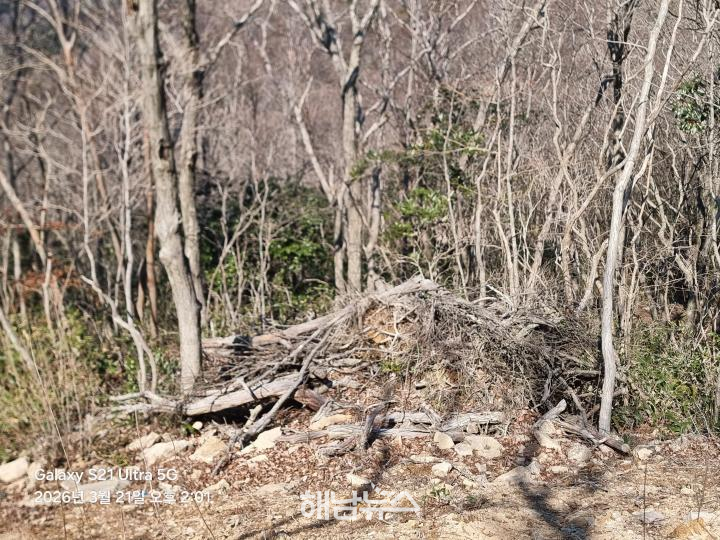 임도 개설 후 방치된 잡목 / 사진제공=해남늇, |
[Haenam News Editorial]
An Administration That Cut Through Duryunsan — Now It Must Answer
[Jeonnam = AI Honam News] aihnews@kakao.com
www.aihnnews.kr
The construction of a firefighting access road within Duryunsan Provincial Park has evolved beyond a simple infrastructure project. It has become a matter that fundamentally questions administrative judgment and responsibility.
Jeollanam-do Province and the Provincial Park Management Office explain that the project was carried out under the public interest goals of disaster response, safety enhancement, and the restoration of the Manilam site. However, what is visible on the ground does not easily align with those justifications.
Duryunsan is not a mountain lacking access. It already contains a dense network of hiking trails and forest roads, developed over many years. These routes have long served not only as paths for visitors but also as functional infrastructure for management and accessibility. In this context, the decision to cut through forest land to create an additional road naturally raises the question: was this truly unavoidable?
The controversy has intensified further as the project has been linked to the restoration of the Manilam site. While restoring a historic site may carry meaningful value, choosing to damage another ancient forest in the process creates a clear contradiction. It raises a fundamental question: can destruction be justified in the name of restoration?
From a legal standpoint, the construction of a firefighting road within a provincial park may be permitted under the Natural Parks Act, provided that public necessity is recognized. Likewise, the Framework Act on Fire Services and the Framework Act on the Management of Disasters and Safety define securing access routes for wildfire response as a responsibility of both the state and local governments.
However, these legal grounds come with clear conditions.
Damage must be minimized, existing infrastructure must be used first, and such development must only proceed when absolutely unavoidable.
When evaluated against these standards, it remains unclear whether the additional road construction in a mountain already equipped with multiple access routes was truly the best or only option.
A more serious issue lies in the condition of post-construction management. Logging residues — including branches, roots, and debris — have been left unattended on-site. This is not merely a matter of poor aesthetics. It significantly increases the risk of forest fires, accelerates soil erosion, and contributes to the spread of pests and diseases.
The Act on the Creation and Management of Forest Resources clearly stipulates obligations for reforestation and restoration following logging activities. Failure to fulfill these obligations can lead to administrative orders and legal penalties. In other words, while logging itself may be permitted, neglecting post-management and restoration is not exempt from responsibility.
Under these circumstances, reactions from residents and hikers are becoming increasingly intense. Statements such as “Duryunsan has been ruined” and “the forest trail of Daeheungsa has turned into a scar” are not mere emotional outbursts. They are assessments from those who have directly witnessed the changes on-site.
Hikers from across the country who visit Duryunsan are also raising serious concerns about both the extent of the damage and the continued neglect of the site.
At this point, Jeollanam-do Province and the Provincial Park Management Office can no longer remain silent. They must clearly explain why existing trails and roads were not utilized, why this particular construction method was chosen, and whether sufficient consideration was given to minimizing environmental damage.
Above all, immediate action is required to address the conditions currently left unattended.
The clearing of logging residues and debris is not an optional measure; it is a basic administrative responsibility. What residents and visitors across the country are demanding is not excessive. They are simply calling for the site to no longer be left neglected, and for at least minimal restoration and cleanup to be carried out without delay.
Duryunsan is a natural asset that has existed alongside the region for generations. Development within such a space must go beyond legal permissibility and be grounded in public responsibility and careful judgment.
There were already paths.
Yet another road was created.
If the result has become a scar upon nature,
then the decision behind it must now be fully explained — and held accountable.
 해남뉴스 박충배 편집 및 논설위원 haenamnews@kakao.com