2026.02.01 (일) 05:26




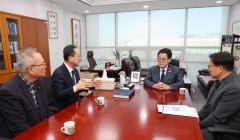
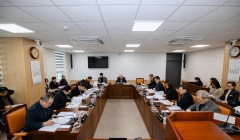
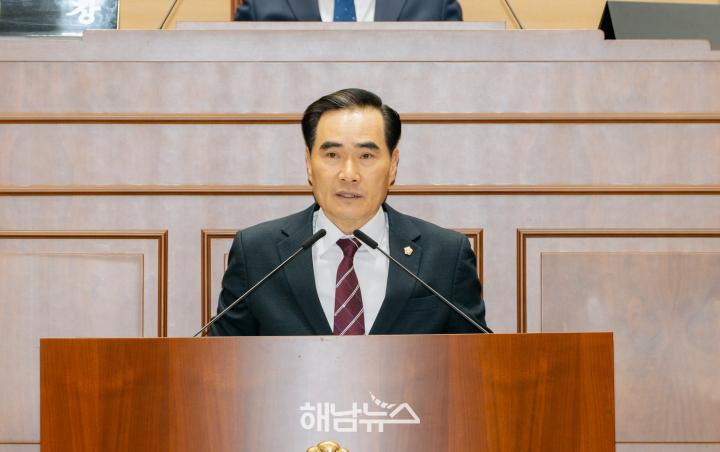 민홍일의원 5분 자유발언 / 사진제공=해남군의회 |
존경하는 해남군민 여러분,
그리고 집행부 공직자 여러분.
본 의원은 오늘, 해남군의 향후 수십 년을 좌우할 광주·전남 행정통합 논의에 대해 매우 무거운 문제의식을 가지고 이 자리에 섰습니다.
최근 정부와 광주광역시, 전라남도가 추진 중인 행정통합은 단순한 행정구역 조정이 아닙니다.
이는 지역의 존립 구조와 발전 축 자체를 재편하는 중대한 정책 전환입니다.
통합 특별시에 대한 대규모 재정 지원, 공공기관 우선 이전, 산업 육성 인센티브 등은 분명 매력적인 요소입니다.
그러나 동시에, 인구감소와 고령화가 심화된 군 단위 농어촌 지역에는 또 다른 소외의 출발점이 될 수 있다는 점을 우리는 직시해야 합니다.
행정통합은 구조적으로 대도시 중심의 성장 모델입니다.
인구와 산업, 교통과 행정 인프라가 이미 집중된 지역을 중심으로 정책 효과가 먼저 나타나는 구조입니다.
그 결과, 예산과 공공기관, 기업과 인재는 자연스럽게 중심 도시로 집중될 가능성이 큽니다.
문제는 바로 여기에 있습니다.
군 단위 지역은 같은 통합 안에 있으면서도, 실제로는 주변부로 남는 구조에 놓일 수 있다는 점입니다.
우리는 이미 과거의 여러 광역 정책에서 “함께 발전하자”는 구호와 달리, 실질적 성과는 중심 지역에 먼저 귀속되었던 경험을 반복해서 보아왔습니다.
이제 더 이상 광역자치단체 중심의 청사진에 부화뇌동할 것이 아니라,
행정통합이 과연 해남 군민의 삶에 어떤 실익을 가져다주는지 냉정하게 계산하고 따져봐야 할 시점입니다.
준비되지 않은 행정통합은 해남에 또 하나의 소멸 리스크가 될 수 있습니다.
만약 통합 이후에도 공공기관 이전에서 해남군이 배제되고, 산업 유치에서 후순위로 밀리며, 재정 배분 구조에서 군 단위 몫이 보장되지 않는다면, 그 통합은 해남의 미래를 여는 계기가 아니라, 지방소멸의 속도를 앞당기는 결정이 될 것입니다.
이제 해남군은 행정통합 논의에 능동적으로 대응할 정책 중심의 TF를 구성해야 할 시점입니다.
이 TF는 단순히 통합을 전제로 한 기구가 아니라, 다음의 역할을 분명히 수행해야 합니다.
첫째, 해남군의 이익과 손실을 객관적으로 분석해야 합니다.
통합 시 재정 구조 변화, 공공기관 이전 가능성과 배제 위험, 농어촌 교통·의료·교육 서비스 변화 등 모든 사안을 데이터와 시나리오에 기반해 면밀히 분석해야 합니다.
둘째, 해남군만의 협상 조건을 명확히 정리해야 합니다.
통합이 논의된다면 해남군은 조건 없는 참여 대상이 아니라, 조건을 제시하는 협상 주체가 되어야 합니다.
군 단위 재정 의무 배분 비율 보장, 인구감소지역 전용 재정계정 설치, 공공기관의 기능 분산형 이전 제도화, 이러한 요구가 법과 제도로 보장되지 않는 통합은 받아들일 수 없다는 분명한 원칙이 필요합니다.
셋째, 지방소멸 대응을 통합 논의의 중심에 올려야 합니다.
행정통합의 목적이 도시 경쟁력 강화에만 머문다면, 그 통합은 결국 또 다른 양극화를 낳게 됩니다.
해남군이 바라는 통합은 농어촌이 살아남는 통합, 군민의 삶이 나아지는 통합, 청년이 돌아올 수 있는 통합, 즉, 지방소멸을 막는 통합이어야 합니다.
이제 해남군의회와 집행부가 함께 나서야 합니다.
1회성 설명회나 찬반을 묻는 형식적 공청회로는 이 거대한 구조 변화에 대응할 수 없습니다.
본 의원은 해남군의회와 해남군이 함께 참여하는 「광주·전남 행정통합 대응 및 해남 미래전략 TF」 구성을 공식적으로 건의합니다.
이 TF는 행정과 의회, 전문가, 그리고 군민의 의견이 함께 담기는 지속 가능한 논의 구조가 되어야 합니다.
존경하는 군민 여러분.
행정통합은 선택의 문제가 아니라, 이미 다가오고 있는 현실일 수 있습니다.
그러나 그 방향이 해남 군민의 삶을 향하고 있지 않다면, 그 통합은 재도약이 아니라 또 하나의 소외일 뿐입니다.
해남군은 통합 논의의 주변부가 아니라, 해남의 미래를 스스로 설계하는 주체가 되어야 합니다.
그 출발이 바로, 지금 이 자리에서의 냉정한 준비와 책임 있는 대응이라고 본 의원은 생각합니다.
이상으로 발언을 마치겠습니다.
경청해 주셔서 감사합니다.
[Jeonnam = Haenam News] haenamnews@kakao.com
“Integration Is Not About Speed, but Direction — An Unprepared Administrative Merger Will Accelerate Haenam’s Decline”
Gwangju–Jeonnam Administrative Integration:
Haenam Must Be a Negotiating Party, Not a Passive Participant
Honorable citizens of Haenam,
and respected public officials of the executive branch,
Today, I stand before you with a deep sense of responsibility regarding the discussion on the Gwangju–Jeonnam administrative integration, a policy shift that will determine the future of Haenam County for decades to come.
The administrative integration currently being 추진ed by the central government, Gwangju Metropolitan City, and Jeollanam-do is not a simple adjustment of administrative boundaries.
It represents a fundamental restructuring of the region’s very framework of survival and development.
Large-scale fiscal support for a special integrated city, priority relocation of public institutions, and industrial development incentives are certainly attractive elements.
However, at the same time, we must clearly recognize that for county-level rural areas suffering from population decline and rapid aging, this integration could mark the beginning of a new form of marginalization.
Structurally, administrative integration is a metropolitan-centered growth model.
Policy effects tend to emerge first in areas where population, industry, transportation, and administrative infrastructure are already concentrated.
As a result, budgets, public institutions, businesses, and talent are highly likely to gravitate naturally toward the central cities.
This is precisely where the problem lies.
County-level regions may remain within the same integrated system, yet in reality be relegated to the periphery.
We have repeatedly witnessed, through past large-scale regional policies, how slogans such as “shared growth” often resulted in tangible benefits flowing first—and sometimes exclusively—to the central areas.
Now is the time to move beyond blindly following metropolitan-centered blueprints and instead coolly calculate and scrutinize what real benefits administrative integration would bring to the lives of Haenam’s residents.
An unprepared administrative integration could become yet another risk factor for Haenam’s extinction.
If, after integration, Haenam County is excluded from public institution relocations, pushed to the back of the line in industrial attraction, and denied guaranteed shares in fiscal allocation structures, then such integration will not open the door to Haenam’s future.
Rather, it will accelerate the pace of regional decline.
This is why Haenam must now establish a policy-centered task force (TF) to respond proactively to the integration discussion.
This task force must not be a body that merely assumes integration as a given, but one that clearly fulfills the following roles.
First, it must objectively analyze Haenam’s gains and losses.
Changes in fiscal structures, the potential for inclusion or exclusion in public institution relocations, and shifts in transportation, medical, and educational services for rural communities must all be examined thoroughly, based on data and scenario analysis.
Second, Haenam must clearly define its own negotiation conditions.
If integration is to be discussed, Haenam must not be a passive participant, but a negotiating主体 that presents clear conditions.
Guarantees for mandatory fiscal allocation ratios for county-level regions, the establishment of dedicated fiscal accounts for population-declining areas, and the institutionalization of functionally decentralized public institution relocation—
any integration that fails to secure these demands through law and制度 must be firmly rejected.
Third, countermeasures against regional extinction must be placed at the very center of the integration debate.
If the objective of administrative integration remains limited to strengthening urban competitiveness, it will inevitably produce yet another form of polarization.
The integration Haenam seeks is one where rural areas survive, residents’ lives improve, and young people can return—
in short, an integration that prevents regional extinction.
Now, the Haenam County Council and the executive branch must act together.
One-time briefings or perfunctory public hearings asking for simple approval or opposition are wholly insufficient to respond to such a massive structural transformation.
Therefore, I formally propose the establishment of the “Gwangju–Jeonnam Administrative Integration Response and Haenam Future Strategy Task Force,” jointly involving the Haenam County Council and Haenam County Government.
This task force must serve as a sustainable deliberative structure that incorporates the voices of the administration, the council, experts, and the citizens.
Honorable citizens,
Administrative integration may no longer be a matter of choice, but an approaching reality.
However, if its direction does not point toward the lives of Haenam’s residents, then it will not be a leap forward—it will be yet another form of exclusion.
Haenam must not remain on the margins of the integration debate.
It must become the主体 that designs its own future.
And that future begins with calm preparation and responsible 대응, starting here and now.
Thank you for your kind attention.
 강승훈 취재본부장 haenamnews@kakao.com