| “폭염·가뭄에 농작물 2,118㏊ 피해”…전남광주, 농가 복구비 63억 원 지원
대파 피해 1,697㏊로 전체의 약 80%…신안 1,357㏊로 가장 커 해남뉴스 박충배 편집/논설 news@hbcnews.kr |
| 2026년 09월 28일(월) 10:01 |
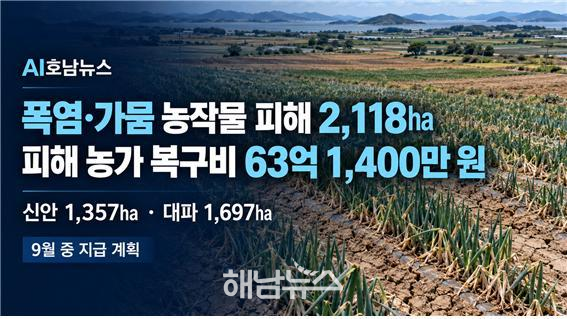 폭염가뭄 농작물 피해복구비 지원 / 사진제공=ai이미지 |
올여름 폭염과 가뭄으로 전남광주 지역 농작물 2,118㏊가 피해를 입은 것으로 집계됐다. 전남광주통합특별시는 피해 농가의 영농 재개를 돕기 위해 63억 1,400만 원 규모의 복구비를 9월 중 지급할 계획이다.
통합특별시가 발표한 7~8월 피해 규모는 2,046농가, 2,118㏊다. 작물별 피해 면적은 대파 1,697㏊, 인삼 200㏊, 단감 156㏊, 벼 65㏊다. 대파가 전체 피해 면적의 약 80%를 차지한다.
지역별로는 신안의 피해 면적이 1,357㏊로 전체의 약 64%에 달한다. 이어 영광 385㏊, 영암 87㏊, 진도 61㏊ 순이다.
복구비는 피해 작물의 생육 회복에 필요한 농약대와 다시 파종하는 데 드는 대파대 등에 쓰인다. 농약대 지원 기준은 ㏊당 인삼 400만 원, 단감 300만 원, 대파 250만 원, 벼 100만 원이다. 대파대는 대파 ㏊당 250만 원, 벼 ㏊당 200만 원으로 제시됐다.
총사업비 63억 1,400만 원은 국비 42억 6,000만 원, 특별시비 9억 9,400만 원, 시군구비 10억 3,400만 원, 융자 1,600만 원, 자부담 1,000만 원으로 구성된다. 따라서 발표된 총액 전부를 농가에 직접 지급하는 보조금으로 해석해서는 안 된다. 국비 복구 대상에서 제외된 곡성과 보성의 80농가, 51㏊에는 특별시비를 투입할 계획이다.
통합특별시는 복구비와 별도로 15농가에 대해 8억 9,500만 원 규모의 농업정책자금 상환 연기와 이자 감면을 추진하고, 78농가에는 14억 3,400만 원 규모의 재해대책 경영자금을 지원할 계획이다. 이 금액들은 복구비 63억 1,400만 원과 구분되는 금융 지원 규모다.
다만 피해 농가 수와 발표된 복구 지원 대상 수는 일치하지 않는다. 전체 피해는 2,046농가로 발표됐지만, 국비 지원 대상 1,946농가와 특별시 자체 지원 대상 80농가를 합하면 2,026농가다. 차이가 나는 20농가가 다른 방식으로 지원받는지, 지원 대상에서 제외됐는지 확인이 필요하다. 반면 지원 대상 면적 2,067㏊와 51㏊의 합계는 전체 피해 면적 2,118㏊와 일치한다.
통합특별시는 9월 중 지급 방침을 밝혔으나, 9월 28일 현재 전체 대상 농가에 대한 실제 지급 완료 여부와 20농가의 처리 내역은 확인되지 않았다. 피해 농가가 지원을 언제 받을 수 있는지까지 명확히 하려면 시군별 지급 현황의 추가 공개가 필요하다.
Sinan recorded the largest affected area at 1,357 hectares, or about 64% of the total. It was followed by Yeonggwang with 385 hectares, Yeongam with 87 hectares and Jindo with 61 hectares.
Recovery support covers crop treatment and replanting costs. The crop treatment rates per hectare are 4 million won for ginseng, 3 million won for sweet persimmons, 2.5 million won for green onions and 1 million won for rice. The stated replanting rates are 2.5 million won per hectare for green onions and 2 million won for rice.
The 6.314 billion won total comprises 4.26 billion won in central government funding, 994 million won from the special city, 1.034 billion won from local governments, 16 million won in loans and 10 million won in farmers’ own contributions. The full amount should therefore not be described as a direct cash grant to farmers. The city plans to use its own funds to support 80 farms covering 51 hectares in Gokseong and Boseong that were excluded from central government recovery support.
Separately, the city plans to defer agricultural policy loan repayments and provide interest relief for 15 farms, covering loans totaling 895 million won. It also plans to provide 1.434 billion won in disaster response operating loans to 78 farms. These are financial support measures distinct from the 6.314 billion won recovery program.
The reported number of affected farms does not match the stated number of recovery support recipients. The city reported damage at 2,046 farms, but its figures for central government support, covering 1,946 farms, and city-funded support, covering 80 farms, add up to 2,026. It remains unclear whether the remaining 20 farms will receive support through another program or are ineligible. The area figures do match: 2,067 hectares under central government support plus 51 hectares under city support equal the reported 2,118 hectares of damage.
The city has announced plans to provide the recovery support during September. As of September 28, completion of payments to all eligible farms and the status of the 20 farms in question had not been confirmed. A breakdown of payments by municipality would clarify when affected farmers can expect to receive support.
 해남뉴스 박충배 편집/논설 news@hbcnews.kr