| 300년 만에 다시 만난 해남의 두 다리…돌은 기억하고 있다 남천교·어성교는 단순한 옛 다리가 아니다…조선 해남 사람들의 삶이 새겨진 역사 해남뉴스 박충배 편집/논설 news@hbcnews.kr |
| 2026년 09월 15일(화) 13:03 |
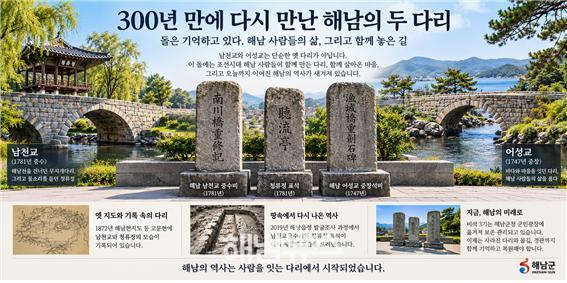 300년 만에 다시 만난 해남의 두다리 / 사진제공=ai이미지 |
[칼럼=AI호남뉴스] aihnnews@kakao.com
다리는 사라졌지만 돌은 기억하고 있다.
해남군청 군민광장에 있는 「남천교중수기」와 「청류정」 표석, 「어성교중창석비」를 단순한 옛 비석 세 개로 바라봐서는 안 된다.
그 돌에는 300여 년 전 해남 사람들이 어떻게 길을 만들고, 홍수로 무너진 다리를 다시 놓고, 서로 돈과 힘을 모으며 공동체를 지켜왔는지가 기록돼 있다.
그것은 왕과 권력자의 역사가 아니다.
해남에서 실제로 살았던 사람들의 역사다.
■ 300년 전에도 해남 사람들은 다리를 함께 놓았다
삼산면 어성포 일대에는 오래전부터 어성교가 있었다.
고산 윤선도의 손자 윤이후가 남긴 『지암일기』에는 1692년 이미 ‘어성교’라는 이름이 등장한다.
그리고 수십 년 뒤인 1747년께 어성교를 다시 크게 고친 사실을 기록한 「어성교중창석비」가 세워졌다.
비석에는 대시주와 차시주, 별좌, 공양주, 석공 등 공사에 참여했던 사람들의 역할과 이름이 남아 있다.
누군가는 돈을 냈고, 누군가는 물자를 마련했다.
누군가는 돌을 다듬었고, 누군가는 공사를 관리했으며, 누군가는 일하는 사람들의 끼니를 책임졌다.
다리 하나를 놓기 위해 마을 전체가 움직였던 것이다.
오늘날로 말하면 관과 주민, 기술자와 지역공동체가 함께 참여한 사회간접자본 사업이었다.
300년 전 해남 사람들이 공동체를 운영했던 방식이 돌 한 장에 남아 있는 것이다.
■ 1781년 남천교를 다시 놓은 사람들도 마찬가지였다
해남읍성 남문 밖에는 해남천이 흘렀고 그 물길을 건너는 남천교가 있었다.
1778년 큰물로 다리가 훼손되자 주민들은 불편을 겪었다.
결국 1781년 현감 김서구를 중심으로 남천교를 돌로 다시 놓았다.
그것도 단순한 돌다리가 아니었다.
무지개 형태의 홍예를 이용한 홍교였다.
더욱 흥미로운 사실은 다리 곁에 ‘청류정(聽流亭)’이라는 정자를 세웠다는 점이다.
이름 그대로 ‘흐르는 물소리를 듣는 정자’다.
당시 해남 사람들은 다리를 단순히 건너가는 시설로만 만들지 않았다.
다리 아래로 흐르는 물과 버드나무, 주변 경관을 바라보고 물소리를 들을 수 있는 공간까지 만들었다.
오늘날 우리가 잃어버린 도시의 품격이 오히려 240여 년 전 해남에 있었던 셈이다.
■ 해남팔경 ‘홍교유수’는 그냥 만들어진 말이 아니다
남천교와 해남천이 어우러진 풍경은 해남을 대표하는 경승으로 기억됐다.
전해지는 해남팔경 가운데 하나인 ‘홍교유수(紅橋流水)’다.
돌로 만든 아름다운 다리 아래로 물이 흐르는 풍경.
그 옆 청류정에서는 사람들이 물소리를 들었다.
상상해 보라.
지금의 해남읍 한복판에 홍예석교가 놓여 있고 맑은 해남천이 흐르며, 버드나무 아래 정자가 서 있는 모습을 말이다.
그 풍경이 바로 해남의 역사였다.
그러나 지금 우리는 그 모습을 제대로 볼 수 없다.
다리는 없어졌고 정자도 사라졌다.
도시는 개발됐고 물길과 주변 경관도 크게 달라졌다.
그런데 놀랍게도 기억은 돌에 남았다.
■ 땅속에 묻어도 역사는 사라지지 않았다
남천교중수기와 청류정 표석은 원래 남천교와 해남천 주변에 있었던 것으로 전한다.
세월이 흐르면서 원래 자리를 떠났고 결국 땅속에 묻혔다.
그렇게 잊히는 듯했다.
그러나 2019년 4월 해남읍성 발굴조사 과정에서 다시 모습을 드러냈다.
200년이 넘는 시간을 견딘 돌이 해남 사람들 앞에 다시 나타난 것이다.
우연이라고만 하기에는 그 의미가 크다.
땅속에 묻어도 역사는 사라지지 않았다.
오히려 우리에게 묻고 있다.
‘너희는 이 역사를 어떻게 기억할 것인가.’
■ 더욱 놀라운 것은 대흥사 승려들의 이름이다
남천교 중수과정을 살펴보면 대흥사 승려들이 등장한다.
대흥사의 승려들이 화주 등으로 참여하고 주민과 기술자들이 함께 힘을 보탠 정황을 확인할 수 있다.
어성교중창석비에도 시주자와 석공, 승려 등의 이름이 남아 있다.
이것은 매우 중요한 역사다.
대흥사를 산속에 있는 사찰 하나로만 바라봐서는 조선시대 해남을 제대로 이해하기 어렵다는 뜻이기 때문이다.
대흥사는 종교공간이면서 지역사회와 연결돼 있었고 사람과 기술, 경제활동이 오가는 중심 가운데 하나였다.
해남읍의 다리와 두륜산 대흥사가 사람을 통해 연결돼 있었던 것이다.
이런 기록이 바로 지역사다.
■ 비석 세 개를 군민광장에 옮겼다고 ‘보존’이 끝난 것은 아니다
현재 남천교중수기와 청류정 표석, 어성교중창석비는 해남군청 군민광장에 보존되고 있다.
물론 유물을 안전하게 관리하는 것은 중요하다.
그러나 여기서 끝나서는 안 된다.
문화유산 보존은 돌을 옮겨 세워놓는 것으로 완성되지 않는다.
그 돌이 어디에 있었는지, 왜 세워졌는지, 누가 만들었는지, 어떤 사람들이 참여했는지, 주변에는 어떤 풍경이 펼쳐져 있었는지를 주민들에게 알려줘야 한다.
그것이 진짜 보존이다.
남천교가 어디에 있었는지 제대로 표시해야 한다.
청류정의 위치와 해남천의 옛 물길도 찾아야 한다.
1872년 해남현지도와 발굴자료, 고문헌을 연결하고 남천교와 청류정을 디지털로 복원할 수도 있다.
어성교 역시 옛 위치를 조사하고 어성포의 역사와 중창석비를 연결해야 한다.
그래야 돌이 이야기를 시작한다.
■ 해남에는 ‘없는 역사’를 만들 필요가 없다
전국 지방자치단체마다 관광객을 끌어들이겠다며 새로운 이야기를 만들고 거대한 조형물을 세운다.
그러나 해남은 굳이 없는 역사를 만들어낼 필요가 없다.
이미 300년의 이야기가 땅속과 돌 위에 남아 있기 때문이다.
해남읍성이 있다.
남천교가 있다.
청류정이 있다.
어성교가 있다.
대흥사가 있고 해남천이 있으며 어성포가 있다.
그리고 그곳에서 실제로 살았던 사람들의 이름이 있다.
이것들을 하나의 이야기로 연결하는 것이 먼저다.
새로운 관광시설 하나를 만드는 것보다 사라진 해남의 공간과 사람의 이야기를 제대로 복원하는 일이 더 오래가는 문화자산이 될 수 있다.
■ ‘300년 해남의 길’을 복원하자
필자는 해남군이 세 석물을 중심으로 ‘300년 해남의 길’ 복원사업을 검토할 필요가 있다고 본다.
남천교중수기와 어성교중창석비의 비문 전체를 정밀 판독하고 국역해야 한다.
공사에 참여했던 주민과 석공, 승려들의 이름도 모두 확인해야 한다.
옛 지도와 발굴자료를 토대로 남천교와 청류정, 어성교의 위치와 형태를 고증하고 3D·AR 등을 이용해 옛 모습을 복원할 수도 있다.
해남읍성에서 남천교·청류정·해남천을 거쳐 대흥사와 어성포의 역사로 이어지는 문화유산 콘텐츠도 충분히 가능하다.
특히 남천교의 ‘홍교유수’와 어성포 일대의 역사경관을 함께 묶는다면 사라진 해남의 옛 풍경을 되살리는 새로운 문화유산 프로젝트가 될 수 있다.
■ 역사를 잃는 것은 돌이 없어질 때가 아니다
문화유산은 오래된 물건이 아니다.
그 안에 사람의 기억이 있을 때 문화유산이 된다.
300년 전 이름 없는 해남 주민들은 홍수에 무너진 다리를 다시 놓았다.
돌을 다듬고 돈과 물자를 보탰다.
승려들도 산에서 내려와 힘을 보탰다.
그리고 자신들이 한 일을 돌에 새겨 후대에 남겼다.
그 돌이 300년의 세월을 건너 오늘 우리 앞에 와 있다.
그렇다면 이제 우리가 답할 차례다.
역사를 잃는 것은 오래된 다리가 무너질 때가 아니다.
그 다리가 왜 존재했는지 아무도 기억하지 않을 때, 비로소 역사는 사라진다.
해남군청 광장에 서 있는 세 개의 돌을 더 이상 ‘오래된 비석’으로만 보아서는 안 된다.
남천교와 어성교를 다시 놓을 수는 없을지 모른다.
그러나 그 다리를 건넜던 사람들의 이야기는 다시 이어놓을 수 있다.
돌은 300년을 버텼다.
이제 해남이 그 기억을 지킬 차례다.
[Column]
Two Bridges of Haenam Reunited After 300 Years — The Stones Remember
Namcheon Bridge and Eoseong Bridge are more than old bridges — they preserve the lives and memories of the people of Joseon-era Haenam
Eoseong Bridge rebuilt around 1747 and Namcheon Bridge restored in 1781 — stonemasons, residents, and monks from Daeheungsa Temple all contributed
At Cheongnyujeong Pavilion beside Namcheon Bridge, people once listened to the flowing water — a vanished landscape remembered as “Honggyo Yusu”
Buried monuments to Namcheon Bridge and Cheongnyujeong rediscovered during archaeological excavations in 2019 — history returned to Haenam
Moving three stone monuments to the Haenam County Office plaza must not be the end — the bridges, waterways, and historic landscape should also be restored
“Preserving history is not merely about protecting stones. It is about bringing the stories carved into those stones back to life.”
[Column = AI Honam News] aihnnews@kakao.com
The bridges are gone, but the stones remember.
The three historic stone monuments now preserved at the public plaza of the Haenam County Office — the Namcheon Bridge Restoration Monument, the Cheongnyujeong Pavilion Marker, and the Eoseong Bridge Reconstruction Monument — should not be regarded simply as three old stones.
Carved into them is the story of how the people of Haenam built roads, reconstructed bridges destroyed by floods, pooled their money and labor, and sustained their community more than 300 years ago.
This is not the history of kings and powerful elites.
It is the history of the people who actually lived in Haenam.
■ Three Centuries Ago, the People of Haenam Built Bridges Together
Eoseong Bridge had existed for centuries in the Eoseongpo area of present-day Samsan-myeon.
The Jiam Ilgi (Diary of Jiam), written by Yun I-hu, a grandson of the renowned Joseon scholar and poet Yun Seon-do, mentions “Eoseong Bridge” as early as 1692.
Several decades later, around 1747, the Eoseong Bridge Reconstruction Monument was erected to record a major rebuilding of the bridge.
The inscription preserves the names and responsibilities of those who participated in the project, including major donors, secondary donors, supervisors, meal providers, and stonemasons.
Some contributed money.
Others provided materials.
Some cut and shaped the stone, others supervised construction, while still others prepared meals for the workers.
An entire community mobilized to build a single bridge.
In modern terms, it was a public infrastructure project jointly undertaken by local authorities, residents, craftsmen, and the wider community.
The way Haenam’s people organized their community 300 years ago remains carved into a single stone monument.
■ The Same Was True When Namcheon Bridge Was Rebuilt in 1781
Outside the southern gate of the old Haenam walled town, Haenamcheon Stream flowed through the landscape, and Namcheon Bridge carried people across it.
When severe flooding damaged the bridge in 1778, local residents suffered considerable inconvenience.
In 1781, under the leadership of County Magistrate Kim Seo-gu, Namcheon Bridge was rebuilt in stone.
It was no ordinary stone bridge.
It was constructed as a honggyo — an elegant stone arch bridge.
Even more remarkable was the construction of a pavilion beside it called Cheongnyujeong (聽流亭).
Its name literally means “Pavilion for Listening to Flowing Water.”
The people of Haenam did not see a bridge merely as something to cross.
They created a place where people could watch the water flow beneath the bridge, enjoy the willow trees and surrounding scenery, and listen to the sound of the stream.
In some respects, the urban grace we have lost today already existed in Haenam more than two centuries ago.
■ “Honggyo Yusu” Was Not Just a Poetic Expression
The scenery created by Namcheon Bridge and Haenamcheon Stream became remembered as one of Haenam’s celebrated scenic views.
It was known as Honggyo Yusu (紅橋流水) — the flowing water beneath the arched bridge.
Imagine the scene.
An elegant stone arch bridge standing in what is now central Haenam.
Clear water flowing beneath it.
A pavilion standing under willow trees, where people paused to listen to the stream.
That landscape was once Haenam.
Today, however, we can no longer see it as it once was.
The bridge has disappeared.
The pavilion is gone.
Urban development transformed the town, while the waterway and surrounding landscape changed dramatically.
And yet, remarkably, the memory survived in stone.
■ History Did Not Disappear Even When It Was Buried Underground
The Namcheon Bridge restoration monument and the Cheongnyujeong marker are believed to have originally stood near Namcheon Bridge and Haenamcheon Stream.
As the town changed over time, they were removed from their original locations and eventually buried underground.
For a time, they seemed destined to be forgotten.
Then, in April 2019, they emerged again during archaeological excavations of the old Haenam walled town.
After surviving underground for more than two centuries, the stones returned to the people of Haenam.
It is difficult to dismiss their rediscovery as merely an archaeological coincidence.
History did not disappear simply because it was buried.
Instead, these stones now seem to ask us a question:
“How will you remember this history?”
■ Even More Remarkable Are the Names of Monks from Daeheungsa Temple
Records concerning the restoration of Namcheon Bridge include monks from Daeheungsa Temple.
Monks from the temple participated in fundraising and other aspects of the project, alongside local residents and craftsmen.
The Eoseong Bridge monument likewise records donors, stonemasons, and Buddhist monks.
This is an important piece of Haenam’s history.
It demonstrates that we cannot fully understand Joseon-era Haenam if we view Daeheungsa merely as an isolated Buddhist temple in the mountains.
Daeheungsa was a religious center, but it was also closely connected with local society through people, craftsmanship, resources, and economic activity.
The bridges of Haenam and Daeheungsa beneath Duryunsan Mountain were connected through people.
That is what local history truly means.
■ Moving Three Stones to the County Office Plaza Is Not the End of Preservation
Today, the Namcheon Bridge restoration monument, Cheongnyujeong marker, and Eoseong Bridge reconstruction monument are preserved at the Haenam County Office public plaza.
Protecting these artifacts is, of course, important.
But preservation cannot end there.
Cultural heritage is not truly preserved simply by moving old stones to a safe location and putting them on display.
People should be told where those stones originally stood.
They should know why they were erected, who made them, who participated in the projects they commemorate, and what the surrounding landscape once looked like.
That is genuine preservation.
The original location of Namcheon Bridge should be clearly identified.
The site of Cheongnyujeong and the historic course of Haenamcheon Stream should also be investigated.
The 1872 map of Haenam, archaeological findings, and historical documents could be brought together to digitally reconstruct Namcheon Bridge and Cheongnyujeong.
The original location of Eoseong Bridge should likewise be investigated, connecting the monument now preserved at the county office with the historical landscape of Eoseongpo.
Only then will the stones begin to tell their stories again.
■ Haenam Does Not Need to Invent a History It Never Had
Across Korea, local governments build enormous sculptures and manufacture new stories in an effort to attract tourists.
Haenam does not need to invent a history that never existed.
Three centuries of real stories are already preserved beneath its soil and upon its stones.
There is the old Haenam walled town.
There is Namcheon Bridge.
There is Cheongnyujeong.
There is Eoseong Bridge.
There are Daeheungsa Temple, Haenamcheon Stream, and Eoseongpo.
And there are the names of real people who once lived and worked in these places.
The first task is to connect these fragments into one coherent story.
Properly restoring the stories of Haenam’s vanished spaces and its people may create a cultural asset of far greater and more lasting value than constructing yet another tourist attraction.
■ Restore the “300-Year Road of Haenam”
Haenam County should consider developing a heritage project centered on these three stone monuments — a “300-Year Road of Haenam.”
The complete inscriptions on the Namcheon Bridge and Eoseong Bridge monuments should be carefully deciphered, translated into modern Korean, documented, and made publicly accessible.
The names of residents, stonemasons, monks, donors, and others involved in the construction projects should also be identified.
Historical maps, archaeological evidence, and documentary records could be used to determine the original locations and structures of Namcheon Bridge, Cheongnyujeong Pavilion, and Eoseong Bridge.
Their historic appearances could then be reconstructed through 3D modeling and augmented reality.
A broader cultural heritage route could connect the old Haenam walled town with Namcheon Bridge, Cheongnyujeong, Haenamcheon Stream, Daeheungsa Temple, and the historic landscape of Eoseongpo.
If the scenery of Honggyo Yusu and the historical landscape of Eoseongpo are interpreted together, Haenam could create a distinctive heritage project capable of reviving landscapes that have disappeared from physical view but remain embedded in historical memory.
■ History Is Not Lost When a Stone Disappears
Cultural heritage is not simply something old.
It becomes heritage because it contains human memory.
Three centuries ago, ordinary residents of Haenam rebuilt bridges destroyed by floods.
They shaped stones.
They contributed money and materials.
Monks came down from the mountains and joined the effort.
And they carved a record of what they had accomplished into stone so future generations would know.
Those stones have now crossed 300 years of history to stand before us.
It is now our turn to answer them.
History is not lost when an old bridge collapses.
History is truly lost when no one remembers why that bridge once stood there.
The three stones standing at the Haenam County Office plaza should no longer be regarded merely as “old monuments.”
We may never be able to rebuild Namcheon Bridge and Eoseong Bridge exactly as they once were.
But we can reconnect the stories of the people who crossed them.
The stones have endured for 300 years.
Now it is Haenam’s turn to preserve their memory.
[AI Honam News]
 해남뉴스 박충배 편집/논설 news@hbcnews.kr