| “배추농가, 18일 놓치지 마세요”…가을배추 농작물보험 최대 90% 지원 자연재해 수확량 감소부터 가격하락에 따른 소득 감소까지 보장 해남뉴스 박충배 편집/논설 news@hbcnews.kr |
| 2026년 09월 15일(화) 10:47 |
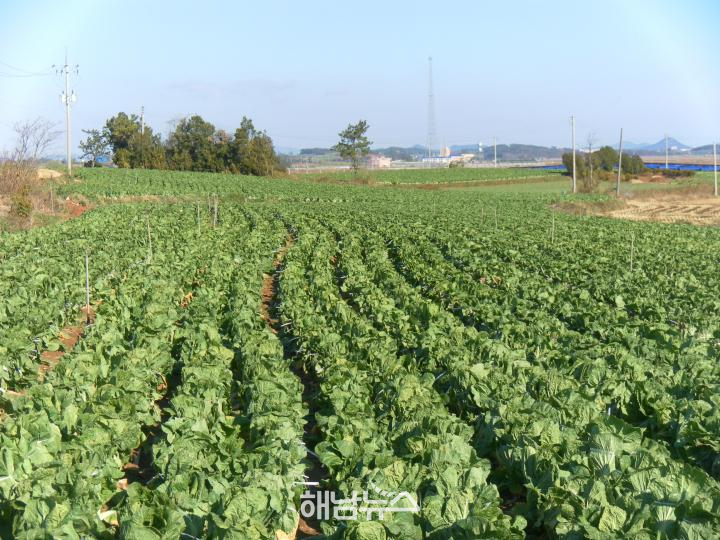 해남 배추단지 ? 사진제공=전남광주특별시 |
가을배추 주산지인 전남광주지역 농가들이 자연재해와 가격하락에 따른 경영 위험을 줄이기 위해서는 오는 18일까지 농작물보험 가입을 서둘러야 한다.
전남광주통합특별시는 농가 소득의 불안정성을 완화하고 안정적인 농업경영을 지원하기 위해 가을배추 농작물보험 가입 신청을 오는 18일까지 지역 농·축협을 통해 받는다고 밝혔다.
가을배추 농작물보험은 크게 농작물 재해보험과 농업수입안정보험으로 운영된다.
농작물 재해보험은 자연재해 등으로 가을배추 수확량이 감소했을 때 피해를 보장하며, 농업수입안정보험은 여기에 시장가격 하락으로 발생하는 농가소득 감소분까지 추가로 보장한다.
특히 국내 대표 가을배추 주산지인 해남지역에서는 병충해 피해까지 보장 범위가 확대됐다.
지난해부터 해남지역을 대상으로 ‘가을배추 병충해 보장형 상품’이 시범 도입돼 기상 상황과 피해면적 등 일정 요건을 충족할 경우 배추 무름병 피해도 보장받을 수 있다.
최근 이상고온과 집중호우, 가뭄 등 기상이변이 반복되면서 배추 생육과 생산량의 불확실성이 커지고 있는 만큼 농작물보험이 농가의 경영안전망 역할을 할 것으로 기대된다.
보험료 부담도 크게 낮췄다.
전남광주통합특별시는 배추 재배농가의 부담을 줄이기 위해 보험료의 최대 90%를 지원하고 있다.
지난해 기준 1ha당 농작물 재해보험의 평균 보험료는 약 109만원이지만 농업인이 실제 부담하는 금액은 10%인 약 10만9천원이다.
농업수입안정보험의 경우 1ha당 보험료가 약 203만원이며 농업인의 실제 부담액은 약 35만원 수준이다.
전남광주지역은 전국 최대 가을배추 생산기반을 갖춘 지역인 만큼 보험 가입의 중요성도 크다.
전남광주통합특별시가 한국농촌경제연구원(KREI)의 ‘2026년 가을배추 재배면적 의향조사’를 분석한 결과 전국 가을배추 재배의향 면적은 1만3,543ha로 나타났다.
이 가운데 전남광주지역은 3,178ha로 전국의 23.5%를 차지해 전국에서 가장 많은 것으로 분석됐다. 전국 가을배추 재배의향 면적 4ha 가운데 약 1ha가 전남광주지역에 집중된 셈이다.
정원진 전남광주통합특별시 식량원예과장은 “최근 기후변화로 예측하기 어려운 자연재해가 빈번하게 발생하고 있어 농가의 사전 대비가 무엇보다 중요하다”며 “가을배추 재배농가는 신청 기간에 농작물보험에 빠짐없이 가입해 자연재해와 가격하락 등 경영 위험에 대비해 주길 바란다”고 당부했다.
가을배추 농작물보험 가입을 희망하는 농가는 오는 18일까지 지역 농·축협을 통해 신청하면 된다.
“Cabbage Farmers, Don’t Miss the Sept. 18 Deadline”…Up to 90% Support for Autumn Cabbage Crop Insurance
Insurance covers crop losses caused by natural disasters as well as income losses from falling market prices
Applications accepted through local agricultural and livestock cooperatives until Sept. 18…Farmers pay as little as 10% of crop disaster insurance premiums
Haenam included in pilot “pest and disease coverage” program…Soft rot covered when certain conditions are met
Average crop disaster insurance premium is KRW 1.09 million per hectare…Farmers pay about KRW 109,000
Jeonnam-Gwangju accounts for 3,178 hectares, or 23.5% of Korea’s intended autumn cabbage cultivation area—the largest share nationwide
[JEONNAM-GWANGJU = AI Honam News] aihnnews@kakao.com
Autumn cabbage farmers in Jeonnam-Gwangju, one of South Korea’s major cabbage-producing regions, are being urged to sign up for crop insurance by Sept. 18 to protect themselves against financial risks stemming from natural disasters and falling market prices.
The Jeonnam-Gwangju Integrated Special Metropolitan Government announced that applications for autumn cabbage crop insurance will be accepted through local agricultural and livestock cooperatives until Sept. 18 as part of efforts to reduce income instability among farmers and support stable farm management.
The autumn cabbage insurance program consists primarily of crop disaster insurance and agricultural income stabilization insurance.
Crop disaster insurance compensates farmers for reduced yields caused by natural disasters and other covered events, while agricultural income stabilization insurance provides additional protection against declines in farm income resulting from falling market prices.
In Haenam, one of South Korea’s leading autumn cabbage-producing areas, coverage has been expanded to include certain crop diseases.
Since last year, a pilot “pest and disease coverage” insurance product has been introduced for autumn cabbage farms in Haenam. Under the program, damage caused by bacterial soft rot may also be covered when specific requirements, including weather conditions and the extent of the affected area, are met.
With abnormal temperatures, torrential rainfall, drought and other extreme weather events becoming increasingly frequent, uncertainty surrounding cabbage growth and production has also increased. Crop insurance is therefore expected to serve as an important financial safety net for farmers.
The financial burden of insurance premiums has also been significantly reduced.
The Jeonnam-Gwangju Integrated Special Metropolitan Government provides subsidies covering up to 90% of insurance premiums for cabbage farmers.
Based on last year’s figures, the average crop disaster insurance premium was approximately KRW 1.09 million per hectare, while farmers were required to pay only 10%, or about KRW 109,000.
For agricultural income stabilization insurance, the premium is approximately KRW 2.03 million per hectare, with farmers paying about KRW 350,000.
The importance of insurance coverage is particularly significant in Jeonnam-Gwangju, which has the country’s largest autumn cabbage cultivation base.
According to the Jeonnam-Gwangju Integrated Special Metropolitan Government’s analysis of the Korea Rural Economic Institute’s (KREI) 2026 Autumn Cabbage Cultivation Intention Survey, the nationwide intended cultivation area for autumn cabbage stands at 13,543 hectares.
Of that total, Jeonnam-Gwangju accounts for 3,178 hectares, or 23.5%, the largest share in the country. In other words, nearly one out of every four hectares intended for autumn cabbage cultivation nationwide is located in the Jeonnam-Gwangju region.
“With climate change causing increasingly frequent and unpredictable natural disasters, advance preparation by farmers is more important than ever,” said Jeong Won-jin, director of the Food and Horticulture Division of the Jeonnam-Gwangju Integrated Special Metropolitan Government.
“We strongly encourage all autumn cabbage farmers to enroll in crop insurance during the application period so they can prepare for management risks, including natural disasters and falling market prices,” Jeong added.
Farmers wishing to enroll in the autumn cabbage crop insurance program can apply through their local agricultural or livestock cooperative by Sept. 18.
 해남뉴스 박충배 편집/논설 news@hbcnews.kr