| “2027년부터 농어촌기본소득 전면 시행”…전남광주 30개 단체, 추진본부 출범 전남광주 농어촌기본소득 전면 실시 추진본부 결성…민형배 시장에 입장 표명 요구 해남뉴스 박충배 편집/논설 news@hbcnews.kr |
| 2026년 09월 08일(화) 09:02 |
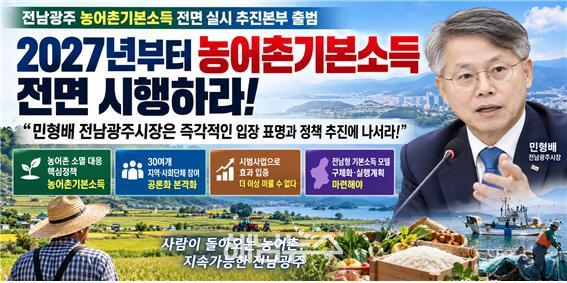 농어촌 기본소득 / 사진제공=ai호남뉴스 |
전남광주지역 농민·농업인 단체 등을 중심으로 2027년부터 농어촌기본소득을 전면 시행해야 한다는 요구가 본격화되고 있다.
전남광주 농어촌기본소득 전면 실시 추진본부(추진본부)는 최근 출범을 선언하고 전남광주 전역에서 농어촌기본소득을 시행할 것을 촉구했다.
추진본부는 전남광주시의회 광주청사 브리핑룸에서 기자회견을 열고 “전남광주 통합의 첫 번째 이유는 지역소멸을 막기 위한 것”이라며 통합특별시 출범 이후 농어촌지역의 지속가능성을 확보하기 위한 핵심 정책으로 농어촌기본소득을 제시했다.
특히 개별 사업의 속도를 내는 것과 함께 농어촌기본소득을 전면 도입하는 것이 지역소멸 대응 정책의 중요한 축이 돼야 한다고 주장했다.
추진본부는 “농어촌기본소득에 대해서는 어떠한 입장도 밝히지 않고 있다”며 민형배 전남광주시장의 명확한 입장 표명과 정책 추진을 요구했다.
이어 “이미 시범사업으로 효과가 입증된 농어촌기본소득을 외면하는 동안 농어촌지역의 소외감과 상대적 박탈감은 심화되고 있다”며 “통합의 취지를 살리기 위해서라도 농어촌기본소득 전면 실시는 더 이상 미룰 수 없는 시대적 과제”라고 강조했다.
■ “현장 제안 바탕으로 전남형 기본소득 모델 마련해야”
추진본부는 민형배 시장에게 즉각적인 입장 표명과 함께 현장의 제안을 바탕으로 전남형 기본소득 모델을 구체화하고 실행계획을 마련할 것을 촉구했다.
농어촌기본소득을 단순한 현금성 복지정책이 아니라 농촌지역의 인구감소와 지역경제 위축, 농업 기반 약화 등에 대응하기 위한 지역소멸 대책으로 접근해야 한다는 것이다.
특히 농촌지역 주민들에게 일정한 소득 기반을 제공할 경우 지역 내 소비를 유도하고 정주 여건을 개선하는 한편, 귀농·귀촌과 청년층 유입 등에도 긍정적인 영향을 미칠 수 있다는 것이 추진본부의 주장이다.
추진본부는 향후 농민·농업인·귀농인뿐 아니라 광주 도심지역 등으로 참여 범위를 확대해 농어촌기본소득 전면 시행을 위한 지역사회 공론화에 나설 방침이다.
현재 추진본부에는 농민·농업인·귀농 관련 단체와 광주 도심지역 등을 포함해 30여 개 지역·사회단체가 참여하고 있는 것으로 전해졌다.
■ 통합특별시 출범 이후 ‘도농 상생정책’ 쟁점 부상
농어촌기본소득 전면 시행 요구는 전남광주 통합 이후 농촌지역의 소멸 위기를 어떤 방식으로 해결할 것인지와 맞물려 향후 주요 정책 쟁점으로 떠오를 전망이다.
특히 추진본부가 2027년 전면 시행을 요구하고 있는 만큼 실제 정책화를 위해서는 대상지역과 지급대상, 지급액, 소요예산, 재원 분담 방식, 지역화폐 연계 여부, 기존 농민수당·농어민 공익수당 등과의 관계에 대한 구체적인 설계가 필요하다.
전 지역을 대상으로 기본소득을 시행할 경우 상당한 재정이 필요한 만큼 중앙정부와 전남광주통합특별시, 시·군 간 재원 분담 문제 역시 향후 논의 과정에서 핵심 쟁점이 될 것으로 보인다.
결국 농어촌기본소득이 지역소멸을 막는 실질적인 정책으로 자리 잡기 위해서는 단순한 지급 확대 논의를 넘어 인구 유입과 정주, 지역 내 소비, 농업 유지, 소상공인 매출 등 실제 지역경제에 미치는 효과를 객관적으로 검증하는 과정도 함께 이뤄져야 한다.
전남광주 30여 개 단체가 추진본부를 구성하고 전면 시행을 공식 요구하면서 농어촌기본소득 문제가 향후 전남광주통합특별시의 ‘도농 상생’과 ‘지역소멸 대응’을 가늠할 주요 정책 시험대로 떠오르고 있다.
“Full Implementation of Rural Basic Income from 2027”… 30 Organizations in Jeonnam-Gwangju Launch Promotion Committee
Jeonnam-Gwangju Committee for Full Implementation of Rural Basic Income officially launched… Calls on Mayor Min Hyung-bae to clarify his position
“Develop a Jeonnam-style basic income model and implementation plan based on proposals from the field”
Basic income proposed as a key policy to tackle rural depopulation and the agricultural crisis… Calls for expansion across the entire region
“Ignoring rural basic income, whose effectiveness has already been demonstrated through pilot projects, will accelerate rural decline”
Around 30 local and civic organizations representing farmers, agricultural workers, return-to-farm communities and urban Gwangju join the initiative
Committee urges Jeonnam-Gwangju Mayor Min Hyung-bae to “immediately state his position and move forward with the policy”
[JEONNAM-GWANGJU = AI HONAM NEWS] aihnnews@kakao.com
Calls are gaining momentum among farmers and agricultural organizations across Jeonnam-Gwangju for the full implementation of a rural basic income program beginning in 2027.
The Jeonnam-Gwangju Committee for the Full Implementation of Rural Basic Income recently announced its launch and called for the policy to be introduced throughout the entire Jeonnam-Gwangju region.
At a press conference held in the briefing room of the Gwangju Office of the Jeonnam-Gwangju City Council, the committee said, “The foremost reason for the integration of Jeonnam and Gwangju is to prevent regional depopulation.”
It proposed rural basic income as a key policy for ensuring the sustainability of rural communities following the launch of the integrated special metropolitan government.
The committee argued that, alongside accelerating individual development projects, the full introduction of rural basic income should become a central pillar of policies aimed at addressing regional population decline.
The committee also criticized the lack of a clear policy stance, saying, “No position has yet been presented regarding rural basic income,” and called on Jeonnam-Gwangju Mayor Min Hyung-bae to clearly state his position and move forward with concrete policy measures.
It added, “While rural basic income, whose effectiveness has already been demonstrated through pilot projects, continues to be overlooked, feelings of alienation and relative deprivation in rural communities are deepening.”
The committee stressed, “To uphold the purpose of the Jeonnam-Gwangju integration, the full implementation of rural basic income is an urgent task that can no longer be postponed.”
■ “A Jeonnam-Style Basic Income Model Must Be Developed Based on Proposals from the Field”
The committee urged Mayor Min to immediately clarify his position and develop a Jeonnam-style rural basic income model, together with a detailed implementation plan reflecting proposals and needs raised by residents and organizations on the ground.
It argued that rural basic income should not be viewed simply as a cash-based welfare program, but rather as a comprehensive policy response to rural population decline, weakening local economies and the deterioration of the agricultural base.
According to the committee, providing rural residents with a stable minimum income could stimulate local consumption, improve living and settlement conditions, and potentially encourage young people and people returning to farming or rural communities to settle in the region.
The committee plans to broaden participation beyond farmers, agricultural workers and return-to-farm groups to include organizations and residents in urban Gwangju, while expanding public discussion over the full implementation of rural basic income.
Around 30 local and civic organizations, including groups representing farmers, agricultural workers, return-to-farm communities and urban areas of Gwangju, are currently participating in the committee.
■ Rural-Urban Coexistence Policy Emerges as Major Issue Following Regional Integration
The demand for full implementation of rural basic income is expected to emerge as a major policy issue as Jeonnam-Gwangju seeks ways to address rural depopulation following regional integration.
With the committee calling for full implementation beginning in 2027, any actual policy rollout would require detailed planning regarding eligible areas, beneficiaries, payment amounts, total budget requirements, cost-sharing arrangements, possible links to local currencies, and coordination with existing farmer allowances and public-interest payments for farmers and fishers.
Implementing basic income throughout the region could require substantial public funding. As a result, determining how the financial burden should be divided among the central government, the Jeonnam-Gwangju integrated government, and local municipal and county governments is also expected to become a major issue.
For rural basic income to become an effective tool against regional depopulation, policymakers will ultimately need to go beyond simply expanding cash payments.
Objective assessments will also be necessary to determine whether the policy produces measurable improvements in population inflows, long-term settlement, local consumption, agricultural sustainability and sales at small local businesses.
With around 30 organizations in Jeonnam-Gwangju forming a joint committee and formally calling for full implementation, rural basic income is emerging as a major policy test for rural-urban coexistence and efforts to combat regional depopulation in the newly integrated Jeonnam-Gwangju region.
 해남뉴스 박충배 편집/논설 news@hbcnews.kr