| “고종의 서신을 전달하라”…세계 한 바퀴 돌아 러시아 황제 앞에 선 민영환 제물포 출발 56일 만에 모스크바 도착…러시아 공관에 태극기 게양 해남뉴스 박충배 편집 및 논설위원 news@hbcnews.kr |
| 2026년 08월 08일(토) 19:23 |
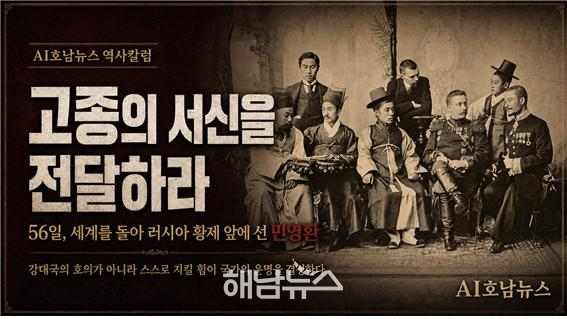 대관식에서 고종의 서신을 전달하라 / 사진제공= 우리역사넷 |
【AI호남뉴스】 aihnnews@kakao.com
1896년 봄, 고종은 민영환에게 국가의 운명을 건 임무를 맡겼다.
“러시아 황제에게 나의 서신을 전달하라.”
겉으로 내세운 목적은 러시아 황제 니콜라이 2세의 대관식 축하였다. 그러나 민영환이 품고 떠난 진짜 임무는 축하 인사를 전하는 데 그치지 않았다. 명성황후 시해와 아관파천으로 이어진 국가적 위기 속에서 러시아의 지원을 얻어 일본을 견제하고, 고종의 안전과 조선의 자주권을 지켜내야 했다.
고종이 러시아에 보내는 특명전권공사로 민영환을 선택한 것은 그만큼 그를 신뢰했기 때문이다. 고종의 국서는 의례적인 축하문이면서 동시에 민영환에게 외교적 권한을 부여하는 신임장이었다.
국서의 취지는 명확했다.
‘짐이 특별히 민영환을 보내니 그를 믿고, 그가 전하는 말을 짐의 말과 같이 여겨 달라.’
고종은 민영환의 입을 통해 조선이 처한 위급한 사정을 러시아 황제에게 직접 호소하려 했다.
제물포에서 모스크바까지 56일
민영환 사절단은 1896년 4월 1일 서울을 떠나 제물포에서 바닷길에 올랐다.
사절단에는 영어 통역을 맡은 윤치호, 중국어 통역 김득련, 러시아어 통역 김도일, 수행원 손희영과 러시아 공사관 관계자 스타인 등이 동행했다.
이들은 상하이와 일본 나가사키·요코하마를 거쳐 태평양을 건넜다. 캐나다 밴쿠버에 도착한 뒤 대륙횡단철도를 이용해 캐나다와 북미대륙을 통과했다. 일부 여정 기록에는 몬트리올 등 캐나다 동부지역 통과 과정이 언급되지만, 대표적인 공식 경로는 밴쿠버에서 뉴욕으로 이어진다.
뉴욕에서는 다시 배를 타고 대서양을 건넜다. 영국 리버풀에 도착한 사절단은 런던을 거쳐 네덜란드 플러싱으로 향했다. 이어 독일 베를린과 폴란드 바르샤바를 지나 5월 20일 마침내 모스크바에 도착했다.
출발한 지 56일 만이었다.
증기선과 기차를 갈아타며 태평양과 대서양, 북미와 유럽을 횡단한 대장정이었다. 당시 조선인들에게는 상상하기조차 어려운 세계여행이었다. 사절단이 모스크바의 러시아 공관에 도착하자 건물 위에는 조선의 국기인 태극기가 게양됐다.
망국의 위기에 놓인 작은 나라의 국기가 세계 열강이 모인 러시아의 수도 하늘에 오른 순간이었다.
니콜라이 2세 앞에 선 조선의 특사
민영환은 모스크바 크렘린궁에서 니콜라이 2세를 알현하고 고종의 국서와 예물을 전달했다.
러시아 황제는 국서를 받은 뒤 조선의 뜻을 알겠다는 취지로 답했다. 그러나 첫 알현은 대관식 축하와 국서 전달을 중심으로 한 공식 의례였다. 제한된 시간과 엄격한 외교 절차 때문에 민영환이 조선의 절박한 요구를 모두 구체적으로 설명하기는 어려웠다.
민영환이 러시아에 가져간 요구는 단순한 우호 요청이 아니었다.
당시 조선이 러시아에 요청한 핵심 사항은 크게 다섯 가지였다.
첫째, 고종의 환궁과 신변 보호를 위한 궁궐 경비병 지원이었다.
둘째, 조선의 근대식 군대와 경찰을 양성할 러시아 교관 파견이었다.
셋째, 궁내·재정·광산·철도 등 국가 운영을 돕는 고문관과 기술자 제공이었다.
넷째, 일본에 진 빚을 갚고 재정을 안정시키기 위한 300만 원 규모의 차관 제공이었다.
다섯째, 조선과 러시아를 연결하는 전신선 설치였다.
이는 군사·재정·통신을 러시아의 지원으로 재건해 일본의 압박에서 벗어나려는 고종의 국가 생존 전략이었다.
민영환은 대관식 이후 러시아 외무대신 알렉세이 로바노프를 만나 이 문제를 본격적으로 제기했다. 그는 명성황후가 일본 세력에 의해 시해됐으며, 고종마저 신변의 위협을 받아 러시아 공사관에 머물고 있다는 조선의 위급한 사정을 설명했다.
“조선이 도움을 기대할 수 있는 나라는 러시아뿐이다.”
민영환의 호소에는 나라를 지키지 못하면 왕실은 물론 조선의 독립 자체가 무너질 수 있다는 절박함이 담겨 있었다.
하지만 러시아는 즉각적인 확답을 피했다. 로바노프는 요구사항을 서면으로 제출하도록 했고, 러시아 정부의 이해관계와 일본의 움직임을 함께 계산했다.
민영환은 다시 니콜라이 2세를 만나 조선의 요구를 설명하려 했다. 기록에 따르면 그는 외무대신에게 밝혔던 내용을 황제 앞에서도 거듭 강조했다. 그러나 조선이 기대했던 군사·재정 지원 전체에 대한 명확한 약속을 받아내지는 못했다.
대관식 뒤에서 움직인 일본
민영환이 러시아의 지원을 얻기 위해 분투하는 동안 일본도 가만히 있지 않았다.
일본은 니콜라이 2세 대관식에 야마가타 아리토모를 파견했다. 일본 대표단의 목적은 축하에만 있지 않았다. 러시아가 조선을 일방적으로 장악하지 못하도록 견제하고, 조선 문제를 일본과 러시아가 함께 관리하는 구도를 만드는 것이었다.
결국 러시아 외무대신 로바노프와 야마가타는 1896년 6월 ‘로바노프-야마가타 의정서’를 체결했다. 조선의 군사와 재정 문제에 양국이 공동으로 관여하고, 비상사태가 발생하면 양국군의 충돌을 막기 위한 조치를 마련한다는 내용이었다.
정작 당사자인 조선은 협상에서 배제됐다.
민영환이 러시아 황제에게 조선의 독립과 안전을 호소하고 있던 바로 그 외교무대에서 러시아와 일본은 조선을 자신들의 세력 조정 대상으로 다루고 있었다.
러시아가 조선의 요청에 소극적이었던 이유도 여기에 있었다. 러시아는 일본과 즉각 충돌하면서까지 조선을 전면적으로 지원할 의사가 없었다. 조선을 돕겠다는 우호적인 표현과 달리 실제 외교에서는 자국의 이익을 먼저 계산했다.
다만 민영환의 교섭이 아무런 성과도 거두지 못한 것은 아니다. 이후 러시아 군사교관들이 조선에 들어와 궁궐 경비병과 근대식 군대를 훈련했다. 이는 고종의 경운궁 환궁과 대한제국 수립을 뒷받침하는 한 요인이 됐다.
그러나 차관과 전신선, 광범위한 고문관 파견 등 조선이 요청한 사항 대부분은 기대만큼 실현되지 않았다.
러시아의 힘을 빌리려 했던 외교의 한계
고종과 민영환은 일본의 침략을 막기 위해 러시아의 힘을 빌리려 했다. 당시 조선의 군사력과 재정 상태를 고려하면 현실적인 선택으로 보일 수 있었다.
그러나 강대국은 약소국의 절박함만으로 움직이지 않는다.
러시아는 조선을 보호하기 위해 일본과 맞선 것이 아니라 극동에서 자국의 영향력을 확대하기 위해 움직였다. 일본 역시 조선의 근대화나 독립을 원한 것이 아니라 대륙 진출을 위한 교두보로 조선을 장악하려 했다.
청나라를 끌어들이고, 일본에 기대고, 다시 러시아에 의존하는 외교만으로는 조선의 자주권을 지킬 수 없었다. 외세를 견제하기 위해 또 다른 외세를 불러들이는 방식은 잠시 시간을 벌 수는 있어도 국가의 운명을 보장하지 못했다.
민영환의 러시아 외교는 바로 그 냉혹한 현실을 보여준다.
세계를 보고 ‘새사람’이 되어 돌아오다
민영환의 여정은 외교적 성과만으로 평가할 수 없다.
그는 태평양과 대서양을 건너며 철도·항만·전신·공장·학교·군대·도시 행정 등 서구의 근대문명을 직접 목격했다. 귀국길에는 아직 완공되지 않은 시베리아 횡단철도 구간과 바이칼호, 이르쿠츠크, 치타, 블라고베시첸스크, 하바롭스크, 블라디보스토크를 거쳤다.
1896년 10월 21일 제물포로 돌아오기까지 6개월 20여 일이 걸렸다. 사절단은 결과적으로 세계를 한 바퀴 돈 한국 최초의 세계일주 주인공이 됐다.
이 여정은 『해천추범』과 김득련의 『환구일기』에 남았다. 두 기록은 서구의 교통과 산업, 군사제도, 교육시설뿐 아니라 러시아 연해주 일대에서 살아가던 조선인 이주민들의 모습까지 전하고 있다.
민영환은 해외에서 돌아온 뒤 이전과 다른 인물이 됐다는 평가를 받았다. 세계의 변화를 직접 본 그는 조선이 살아남으려면 군사·교육·산업·행정 전반의 근대화가 필요하다고 판단했다.
그는 독립협회의 활동을 지지하고 군제 개혁과 근대식 군대 양성에 관심을 기울였다. 조선이 형식적인 왕조의 틀에 머물러서는 세계 열강의 침략을 막을 수 없다는 사실을 체감한 것이다.
민영환의 여정이 오늘에 던지는 경고
1896년 모스크바에 게양된 태극기는 조선도 국제사회의 독립된 국가임을 알리는 상징이었다.
그러나 국기만으로 주권을 지킬 수는 없었다. 국제무대에서 존중받으려면 국권을 뒷받침할 군사력과 경제력, 외교력, 국민적 결속이 필요했다.
민영환은 세계를 돌아보며 조선의 낙후를 확인했고, 러시아 외교를 통해 강대국의 약속이 얼마나 이해관계에 따라 달라지는지도 목격했다. 그가 모스크바에서 얻은 가장 뼈아픈 교훈은 러시아의 원조가 아니라 자강의 필요성이었을 것이다.
외교는 필요하다. 우방과의 협력도 중요하다. 그러나 다른 나라의 호의와 선의만 믿고 국가의 운명을 맡겨서는 안 된다.
1905년 일본이 을사늑약을 강제로 체결하자 민영환은 조약 파기와 을사오적 처벌을 요구했다. 받아들여지지 않자 그는 죽음으로 일본 침략의 부당성을 고발했다.
러시아 황제 앞에서 조선을 살려달라고 호소했던 특사는 9년 뒤 외교권을 빼앗긴 나라 앞에서 자신의 목숨을 내놓았다.
민영환의 56일간 대장정과 모스크바 외교는 한 사람의 여행담이 아니다. 외세 의존의 한계와 자주국방, 근대화의 절박성을 보여주는 역사적 경고다.
강대국은 자국의 이익에 따라 움직인다. 결국 나라를 지키는 마지막 힘은 다른 나라의 약속이 아니라 국민과 국가가 스스로 준비한 역량에서 나온다.
그것이 130년 전 세계를 한 바퀴 돌아 러시아 황제 앞에 섰던 민영환의 외교가 오늘 우리에게 남긴 가장 무거운 교훈이다.
※ 주요 사실관계는 국사편찬위원회 우리역사넷, 국가유산진흥원, 한국민족문화대백과사전의 자료를 참고했다.
[AI Honam News Historical Column]
“Deliver the King’s Letter”—Min Yeong-hwan Circumnavigates the Globe to Stand Before the Russian Emperor
Arriving in Moscow 56 days after departing Jemulpo, the Korean flag was raised over the Russian legation
An epic journey through Shanghai, Yokohama, Vancouver, New York, Liverpool, Berlin and Warsaw
Delivering King Gojong’s letter to Nicholas II: “Trust Min Yeong-hwan’s words as you would my own”
Korea sought support in five areas—palace guards, military instructors, advisers, a loan and a telegraph line
Japan negotiated separately with Russia during the coronation, leaving Korea excluded from the contest for power
After witnessing Western modernity, Min returned convinced of the need for military reform and national independence
“A nation’s destiny depends not on the goodwill of great powers, but on its own strength to defend itself”
【AI Honam News】 aihnnews@kakao.com
In the spring of 1896, King Gojong entrusted Min Yeong-hwan with a mission upon which the fate of the nation depended.
“Deliver my letter to the Russian emperor.”
The official purpose of the mission was to congratulate Emperor Nicholas II on his coronation. Yet Min’s true assignment went far beyond offering ceremonial greetings. Amid a national crisis marked by the assassination of Queen Min—posthumously known as Empress Myeongseong—and Gojong’s flight to the Russian legation, Min was expected to secure Russian assistance, restrain Japan, protect the king and defend Korea’s sovereignty.
Gojong’s decision to appoint Min as special envoy and minister plenipotentiary demonstrated the depth of his trust in him. The royal letter was both a ceremonial message of congratulations and a diplomatic credential granting Min the authority to speak on the king’s behalf.
Its meaning was unmistakable:
“I have specially appointed Min Yeong-hwan as my envoy. Trust him, and regard the words he delivers as though they were my own.”
Through Min, Gojong intended to make a direct appeal to the Russian emperor concerning Korea’s desperate circumstances.
From Jemulpo to Moscow in 56 Days
Min’s delegation left Seoul on April 1, 1896, and embarked from Jemulpo, today’s Incheon.
The mission included Yun Chi-ho, who served as the English-language interpreter; Kim Deuk-ryeon, the Chinese-language interpreter; Kim Do-il, the Russian-language interpreter; attendant Son Hui-yeong; and Stein, an official associated with the Russian legation in Korea.
The delegation travelled through Shanghai and the Japanese ports of Nagasaki and Yokohama before crossing the Pacific. After arriving in Vancouver, Canada, its members travelled across Canada and North America by transcontinental railway. Some accounts mention their passage through Montreal and other parts of eastern Canada, although the principal documented route generally traces the journey from Vancouver to New York.
From New York, they again boarded a ship and crossed the Atlantic. After landing at Liverpool, they travelled through London and continued to Vlissingen in the Netherlands. They then passed through Berlin, Germany, and Warsaw, Poland, before finally arriving in Moscow on May 20.
It had taken 56 days.
The delegation had crossed the Pacific and Atlantic oceans and traversed North America and Europe, repeatedly transferring between steamships and trains. For Koreans at the time, it was an almost unimaginable journey around the world.
When the delegation reached its quarters in Moscow, the Korean national flag—the Taegeukgi—was raised above the building.
It was a poignant moment: the flag of a small nation facing the threat of losing its independence flew in the capital of an empire where the world’s great powers had gathered.
A Korean Envoy Before Nicholas II
At the Kremlin, Min received an audience with Nicholas II and presented Gojong’s royal letter and gifts.
After receiving the letter, the emperor responded that he understood Korea’s position. The first audience, however, was largely a formal occasion centred on congratulating the emperor and delivering the royal message. Because of strict diplomatic protocol and limited time, Min was unable to explain all of Korea’s urgent requests in detail.
The requests he carried were far more substantial than a general appeal for friendship.
Korea sought Russian assistance in five principal areas.
First, it requested palace guards to protect Gojong and ensure his safety after his return to the royal palace.
Second, it asked Russia to dispatch instructors to train a modern Korean military and police force.
Third, it requested advisers and technical experts to assist with the royal household, national finances, mining, railways and other areas of state administration.
Fourth, it sought a loan of three million won to repay debts owed to Japan and stabilise the country’s finances.
Fifth, it requested the construction of a telegraph line connecting Korea and Russia.
The five demands formed part of Gojong’s strategy for national survival: rebuilding Korea’s military, financial and communications systems with Russian assistance and escaping mounting Japanese pressure.
Following the coronation, Min met Russian Foreign Minister Alexei Lobanov-Rostovsky and formally raised these issues. He explained that Queen Min had been murdered by Japanese forces and that Gojong, facing threats to his own life, had been compelled to take refuge in the Russian legation.
“Russia is the only country from which Korea can expect assistance.”
Behind Min’s appeal was a profound sense of urgency. Unless the country could defend itself, not only the royal family but Korea’s very independence would be lost.
Russia, however, avoided giving an immediate and definitive answer. Lobanov requested that the demands be submitted in writing, while the Russian government weighed its own interests and closely monitored Japan’s movements.
Min subsequently sought another audience with Nicholas II to explain Korea’s position. Historical records indicate that he repeated before the emperor the points he had presented to the foreign minister. Nevertheless, he failed to obtain a clear commitment to provide all the military and financial assistance Korea had requested.
Japan’s Manoeuvres Behind the Coronation
While Min struggled to secure Russian support, Japan was also moving aggressively on the diplomatic front.
Japan dispatched Yamagata Aritomo to attend the coronation of Nicholas II. The Japanese delegation had objectives that extended far beyond offering congratulations. Japan intended to prevent Russia from gaining unilateral control over Korea and sought to establish an arrangement under which Russia and Japan would jointly manage Korean affairs.
In June 1896, Russian Foreign Minister Lobanov and Yamagata concluded the Lobanov–Yamagata Protocol. It provided for Russian and Japanese involvement in Korea’s military and financial affairs and included measures intended to prevent clashes between their forces in the event of an emergency.
Korea—the country directly concerned—was excluded from the negotiations.
At the very moment Min was appealing to the Russian emperor for Korea’s independence and security, Russia and Japan were treating Korea as an object of negotiation in their struggle for influence.
This also explains Russia’s reluctance to fully accept Korea’s requests. Russia had no intention of entering an immediate confrontation with Japan in order to provide Korea with comprehensive support. Despite its friendly language about assisting Korea, Russia placed its own national interests first when conducting actual diplomacy.
Min’s mission was not entirely without results. Russian military instructors later arrived in Korea and helped train palace guards and modern military units. This contributed to Gojong’s return to Gyeongungung Palace, now Deoksugung Palace, and became one of the factors supporting the subsequent establishment of the Korean Empire.
Most of Korea’s other requests, however—including the loan, the telegraph line and the broad dispatch of advisers—were not realised to the extent Gojong and Min had hoped.
The Limits of Diplomacy Dependent on Russian Power
Gojong and Min sought to use Russian power to block Japanese aggression. Considering Korea’s weak military and precarious finances at the time, this may have appeared to be a realistic choice.
Great powers, however, do not act solely in response to the desperation of weaker nations.
Russia confronted Japan not to protect Korea, but to expand its own influence in the Far East. Japan likewise had no interest in Korea’s modernisation or independence. It sought to control the Korean Peninsula as a bridgehead for its advance onto the Asian continent.
Korea’s sovereignty could not be protected merely by bringing in China, relying on Japan and then turning to Russia. Inviting one foreign power to restrain another could buy time, but it could not guarantee the nation’s future.
Min’s diplomacy in Russia revealed this cold reality.
Returning as a “New Man” After Seeing the World
Min’s journey cannot be judged solely by its diplomatic results.
As he crossed the Pacific and Atlantic oceans, he witnessed Western railways, harbours, telegraph systems, factories, schools, armed forces and municipal administration. On the return journey, the delegation travelled through sections of the still-unfinished Trans-Siberian Railway and passed Lake Baikal, Irkutsk, Chita, Blagoveshchensk, Khabarovsk and Vladivostok.
The delegation returned to Jemulpo on October 21, 1896, after more than six months abroad. In effect, its members became the first Koreans to circumnavigate the globe.
The journey was documented in Haecheon Chubeom and Kim Deuk-ryeon’s Hwanggu Ilgi. These records describe Western transport, industry, military institutions and educational facilities, as well as the lives of Korean emigrants living in the Russian Far East.
After returning home, Min was regarded as a different man. Having personally witnessed the transformation of the wider world, he concluded that Korea could survive only by modernising its military, education, industry and state administration.
He supported the activities of the Independence Club and took a strong interest in military reform and the establishment of a modern armed force. He had come to understand that Korea could not resist the encroachment of the great powers while remaining confined within the formal structures of the old dynasty.
The Warning Min Yeong-hwan’s Journey Offers Today
The Taegeukgi raised in Moscow in 1896 symbolised Korea’s claim to recognition as an independent member of the international community.
A flag alone, however, could not protect sovereignty. To command respect on the international stage, a country required military strength, economic power, diplomatic capability and national unity.
As Min travelled around the world, he saw how far Korea had fallen behind. Through his diplomacy in Russia, he also learned how quickly the promises of powerful states could change according to their interests. The most painful lesson he brought home from Moscow may not have been the promise of Russian assistance, but the necessity of national self-strengthening.
Diplomacy is indispensable. Cooperation with friendly nations is also important. Yet a country must never entrust its destiny solely to the goodwill and benevolence of another power.
When Japan forcibly imposed the Eulsa Treaty in 1905, stripping Korea of its diplomatic sovereignty, Min demanded that the treaty be annulled and that the five Korean officials who supported it be punished. When his appeals failed, he took his own life in protest, exposing through his death the injustice of Japan’s aggression.
The envoy who had once stood before the Russian emperor and pleaded for Korea’s survival gave his life nine years later, after his country’s diplomatic sovereignty had been taken away.
Min’s 56-day journey to Moscow and his diplomatic mission were far more than the story of one man’s travels. They remain a historical warning about the limits of dependence on foreign powers and the urgent need for national defence, modernisation and self-reliance.
Great powers act according to their own interests. Ultimately, a nation’s last line of defence lies not in the promises of another country, but in the capabilities its people and government have built for themselves.
That is the weightiest lesson Min Yeong-hwan’s diplomacy leaves us today, 130 years after he circumnavigated the globe and stood before the Russian emperor.
※ The principal historical facts in this article were drawn from materials published by the National Institute of Korean History’s Our History Net, the Korea Heritage Agency and the Encyclopedia of Korean Culture.
 해남뉴스 박충배 편집 및 논설위원 news@hbcnews.kr