| 전남광주특별시, 발전공기업 통합 본사 유치 나섰다…“국가 에너지 전환 최적지” 해상풍력 최대 생산기지·전력 공공기관 집적 등 유치 논리 제시 해남뉴스 박충배 편집 및 논설위원 news@hbcnews.kr |
| 2026년 08월 08일(토) 11:36 |
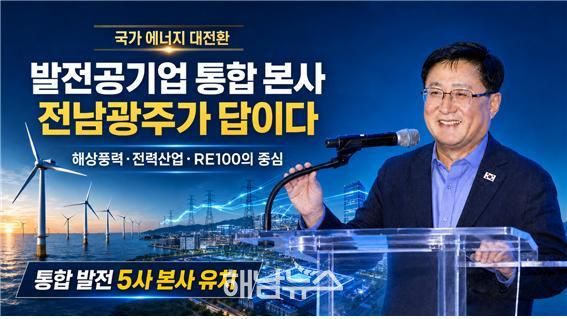 발전공기업통합본사 유치 / 사진제공=AI호남뉴스 |
전남광주통합특별시가 정부가 추진하는 발전공기업 구조 개편에 맞춰 통합 발전 5사의 본사를 지역에 유치하기 위한 본격적인 활동에 나섰다.
전남광주통합특별시는 김성환 기후에너지환경부 장관에게 발전공기업 통합 본사를 특별시에 설치해 줄 것을 공식 건의했다고 밝혔다.
이번 건의는 통합특별시 출범 이후 정부에 전달한 첫 공식 건의다. 특별시는 지난 6월 발표한 유치성명서의 논리를 보완해 재생에너지 생산 기반과 전력 공공기관 집적, 첨단산업 전력 수요 등을 아우르는 통합 본사 유치 전략을 마련했다.
특별시는 발전공기업 통합이 단순한 기관 통폐합이나 조직 축소에 그쳐서는 안 된다는 입장이다. 석탄발전 중심의 기존 전력산업을 재생에너지 중심으로 전환하고 국가 에너지 안보와 미래 산업 경쟁력을 확보하는 전략적 구조 개혁으로 추진해야 한다고 강조했다.
통합 발전공기업이 이러한 역할을 제대로 수행하려면 재생에너지 생산 현장과 전력산업 기반이 집적된 전남광주통합특별시에 현장 중심의 컨트롤타워를 구축해야 한다는 것이 특별시의 주장이다.
특별시는 통합 본사 유치의 첫 번째 근거로 대규모 해상풍력 생산 기반을 제시했다.
통합 대상 발전공기업이 운영하는 약 32GW 규모의 석탄발전을 단계적으로 대체하려면 대규모 재생에너지 생산기지가 필요하며, 전남 해역을 중심으로 추진되는 해상풍력 사업이 정의로운 에너지 전환의 가장 현실적인 대안이 될 수 있다는 설명이다.
현재 발전공기업 4개사가 지역에서 총 3.8GW 규모의 11개 해상풍력 사업에 참여하고 있다. 향후 석탄발전소 운영 인력을 해상풍력 건설과 운영·유지보수 분야로 재배치하면 발전공기업 구조 개편에 따른 고용 불안을 줄이고 새로운 에너지 일자리를 창출할 수 있을 것으로 특별시는 내다봤다.
국가 에너지 정책과 연계할 수 있는 기반도 유치 강점으로 내세웠다.
옛 전남 전역에서는 ‘차세대 전력망 혁신기지’와 ‘분산에너지 특화지역’ 조성이 추진되고 있으며, 재생에너지 100% 사용을 목표로 하는 RE100 산업단지 지정 가능성도 높은 것으로 평가받고 있다.
특히 나주 빛가람혁신도시에는 한국전력공사와 한국전력거래소, 한전KDN, 한전KPS 등 국가 전력산업을 이끄는 핵심 공공기관이 집적돼 있다. 통합 발전공기업 본사가 들어설 경우 발전·송전·전력거래·설비관리 분야의 협업 체계를 한층 강화할 수 있다는 설명이다.
한국에너지공과대학교와 4대 국가 에너지 특구를 비롯해 에너지 생산부터 연구개발, 기업 육성, 실증, 인력 양성까지 연결되는 전 주기 산업생태계를 갖추고 있다는 점도 강조했다.
특별시는 발전공기업 통합 본사 유치가 서남권 첨단산업 육성과도 직결된다고 밝혔다.
896조 원 규모로 추진되는 서남권 반도체 메가프로젝트를 비롯한 첨단산업은 막대한 규모의 안정적인 전력과 RE100 공급체계가 필요하다. 재생에너지 생산 기반과 통합 발전공기업의 사업 역량을 결합하면 국가 첨단산업에 전력을 공급하는 새로운 사업 모델을 만들 수 있다는 것이다.
황기연 전남광주통합특별시 행정부시장은 “통합 본사의 입지는 국가 에너지 대전환의 성공과 직결되는 만큼 재생에너지 생산과 전력산업 전 주기 생태계가 집적된 전남광주통합특별시가 최적의 선택이 될 것”이라고 말했다.
이어 “특별시 유치 TF와 범시민 유치위원회 등을 구성하고 통합 본사 특별시 유치에 대한 국민적·정책적 공감대를 확산할 수 있는 대대적인 유치 활동을 본격화할 계획”이라고 밝혔다.
발전공기업 통합 본사 입지는 지역 간 정치적 배분이나 기관 나눠 먹기 방식이 아니라 국가 에너지 전환의 효율성과 산업 연계성, 지역 균형발전 효과를 기준으로 결정돼야 한다.
전남광주통합특별시도 유치 선언에 머물지 말고 통합 본사 후보 부지와 정주 여건, 교통망, 전문인력 확보 방안, 지역 상생계획을 구체적으로 공개해야 한다. 특히 해남·영암 일대의 대규모 재생에너지 생산기지와 나주 전력산업 기반, 광주 첨단산업을 하나의 에너지 경제권으로 연결하는 실행계획을 제시해야 유치 경쟁에서 설득력을 확보할 수 있다.
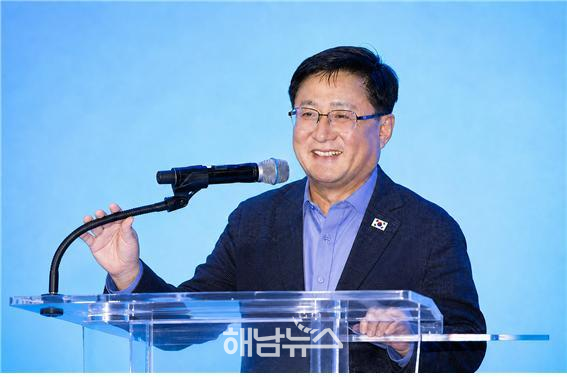 26년 기후에너지환경부장관 / 사진제공=기후에너지환경부 |
Jeonnam-Gwangju Special City Launches Bid to Host Integrated Power Generation Corporation Headquarters
“The region is ideally positioned to lead Korea’s national energy transition”
Region presents large-scale offshore wind production and concentration of major power-sector public institutions as key advantages
Formal proposal submitted to Climate, Energy and Environment Minister Kim Sung-hwan
First official proposal submitted to the central government since the launch of the integrated special city
Four state-run power companies currently participating in 11 regional offshore wind projects totaling 3.8 GW
Coal-fired power plant workers could transition into offshore wind operation and maintenance jobs
Major energy institutions, including KEPCO, Korea Power Exchange, KEPCO KDN and KEPCO KPS, concentrated in the region
Full-cycle energy ecosystem supported by Korea Institute of Energy Technology and four national energy special zones
RE100 electricity supply base highlighted for the 896-trillion-won Southwest Semiconductor Megaproject
Dedicated task force and citywide civic campaign committee to be established
“The decision must be based on national energy strategy and balanced regional development—not political bargaining”
【JEONNAM-GWANGJU=HAENAM NEWS】 haenamnews@kakao.com
Jeonnam-Gwangju Integrated Special City has launched a full-scale campaign to attract the headquarters of the five state-run power generation companies expected to be consolidated under the government’s restructuring plan.
The special city announced that it had formally asked Climate, Energy and Environment Minister Kim Sung-hwan to locate the headquarters of the integrated power generation corporation in the region.
This marks the first official proposal submitted to the central government since the launch of the integrated special city. Building on a statement issued in June, the city has strengthened its case by combining the region’s renewable energy production capacity, concentration of major electricity-sector public institutions and growing power demand from advanced industries.
The special city argues that the consolidation of the state-run power companies must not be treated merely as an institutional merger or organizational downsizing. Instead, it should become a strategic reform aimed at shifting Korea’s electricity industry from coal-fired power generation to renewable energy, strengthening national energy security and securing future industrial competitiveness.
To successfully carry out that role, the city says the integrated power corporation needs a field-oriented control tower in Jeonnam-Gwangju, where renewable energy production facilities and the nation’s electricity industry infrastructure are concentrated.
The city cited its large-scale offshore wind capacity as the first major reason why the headquarters should be located in the region.
Approximately 32 GW of coal-fired generation capacity currently operated by the power companies must eventually be replaced with large-scale renewable energy sources. According to the city, offshore wind projects being developed in waters off Jeonnam offer one of the most realistic alternatives for achieving a just energy transition.
Four state-run power generation companies are currently participating in 11 offshore wind projects in the region with a combined capacity of 3.8 GW. The city expects that workers now employed at coal-fired power plants could be reassigned to offshore wind construction, operation and maintenance, helping ease employment concerns arising from the restructuring while creating new clean-energy jobs.
The region’s close connection to national energy policies was also presented as a major advantage.
Projects are underway across the former Jeonnam region to establish a next-generation power grid innovation hub and a distributed energy special zone. The area is also considered a strong candidate for designation as an RE100 industrial complex powered entirely by renewable energy.
Naju’s Bitgaram Innovation City is home to major national electricity-sector institutions, including Korea Electric Power Corporation, Korea Power Exchange, KEPCO KDN and KEPCO KPS. The city argues that locating the integrated corporation’s headquarters nearby would strengthen cooperation across power generation, transmission, electricity trading and facility maintenance.
Jeonnam-Gwangju also highlighted its full-cycle energy industrial ecosystem, spanning power production, research and development, business incubation, technology demonstration and workforce training. This foundation includes the Korea Institute of Energy Technology and four national energy special zones.
The special city said the headquarters bid is also directly linked to the development of advanced industries in southwestern Korea.
The 896-trillion-won Southwest Semiconductor Megaproject and other advanced industrial developments will require vast amounts of stable electricity and a reliable RE100 supply system. Combining the region’s renewable energy production capacity with the business capabilities of the integrated power corporation could create a new electricity supply model for Korea’s strategic industries.
“The location of the integrated headquarters will be directly tied to the success of Korea’s national energy transition,” said Hwang Ki-yeon, administrative vice mayor of Jeonnam-Gwangju Integrated Special City. “Jeonnam-Gwangju, where renewable energy production and the full cycle of the electricity industry are concentrated, would be the optimal choice.”
“We plan to establish a dedicated special-city task force and a citywide civic campaign committee,” Hwang added. “We will launch a broad campaign to build public and policy support for bringing the integrated headquarters to the region.”
The headquarters location should not be decided through political bargaining or the regional division of public institutions. It must instead be determined according to the efficiency of the national energy transition, links with relevant industries and the potential contribution to balanced regional development.
Jeonnam-Gwangju must also move beyond a simple declaration of intent. It should disclose detailed plans covering potential sites, residential conditions, transportation networks, specialist workforce recruitment and regional benefit-sharing.
In particular, the special city must present a concrete implementation plan connecting the large-scale renewable energy production bases in Haenam and Yeongam, Naju’s electricity industry infrastructure and Gwangju’s advanced industries into a single regional energy economy. Such a plan will be essential if the city is to present a convincing case in the competition to host the headquarters.
 해남뉴스 박충배 편집 및 논설위원 news@hbcnews.kr