| 고구마 덩굴·비상품 고구마가 산업 소재로…전남광주농기원, 업사이클링 기술개발 026년부터 3년간 총사업비 약 13억 원 투입 해남뉴스 박충배 편집 및 논설위원 news@hbcnews.kr |
| 2026년 07월 28일(화) 11:49 |
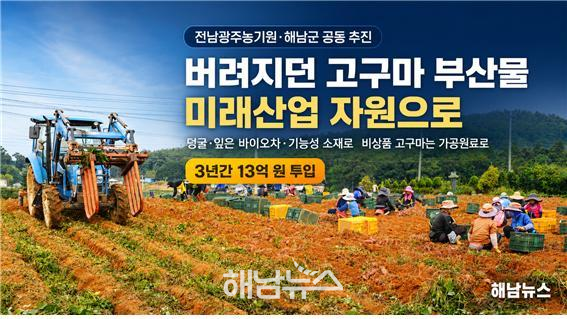 버려진 고구마 부산물 / 사진제공=AI호남뉴스 |
버려지던 고구마 덩굴과 잎, 비상품 고구마를 바이오차와 기능성 소재, 가공제품으로 활용하는 자원순환형 기술개발이 추진된다.
전남광주통합특별시농업기술원은 올해부터 3년간 총사업비 약 13억 원을 투입해 ‘고구마 부산물 업사이클링 및 산업화 기술개발’ 사업을 추진한다고 밝혔다.
이번 사업에는 전남광주농업기술원과 해남군농업기술센터, 민간업체 등이 참여한다. 고구마 덩굴을 효율적으로 수집·가공하는 기술을 개발하고, 이를 바이오차와 식품·화장품 소재, 가공제품 등으로 산업화하는 것이 핵심이다.
전남광주지역은 2025년 기준 약 5천200㏊에서 고구마를 재배해 전국 재배면적의 약 30%를 차지하는 국내 최대 주산지다. 국내 연간 고구마 생산량을 약 31만 톤으로 볼 때 덩굴과 잎 등을 포함한 부산물 발생량은 약 46만 톤에 이를 것으로 추정된다.
그러나 고구마 덩굴과 잎은 수분 함량이 높고 부피가 커 수집과 운반이 어렵다. 별도의 처리시설과 활용처도 충분하지 않아 상당량이 농경지에 방치되거나 폐기되는 실정이다.
농업기술원은 이 같은 문제를 해결하기 위해 고구마 덩굴의 절단·수집·압축·운반 과정을 연계한 기계화 기술과 작업체계를 개발할 계획이다. 부산물 수거 과정에서 발생하는 노동력과 경영비를 줄이고 농업 현장에서 실제로 활용할 수 있는 기술을 만드는 것이 목표다.
수집한 고구마 덩굴과 잎은 바이오차로 생산해 농업 분야 탄소중립 정책과 연계한다. 바이오차는 바이오매스를 산소가 제한된 조건에서 열분해해 만든 탄소 소재로, 토양에 투입하면 탄소를 장기간 저장하고 토양환경을 개선하는 데 활용할 수 있다.
고구마 잎과 줄기에 함유된 루테인과 베타카로틴, 폴리페놀, 클로로젠산 등 기능성 성분을 활용한 식품·화장품 소재 개발도 추진한다. 지금까지 폐기 대상으로 여겨졌던 부산물을 새로운 부가가치 자원으로 전환하겠다는 구상이다.
저장과 유통 과정에서 상품성을 잃어 폐기되는 고구마의 활용 방안도 마련한다. 비상품 고구마는 연간 약 1만8천 톤이 발생하고, 이를 처리하는 데 드는 비용은 약 32억 원에 이르는 것으로 추정된다.
농업기술원은 비상품 고구마를 분말·페이스트 등 식품 가공원료나 다양한 가공제품으로 활용하는 기술을 개발할 방침이다. 부산물 발생량과 처리 실태를 조사하고, 덩굴 수집비용과 개발 제품의 시장 경쟁력을 분석해 농가와 산업체가 적용할 수 있는 표준 경영모델도 제시할 예정이다.
다만 이번 사업이 실질적인 농가소득으로 이어지려면 기술개발에 그쳐서는 안 된다. 덩굴 수거 장비의 농가 부담, 수집·운반 비용, 바이오차 생산단가, 기능성 소재의 안전성과 효능 검증, 가공제품의 안정적인 판로까지 구체적인 사업모델을 마련해야 한다.
특히 국내 최대 고구마 주산지인 해남에서 실증사업을 추진하는 만큼 농가별 부산물 처리비용이 얼마나 줄어드는지, 비상품 고구마 판매를 통해 어느 정도의 추가소득을 얻을 수 있는지 수치로 제시할 필요가 있다.
마경철 전남광주통합특별시농업기술원 식량작물연구소장은 “고구마 부산물을 수집하는 단계부터 바이오차와 기능성 소재, 가공제품 개발까지 전주기 활용체계를 구축하겠다.”며 “고구마 산업을 자원순환형 미래산업으로 육성하겠다.”고 말했다.
이번 사업이 버려지는 농업 부산물을 새로운 소득원으로 전환하고, 해남을 비롯한 고구마 주산지의 폐기물 처리 부담과 탄소배출을 동시에 줄이는 산업화 모델로 정착할 수 있을지 주목된다.
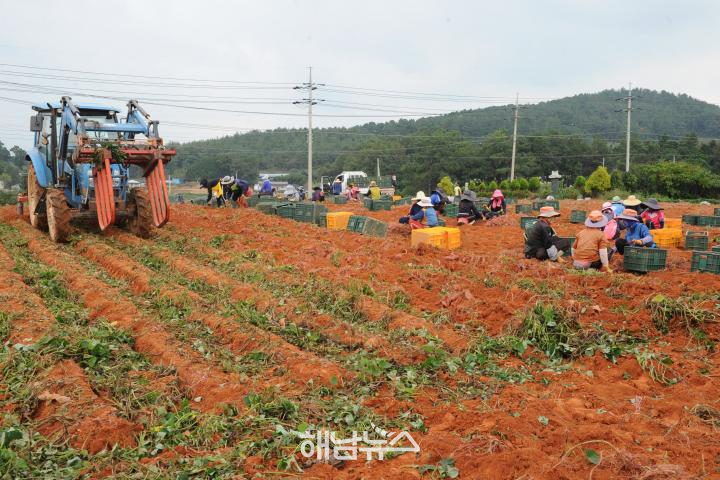 고구마 수확(부산물) / 사진제공=전남광주특별시 |
Sweet Potato Vines and Substandard Roots to Become Industrial Materials…Jeonnam-Gwangju Agricultural Research Institute Launches Upcycling Technology Project
Approximately KRW 1.3 billion to be invested over three years starting in 2026
Joint participation by the Agricultural Research Institute, Haenam Agricultural Technology Center and private companies
Mechanized system to connect vine cutting, collection, compression and transportation
Vines and leaves to be used for biochar and functional food and cosmetic ingredients
About 18,000 tons of substandard sweet potatoes generated annually to be converted into processing materials
“Beyond developing technology, the project must demonstrate benefits in collection costs, market access and farm income”
【Jeonnam-Gwangju·Haenam=Haenam News】 haenamnews@kakao.com
A resource-circulation technology project is being launched to transform discarded sweet potato vines, leaves and substandard roots into biochar, functional ingredients and processed products.
The Jeonnam-Gwangju Special Metropolitan City Agricultural Research and Extension Services announced that it will invest approximately KRW 1.3 billion over three years, beginning in 2026, in the “Sweet Potato By-product Upcycling and Industrialization Technology Development Project.”
The project will involve the Jeonnam-Gwangju Agricultural Research and Extension Services, the Haenam Agricultural Technology Center and private-sector companies. Its primary objective is to develop technology for efficiently collecting and processing sweet potato vines and to commercialize them as biochar, food and cosmetic ingredients, and processed products.
As of 2025, sweet potatoes were cultivated on approximately 5,200 hectares across the Jeonnam-Gwangju region, accounting for about 30 percent of the nation’s total cultivation area and making the region South Korea’s largest sweet potato-producing area. Based on annual domestic sweet potato production of approximately 310,000 tons, the volume of by-products, including vines and leaves, is estimated to reach about 460,000 tons.
However, sweet potato vines and leaves contain high levels of moisture and are bulky, making them difficult to collect and transport. Due to insufficient treatment facilities and limited commercial uses, a significant quantity is left in fields or discarded.
To address the problem, the Agricultural Research and Extension Services plans to develop mechanized technology and an integrated work system covering the cutting, collection, compression and transportation of sweet potato vines. The goal is to reduce labor requirements and operating costs while developing technology that can be practically applied on farms.
Collected sweet potato vines and leaves will be converted into biochar and linked to carbon-neutral agricultural policies. Biochar is a carbon-rich material produced by heating biomass under oxygen-limited conditions. When applied to soil, it can store carbon for long periods and help improve soil conditions.
The institute will also develop food and cosmetic ingredients using functional compounds found in sweet potato leaves and stems, including lutein, beta-carotene, polyphenols and chlorogenic acid. The initiative is intended to transform materials previously treated as waste into resources with new added value.
Measures will also be developed to utilize sweet potatoes that lose their commercial value during storage and distribution. An estimated 18,000 tons of substandard sweet potatoes are generated annually, with disposal costs estimated at approximately KRW 3.2 billion.
The Agricultural Research and Extension Services plans to develop technology for converting substandard sweet potatoes into food-processing materials, including powder and paste, as well as a range of processed products. It will also investigate the volume and current treatment of sweet potato by-products, analyze the cost of collecting vines and assess the market competitiveness of newly developed products.
Based on these findings, the institute intends to present standardized business-management models that farmers and companies can apply in practice.
However, the project must move beyond technology development if it is to generate meaningful income for farmers. A specific business model will be needed to address farmers’ financial burden for vine-collection machinery, collection and transportation costs, biochar production costs, the safety and effectiveness of functional ingredients, and stable market channels for processed products.
As the demonstration project will be conducted in Haenam, the country’s largest sweet potato-producing area, the project should present measurable figures showing how much each farm can save in by-product disposal costs and how much additional income can be generated through the sale of substandard sweet potatoes.
“We will establish a full-cycle utilization system, beginning with the collection of sweet potato by-products and extending to the development of biochar, functional ingredients and processed products,” said Ma Gyeong-cheol, head of the Food Crops Research Institute at the Jeonnam-Gwangju Special Metropolitan City Agricultural Research and Extension Services. “We will develop the sweet potato industry into a resource-circulation-oriented industry of the future.”
Attention is now focused on whether the project can establish a viable industrial model that converts discarded agricultural by-products into new sources of income while reducing waste-treatment burdens and carbon emissions in Haenam and other major sweet potato-producing areas.
 해남뉴스 박충배 편집 및 논설위원 news@hbcnews.kr