| “대한민국의 시작을 지우려는 시도”… 임시정부 부정은 국가 정통성에 대한 정면 도전이다 “대한민국의 시작을 지우려는 시도”… 임시정부 부정은 국가 정통성에 대한 정면 도전이다 해남뉴스 박충배 편집 및 논설위원 haenamnews@kakao.com |
| 2026년 04월 10일(금) 15:08 |
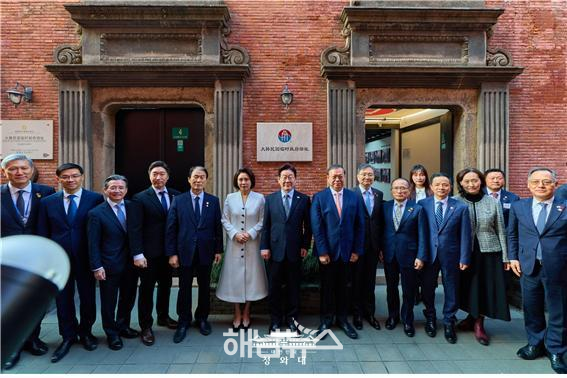 주 상하이 대한민국 총영사관 / 사진제공=청와대 |
【전남=AI호남뉴스】 aihnnews@kakao.com
1919년 4월 11일.
이날은 단순한 과거의 한 시점이 아니라, 대한민국이라는 국가가 스스로를 선언한 역사적 출발점이다.
일제의 식민지 지배 아래 국호조차 빼앗긴 상황에서, 우리 민족은 외세에 의해 규정된 존재가 아니라 스스로 국가를 구성하는 주체임을 천명했다.
대한민국임시정부는 바로 그 선언의 실체였다.
왕정이 아닌 국민 주권에 기초한 민주공화제를 채택하고, 흩어져 있던 독립운동 세력을 하나로 결집시킨 이 정부는 단순한 망명조직이 아니라 ‘국가 그 자체’였다.
영토도, 군대도, 재정도 부족했지만, 임시정부는 27년 동안 외교와 군사, 정치 활동을 이어가며 민족 독립운동의 구심점으로 기능했다.
국가는 땅이 아니라 주권 의지로 존재한다는 사실을 역사로 증명해낸 것이다.
대한민국 헌법은 “대한민국은 임시정부의 법통을 계승한다.”고 명시하고 있다.
이 문장은 단순한 선언이 아니라 대한민국의 정통성을 규정하는 헌법적 판단이다.
즉, 오늘의 대한민국은 1948년에 갑자기 등장한 국가가 아니라, 1919년 임시정부로부터 이어져 온 역사적 연속체라는 뜻이다.
그럼에도 불구하고 최근 일부에서 임시정부를 부정하거나 그 성격을 축소하려는 주장들이 반복되고 있다.
이는 단순한 학술적 견해 차이를 넘어선 문제다. 임시정부를 국가로 인정하지 않는 순간, 대한민국의 출발점은 공백 상태에 놓이게 된다. 그 공백은 곧 국가 정통성의 붕괴로 이어질 수밖에 없다.
더 심각한 문제는 이러한 주장이 독립운동 전체를 흔들 수 있다는 점이다.
임시정부를 중심으로 펼쳐진 수많은 독립운동의 의미 역시 함께 훼손되기 때문이다.
이름 없이 사라져간 수많은 독립운동가들의 희생, 망명지에서 이어진 치열한 외교전, 그리고 무장 투쟁까지 이어진 항일의 역사는 모두 임시정부라는 축 위에서 전개됐다.
이를 부정하는 것은 단순한 역사 해석이 아니라, 그들의 삶과 죽음을 무의미한 것으로 돌려버리는 행위에 가깝다.
왜 지금, 이러한 역사 부정이 반복되는가에 대한 질문도 필요하다.
임시정부의 존재를 약화시키는 논리는 결국 민주공화국의 뿌리를 흔들고, 헌법 정신을 축소시키며, 국가 정체성을 재구성하려는 시도로 이어질 가능성이 크다.
이는 과거를 둘러싼 논쟁이 아니라 현재와 미래를 둘러싼 방향성의 문제다. 역사를 어떻게 정의하느냐에 따라 국가의 기준과 가치 역시 달라지기 때문이다.
세계 어느 나라도 자신의 건국의 뿌리를 스스로 부정하지 않는다.
그것은 곧 국가 존립의 기반을 허무는 일과 다르지 않다.
대한민국 역시 마찬가지다.
1919년의 선언은 단순한 독립운동의 시작이 아니라, 민주공화국으로서의 국가 정체성을 확립한 사건이었다.
따라서 1919년 4월 11일은 단순한 기념일을 넘어 국가적 의미를 재정립해야 할 역사적 기준점이다.
임시정부의 역사적 의의는 교육과 제도 속에서 더욱 분명히 자리 잡아야 하며, 이를 부정하거나 축소하려는 어떠한 시도에도 단호하게 대응해야 한다.
대한민국은 1919년에서 시작되었다.
이 진실을 지키는 일은 과거를 위한 선택이 아니라, 대한민국이라는 국가를 지키기 위한 필수 조건이다.
【Editorial | AI Honam News】
【Jeonnam = AI Honam News】 aihnnews@kakao.com
“An Attempt to Erase the Beginning of the Republic of Korea”… Denying the Provisional Government Is a Direct Challenge to National Legitimacy
Subheading: April 11, 1919—the birth of a democratic republic… The moment its roots are shaken, the Republic of Korea itself is shaken.
April 11, 1919.
This date is not merely a moment in the past, but the historic starting point at which the Republic of Korea declared itself as a nation.
Under Japanese colonial rule, when even the country’s name had been taken away, the Korean people proclaimed that they were not subjects defined by foreign powers, but sovereign agents capable of forming their own state.
The Provisional Government of the Republic of Korea was the embodiment of that declaration.
Adopting a democratic republican system based on popular sovereignty rather than monarchy, and uniting scattered independence movements, this government was not simply a government-in-exile, but the state itself.
Though it lacked territory, military power, and financial resources, the Provisional Government functioned as the central pillar of the national independence movement for 27 years, carrying out diplomatic, military, and political activities.
It proved through history that a nation exists not by land, but by the will of its people.
The Constitution of the Republic of Korea clearly states:
“The Republic of Korea shall succeed to the legal traditions of the Provisional Government.”
This is not a rhetorical phrase, but a constitutional judgment defining the legitimacy of the nation.
In other words, today’s Republic of Korea did not suddenly emerge in 1948, but is a historical continuation rooted in the Provisional Government established in 1919.
Nevertheless, in recent times, some voices have repeatedly attempted to deny or diminish the significance of the Provisional Government.
This is not merely a difference in academic interpretation.
The moment the Provisional Government is denied as a state, the starting point of the Republic of Korea is placed in a vacuum—and that vacuum inevitably leads to the collapse of national legitimacy.
Even more troubling is that such claims risk undermining the entire history of the independence movement.
Countless independence activists, whose struggles were centered around the Provisional Government, would see their sacrifices diminished.
The unnamed individuals who perished, the desperate diplomatic efforts carried out in exile, and the armed resistance against colonial rule—all were part of a unified struggle under the Provisional Government.
To deny this is not simply reinterpretation; it is an act that renders their lives and deaths meaningless.
We must also ask why such historical denial is resurfacing now.
Arguments that weaken the Provisional Government ultimately lead to the erosion of the foundations of a democratic republic, the dilution of constitutional principles, and attempts to redefine national identity.
This is not merely a debate about the past, but a struggle over the present and the future.
How history is defined determines the standards and values of a nation.
No country in the world denies the roots of its own founding.
To do so is tantamount to dismantling the very foundation of the state.
The Republic of Korea is no exception.
The declaration of 1919 was not simply the beginning of an independence movement, but the establishment of a national identity as a democratic republic.
Therefore, April 11, 1919 must be recognized not merely as a commemorative date, but as a fundamental historical benchmark of the nation.
The significance of the Provisional Government must be firmly established in education and institutions, and any attempt to deny or diminish it must be resolutely confronted.
The Republic of Korea began in 1919.
To defend this truth is not a choice for the sake of the past—it is an essential condition for preserving the nation itself.
 해남뉴스 박충배 편집 및 논설위원 haenamnews@kakao.com