| “사리는 길 위에 있다”… 아쇼카에서 대흥사까지, 진신사리의 역사적 전승을 묻다 전설인가, 전승인가 2,600년 불교사의 흐름 속 ‘사리의 이동 경로’를 해석하다 해남뉴스 박충배 편집 및 논설위원 haenamnews@kakao.com |
| 2026년 04월 06일(월) 10:45 |
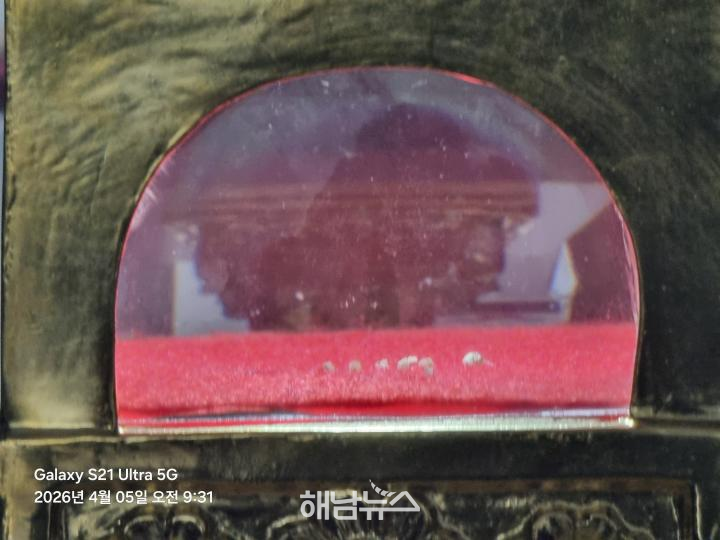 여의주봉 마니보긍에 봉안될 부처님 진신사리 / 사진제공=해남뉴스 |
[해남=해남뉴스] haenamnews@kakao.com
부처님 열반 이후, 인류는 단순한 신앙을 넘어 ‘기억을 보존하는 방식’을 선택했다.
그 상징이 바로 사리(舍利)다.
전해지는 기록에 따르면, 부처님 열반 후 인도 전역에는 여덟 개의 사리탑이 세워졌다.
이는 단순한 유물 보관이 아니라, 불법(佛法)의 중심을 공간적으로 분산시키는 최초의 종교적 정치 행위였다.
그리고 약 200년 후, 인도를 통일한 아쇼카왕(아육왕)은 이 질서를 다시 뒤집는다.
그는 기존의 8대 사리탑을 해체하고 사리를 수습한 뒤, 이를 다시 8만 4천 개의 탑으로 나누어 봉안했다는 전승이 내려온다.
이 대목은 역사와 상징이 교차하는 지점이다.
‘8만 4천’이라는 숫자는 불교에서 번뇌의 수를 의미한다.
즉, 사리의 확산은 단순한 물리적 분배가 아니라 “모든 중생에게 깨달음의 가능성을 나눈다.”는 철학적 선언이었다.
■ 사리는 어떻게 동아시아로 이동했는가.
문제는 그 다음이다.
그렇다면 이 사리들은 어떻게 인도를 넘어 중국, 그리고 한반도까지 전해졌는가.
전승에 따르면, 아쇼카왕이 세운 수많은 사리탑 중 일부는 중국으로 전해졌고, 그 중심에 ‘법문사(法門寺)’가 있다.
법문사는 ‘아육왕사(阿育王寺)’로도 불리며, 아쇼카왕과 직접 연결된 사리 신앙의 핵심 거점으로 알려져 있다.
이곳 아육왕석탑에 봉안된 사리 일부가 다시 문인 소동파에게 전해졌다는 기록은, 사리가 단순한 종교 유물이 아니라 ‘지식인 문화권’ 속에서도 전승되었음을 보여준다.
이어 이 사리는 청나라 금석학자 옹방강에게 전해지고, 그의 제자인 추사 김정희에게 이어진다.
이 지점에서 사리는 불교 신앙의 영역을 넘어, 동아시아 지성사의 흐름 속으로 들어온다.
추사 김정희는 단순한 서예가가 아니라, 금석학과 실증적 학문을 통해 유물의 진위를 탐구했던 인물이다.
그가 사리를 보관하고 전승했다는 사실은, 이 유물이 단순한 신앙의 대상이 아니라 ‘검증된 문화재적 가치’를 지녔음을 시사한다.
■ 한국 불교로 이어진 사리의 계보
이 사리는 다시 백련사의 아암 혜장 스님에게 전해지고, 이어 초의 스님으로 이어진다.
초의 스님은 차 문화와 선불교를 결합한 조선 후기의 대표적 고승으로, 사리의 보존 또한 단순한 보관이 아닌 수행의 연장선에서 이루어졌을 가능성이 크다.
이후 사리는 응송 박영희 스님에게 전해졌고, 마침내 대흥사 제7대 주지였던 지우 스님 시기에 사리탑에 봉안된다.
특히 공양간 앞 사리탑에 봉안되었다는 점은 상징적이다.
공양은 수행의 기본이며, 사리는 깨달음의 결실이다.
즉, ‘먹고 사는 일상과 깨달음의 경지’가 한 공간에서 만나는 구조가 형성된 것이다.
■ 전설과 역사 사이, 우리는 무엇을 볼 것인가
이 전승의 핵심은 ‘사리가 실제로 이동했는가.’에만 있지 않다.
오히려 더 중요한 질문은 이것이다.
왜 이 사리는 끊임없이 전해져야 했는가.
아쇼카왕의 분배, 중국으로의 이동, 지식인과 승려를 거친 전승, 그리고 대흥사 봉안까지.
이 모든 흐름은 하나의 메시지를 향하고 있다.
“깨달음은 특정 장소에 머무르지 않는다.”, 사리는 고정된 유물이 아니라, 시대와 공간을 넘어 이동하는 ‘상징적 매개체’였다.
그리고 그 이동의 경로는 곧 불교가 어떻게 전파되고, 해석되고, 재구성되어 왔는지를 보여주는 살아 있는 역사다.
결국 우리는 이 계보를 ‘사실 여부’만으로 재단할 수 없다.
그 안에는 신앙, 학문, 정치, 그리고 문화가 중첩된 동아시아 2,000년의 축적이 담겨 있기 때문이다.
지금 대흥사에 봉안된 사리 역시, 단순한 relic이 아니다.
그것은 질문이다.
“당신에게 깨달음은 어디에 있는가.”
사리는 탑 안에 있지 않다.
그것은, 전해지는 순간마다 새롭게 살아나는 길 위에 있다.
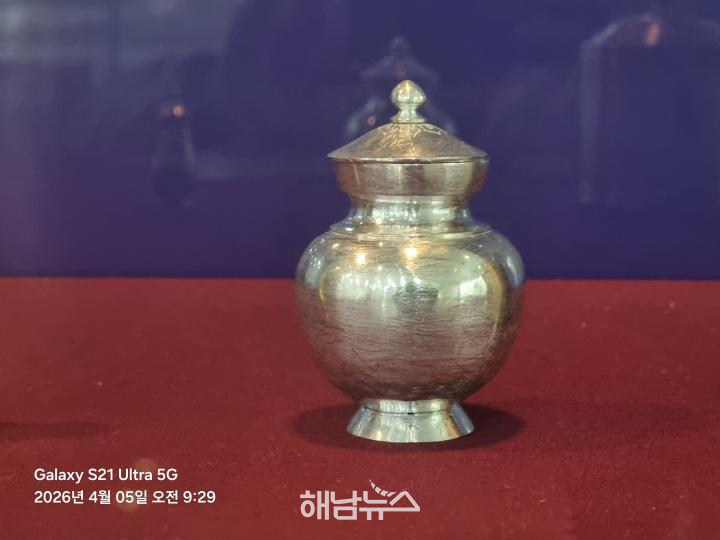 여의주봉 마니보긍에 봉안될 부처님 진신사리 함 / 사진제공=해남뉴스 |
[Column]
[Haenam = Haenam News] haenamnews@kakao.com
“The Relic Is on the Road”…
Tracing the Historical Transmission of the Buddha’s Relic from Ashoka to Daeheungsa
Legend or lineage—interpreting the path of relic transmission across 2,600 years of Buddhist history
After the Buddha’s passing, humanity chose not only to believe, but to preserve memory.
The symbol of that choice is the sarira (relic).
According to traditional accounts, eight stupas were erected across India following the Buddha’s nirvana.
This was not merely the preservation of sacred remains—it was the first religious and political act of distributing the center of the Dharma across space.
About two centuries later, Emperor Ashoka, who unified India, fundamentally reshaped this order.
He is said to have dismantled the original eight stupas, collected the relics, and redistributed them into 84,000 stupas across his empire.
Here, history and symbolism intersect.
The number “84,000” in Buddhism signifies the multitude of human afflictions.
Thus, the dissemination of relics was not a simple act of division, but a philosophical declaration:
to extend the possibility of enlightenment to all beings.
■ How Did the Relics Travel to East Asia?
The next question naturally arises:
How did these relics move beyond India to China, and eventually to the Korean Peninsula?
Tradition holds that some of the relics enshrined by Ashoka were transmitted to China, with Famen Temple (also known as Ayuwang Temple) emerging as a central site of relic veneration.
Closely associated with Ashoka, this temple became a key node in the sacred geography of relic worship.
Records suggest that a portion of the relics housed in the Ayuwang Stone Pagoda at Famen Temple was later passed on to the renowned scholar Su Dongpo.
This indicates that relics were not confined to religious institutions—they were also transmitted within the intellectual circles of East Asia.
The relic then passed to the Qing dynasty epigrapher Weng Fanggang, and subsequently to his disciple, the great Korean scholar Kim Jeong-hui (Chusa).
At this point, the relic entered not only the realm of faith but also the continuum of East Asian intellectual history.
Kim Jeong-hui was not merely a calligrapher, but a rigorous scholar of epigraphy who sought to verify the authenticity of artifacts.
His preservation and transmission of the relic suggest that it was regarded not only as an object of devotion, but as a cultural artifact of verified significance.
■ The Lineage of the Relic in Korean Buddhism
The relic was later entrusted to Monk Hyejang of Baekryeonsa Temple, and then passed on to the eminent Seon master Choui.
Choui, a central figure of late Joseon Buddhism who integrated tea culture and Zen practice, likely preserved the relic not simply as an object, but as part of spiritual discipline.
It was then transmitted to Monk Eungsong (Park Young-hee),
and ultimately enshrined during the tenure of Monk Jiu, the 7th abbot of Daeheungsa Temple.
Significantly, the relic was enshrined in a stupa located in front of the temple kitchen.
This is deeply symbolic.
Offering food is the foundation of daily practice, while relics represent the culmination of enlightenment.
In this space, the ordinary act of sustenance and the ultimate realization of awakening converge.
■ Between Legend and History: What Do We See?
The essence of this transmission is not confined to the question of whether the relic physically moved.
A more profound question emerges:
Why did the relic need to be continuously passed on?
From Ashoka’s redistribution to its journey into China, through scholars and monks, and finally to its enshrinement at Daeheungsa—
this entire trajectory conveys a single message:
“Enlightenment does not reside in one place.”
The relic is not a fixed object.
It is a symbolic medium that moves across time and space.
Its path reveals how Buddhism has been transmitted, interpreted, and reconfigured over centuries.
Thus, this lineage cannot be judged solely by historical verification.
Within it lies a layered accumulation of faith, scholarship, politics, and culture spanning two millennia of East Asian history.
The relic now enshrined at Daeheungsa is not merely a relic.
It is a question.
“Where is enlightenment for you?”
The relic does not reside within the stupa.
It lives on the road—renewed each time it is passed on.
 해남뉴스 박충배 편집 및 논설위원 haenamnews@kakao.com