| “성지의 흙으로 다시 세우는 나라의 기운”… 두륜산 여의주봉 마니보궁, 역사와 수행의 귀환 바라나시에서 쿠시나가라까지… 부처의 길을 모아 ‘호국의 탑’으로 봉안하다 해남뉴스 박충배 편집 및 논설위원 haenamnews@kakao.com |
| 2026년 04월 06일(월) 10:37 |
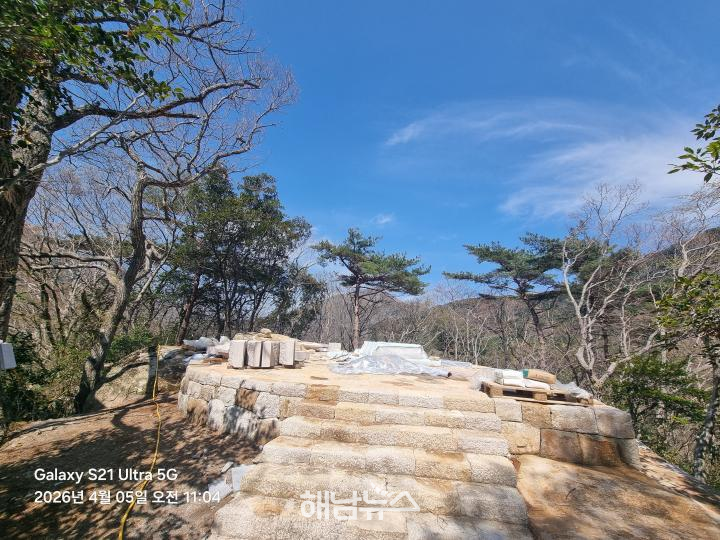 유네스코 세계문화유산 대흥사마니보궁터 / 사진제공=해남뉴스 |
【해남=해남뉴스】 haenamnews@kakao.com
바라나시에서 쿠시나가라까지… 부처의 길을 모아 ‘호국의 탑’으로 봉안하다
부처의 발자취를 따라 모은 흙이 다시 한반도의 남단, 두륜산 여의주봉에 모인다.
단순한 채취가 아니다.
이는 시간과 공간을 넘어선 ‘법의 귀환’이며, 잃어버린 기운을 되살리는 상징적 의식이다.
이번에 봉안될 유리구슬은 인류 정신사의 정점이라 할 수 있는 불교 성지 곳곳에서 채취한 흙으로 만들어진다.
부처님께서 처음 법을 설하신 바라나시 녹야원을 시작으로, 최초의 재가 제자 야사를 만난 자리, 깨달음을 이룬 보리수 아래, 그리고 깨달음 이후 49일 동안 머물며 법의 체계를 완성한 장소까지, 불교의 탄생과 전개를 관통하는 핵심 지점들이 하나로 모인다.
여기에 수행의 극한이었던 부다가야 고행림, 설법의 정수가 펼쳐졌던 왕사성 영취산, 지혜의 요람이었던 나란다 불교대학, 그리고 부처의 마지막 여정을 품은 쿠시나가라 사라쌍수 화장터까지 포함된다.
이는 단순한 유적의 흙이 아니라, 깨달음·전법·열반이라는 불교의 전 과정을 상징적으로 집약한 ‘정신의 토양’이라 할 수 있다.
특히 바아샬리 탑 인근, 원숭이가 꿀을 공양한 아쇼카왕 석주 주변, 기원정사 우물과 급고독이 심은 보리수 잎까지 더해지면서, 이 작업은 ‘성지의 총체적 집합’이라는 차원을 갖는다.
다시 말해, 이는 불교사 전체를 하나의 구슬 안에 응축하는 시도다.
이렇게 모인 흙은 유리구슬로 재탄생해 두륜산 여의주봉 마니보궁 탑에 봉안될 예정이다.
이 탑은 단순한 건축물이 아니다.
동아시아 기(氣)의 흐름 속에서 상징적 정점으로 해석되는 공간이다.
중국 쿤륜산맥에서 시작된 대지의 기운은 백두산을 거쳐 태백산맥을 따라 내려오고, 그 흐름이 두륜산 여의주봉에서 맺힌다는 풍수적 해석은 오래전부터 전해져 왔다.
그러나 일제강점기, 이 기운의 맥을 끊고 일본으로 흐르게 하려는 의도 아래 마니보궁 탑은 해체되는 비극을 겪었다.
그로부터 수십 년. 이번 복원은 단순한 문화재 재건이 아니라, 왜곡된 역사와 단절된 정신을 바로잡는 ‘회복의 의식’이다.
특히 보선조실 스님의 오랜 숙원이었던 마니보궁 복원이 현실화되면서, 이는 한 개인의 원력을 넘어 시대적 과업으로 확장되고 있다.
성지의 흙을 모아 만든 구슬을 봉안하는 행위는 상징적이면서도 깊은 철학을 담고 있다.
흙은 가장 낮은 곳에 있지만, 모든 생명의 근원이자 순환의 출발점이다.
그 흙이 다시 하나로 모여 탑이 되고, 그 탑이 나라의 기운을 지키는 ‘호국의 상징’으로 서는 것이다.
지금 두륜산에서 일어나고 있는 이 일은 단순한 불사가 아니다.
그것은 역사·신앙·민족의식이 교차하는 지점에서 이루어지는 거대한 복원이다.
잃어버린 맥을 잇고, 흩어진 법을 모으며, 다시 이 땅의 중심에 세우는 일.
여의주봉 마니보궁은 그렇게 다시, 깨어나고 있다.
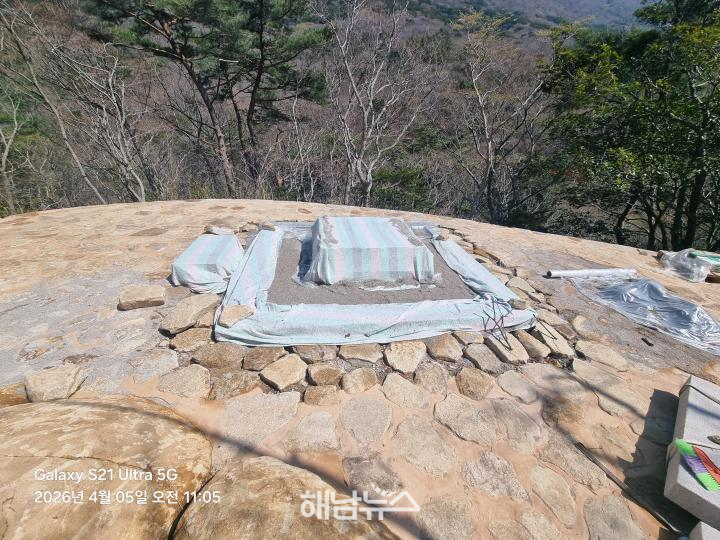 유네스코 세계문화유산 대흥사마니보궁터 / 사진제공=해남뉴스 |
[Column]
“Rebuilding the Nation’s Vital Energy with Sacred Soil”… The Return of History and Practice at Manibogung on Yeouiju Peak, Duryunsan
Subheadline: From Varanasi to Kushinagar… Gathering the Buddha’s Path into a ‘Pagoda of National Protection’
【Haenam = Haenam News】 haenamnews@kakao.com
Soil collected along the footsteps of the Buddha is now converging at Yeouiju Peak of Duryunsan, at the southern tip of the Korean Peninsula.
This is no ordinary collection.
It is a symbolic rite that transcends time and space—“the return of the Dharma”—and an act to restore a lost spiritual current.
The glass beads to be enshrined are crafted from soil gathered from key Buddhist sacred sites—places that represent the pinnacle of humanity’s spiritual history.
Beginning with Deer Park in Varanasi, where the Buddha first turned the Wheel of Dharma, the sites include the place where he met his first lay disciple Yasa, the Bodhi tree under which he attained enlightenment, and the grounds where he remained for 49 days after awakening, completing the structure of his teachings. These are the core locations that encompass the birth and unfolding of Buddhism.
Also included are the ascetic grove of Bodh Gaya, where the Buddha underwent extreme austerities; Vulture Peak in Rajgir, where profound teachings were delivered; Nalanda, the great cradle of Buddhist wisdom; and the cremation grounds beneath the twin sala trees in Kushinagar, marking the Buddha’s final journey.
This is not merely soil from historical sites—it is the “spiritual earth” that symbolically condenses the entire arc of enlightenment, teaching, and nirvana.
In addition, soil from near the Vaishali stupa, the vicinity of Emperor Ashoka’s pillar where a monkey is said to have offered honey, the well at Jetavana Monastery, and leaves from the Bodhi tree planted by Anathapindika further deepen its meaning.
In essence, this endeavor gathers the totality of Buddhist sacred geography into a single form.
It is an attempt to compress the entire history of Buddhism into one bead.
These collected soils will be transformed into glass beads and enshrined within the Manibogung Pagoda at Yeouiju Peak of Duryunsan.
This pagoda is not merely a structure.
It is understood as a symbolic apex within the flow of East Asian geomantic energy.
According to long-standing geomantic interpretations, the earth’s vital energy originates in China’s Kunlun Mountains, passes through Mount Baekdu, flows along the Taebaek mountain range, and ultimately converges at Yeouiju Peak of Duryunsan.
However, during the Japanese colonial period, the Manibogung Pagoda was dismantled in a tragic attempt to sever this flow and redirect the energy toward Japan.
Decades later, this restoration is not simply the reconstruction of a cultural site—it is a ritual of recovery, correcting distorted history and restoring a severed spiritual lineage.
In particular, the realization of the long-cherished aspiration of Venerable Boseon Josil transforms this project from a personal vow into a mission of the times.
The act of enshrining beads made from sacred soil carries profound philosophical meaning.
Soil lies at the lowest place, yet it is the origin of all life and the starting point of all cycles.
When gathered and unified, it becomes a pagoda—and that pagoda stands as a symbol of national protection, safeguarding the vital energy of the land.
What is unfolding now at Duryunsan is not merely a Buddhist undertaking.
It is a grand restoration at the intersection of history, faith, and national consciousness.
Reconnecting what was severed, gathering what was scattered, and reestablishing it at the heart of this land—
Manibogung on Yeouiju Peak is awakening once again.
 해남뉴스 박충배 편집 및 논설위원 haenamnews@kakao.com