| “광주의 관문을 갈아엎는다”… 민형배, ‘노바(NOVA) 전략’으로 군공항·송정권 초대형 미래도시 선언 공항 이전부지·송정역·금호타이어 부지 통합 재편… “기후·AI·산업·교통 결합한 대한민국 최초 미래도시 실험지 구축” 해남뉴스 박충배 편집 및 논설위원 haenamnews@kakao.com |
| 2026년 03월 30일(월) 16:37 |
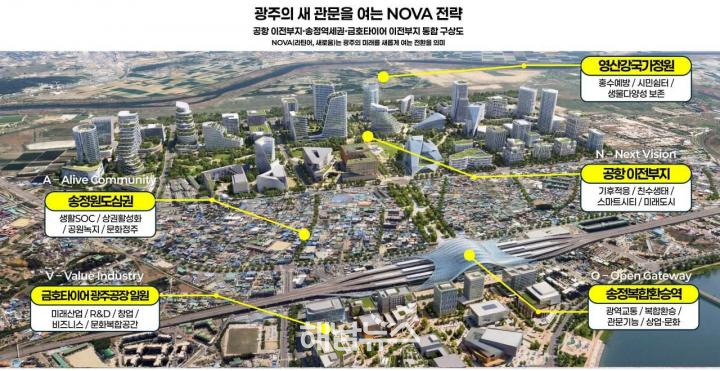 송정역·금호타이어 부지 통합 재편 / 사진제공=민형배의원실 |
전남·광주 통합특별시 구상이 ‘도시 구조 혁명’ 단계로 진입했다. 단순 개발을 넘어 도시의 기능과 흐름 자체를 재설계하는 초대형 프로젝트가 본격화된 것이다.
더불어민주당 전남·광주통합특별시장 경선 후보인 민형배 국회의원(광주 광산구을)은 29일 군공항 이전부지와 송정권 일대를 하나의 유기적 권역으로 묶는 ‘노바(NOVA) 전략’을 발표하며, 광주를 서남권 미래 관문도시로 재탄생시키겠다는 구상을 공식화했다.
민 의원은 “이제 도시 경쟁력은 개별 개발이 아닌 교통·산업·환경·생활이 결합된 통합 전략에서 나온다.”며 “광주의 첫인상을 바꾸고, 다음 100년을 여는 관문 대전환이 필요하다.”고 강조했다.
■ “개발이 아니라 구조를 바꾼다.”… 도시 패러다임 전환 선언
이번 ‘노바 전략’은 단순한 부지 개발이 아니다.
공항 이전이라는 역사적 변곡점을 계기로 ▲공간 ▲산업 ▲환경 ▲교통 ▲생활 체계를 동시에 재편하는 ‘도시 구조 혁명’에 가깝다.
특히 공항 이전으로 고도제한이 해제될 경우, 송정권 일대 전반의 입체적 도시 재구성이 가능해지며, 이를 기반으로 광주와 전남을 연결하는 서남권 관문축을 완성한다는 전략이다.
■ 4대 전략… “기후·AI·산업·생활 한 번에 묶는다.”
민 의원은 이번 구상의 핵심 실행축으로 다음 4대 전략을 제시했다.
① 공항 이전부지 = ‘미래도시 실험지’
공항 이전부지는 단순 개발지가 아닌 ‘기후 대응형 미래도시 플랫폼’으로 조성된다.
홍수 대응 저류공간 + 친수공원 + 생태복원
물순환 체계 기반 도시 설계
AI 기반 스마트시티 기술 전면 적용
특히 ‘영산강 국가정원’ 조성을 통해
홍수 대응과 생태 회복, 시민 삶의 질을 동시에 확보하는 ‘다층형 도시 모델’이 구축된다.
더 나아가 이 공간은 ▲재생에너지 ▲자율주행 ▲로봇 ▲데이터 산업 등을 실증하는 ‘기후·에너지·도시기술 특구’로 지정될 계획이다.
이는 단순 기술 도입을 넘어 도시 자체를 산업 실험 플랫폼으로 전환하는 시도라는 점에서 주목된다.
② 광주송정역 = 서남권 초대형 복합환승 허브
광주송정역 일대는 ‘지나가는 역’에서 ‘머무르는 관문’으로 탈바꿈한다.
KTX·도시철도·버스·자전거 완전 통합
상업·업무·문화 기능 결합 복합공간 조성
서남권 최대 환승 플랫폼 구축
이는 단순 교통 개선이 아닌 도시 관문 이미지 자체를 재설계하는 전략이다.
③ 금호타이어 이전부지 = 미래산업 핵심 거점
금호타이어 이전부지는 R&D·창업·비즈니스 기능이 결합된 복합 산업지구로 조성된다.
첨단 연구개발 클러스터 구축
창업·기업 성장 지원 플랫폼 조성
소촌·평동 산업단지와 연계
이를 통해 기존 제조업을 AI·첨단 산업 중심으로 전환하는 ‘산업 재편 엔진’ 역할을 맡는다.
④ 생활권 상생 재편 = “기존 도시와 함께 성장”
신규 개발과 기존 지역 간 단절을 막기 위한
‘상생형 도시 재편’도 병행된다.
생활 SOC 확충
보행환경 개선
상권 활성화
공원·문화 공간 확대
즉, 개발 이익이 특정 지역에 집중되지 않고 기존 주민과 함께 성장하는 구조를 만든다는 전략이다.
■ “광주를 배우러 오는 도시로”… 도시 자체를 산업화
이번 전략의 핵심은 단순 도시 개발이 아니다.
도시 자체를 ‘수출 가능한 모델’로 만드는 것이다.
민 의원은 “공항 이전부지를 기후위기 대응과 스마트시티를 동시에 구현하는 ‘미래도시 실험실’로 만들겠다.”며 “광주를 배우기 위해 세계가 찾아오는 도시로 전환하겠다.”고 밝혔다.
특히 시민이 참여하는 에너지·데이터 기반 수익 모델까지 도입해 도시 운영 구조 자체를 혁신하겠다는 구상이다.
■ “광주의 첫인상이 바뀐다”… 통합특별시 핵심 축 부상
‘노바 전략’은 단일 사업이 아니라 전남·광주 통합특별시 구상의 핵심 축으로 작동할 전망이다.
생태(환경)
교통(관문)
산업(일자리)
생활(정주환경)
이 네 축을 하나로 묶어 도시 경쟁력의 근본 구조를 바꾸는 장기 전략이라는 점에서 향후 정책 경쟁의 핵심 변수로 부상할 가능성이 크다.
민 의원은 “도시는 더 이상 공간이 아니라 시스템”이라며 “기후위기 대응, 산업 전환, 교통 혁신, 삶의 질 향상을 하나의 전략으로 묶어 전남·광주의 다음 100년을 여는 도시 대전환을 반드시 실현하겠다.”고 밝혔다.
“Rebuilding Gwangju’s Gateway from the Ground Up”… Rep. Min Hyung-bae Unveils ‘NOVA Strategy’ for Mega Future City Across Former Airbase and Songjeong District
Subheadline: Integrated redevelopment of airport relocation site, Gwangju Songjeong Station, and Kumho Tire site… “Korea’s first future-city testbed combining climate, AI, industry, and mobility”
【Jeonnam·Gwangju = AI Honam News】 aihnnews@kakao.com
The vision for a Gwangju–Jeonnam integrated metropolitan city has entered a phase of “urban structural revolution.” Moving beyond piecemeal development, a mega-scale project to redesign the city’s functions and flows is now underway.
Min Hyung-bae, a member of the National Assembly (Gwangju Gwangsan-eul) and a candidate in the Democratic Party primary for mayor of the proposed integrated city, announced on the 29th the “NOVA Strategy,” which integrates the former military airport relocation site and the Songjeong area into a single, cohesive district. The plan aims to transform Gwangju into a future gateway city for Southwest Korea.
Rep. Min emphasized, “Urban competitiveness now stems from integrated strategies that combine transportation, industry, environment, and daily life—not fragmented development,” adding, “We must transform Gwangju’s first impression and open a new gateway for the next 100 years.”
■ “Not development, but structural transformation”… A paradigm shift in urban planning
The NOVA Strategy is not a conventional land development project.
It represents a comprehensive “urban structural revolution,” reorganizing spatial, industrial, environmental, transportation, and lifestyle systems simultaneously—triggered by the historic turning point of airport relocation.
With the removal of height restrictions following the relocation, large-scale, three-dimensional urban restructuring across the Songjeong district becomes feasible. This will serve as the foundation for establishing a new southwestern gateway connecting Gwangju and Jeonnam.
■ Four Core Strategies… “Integrating climate, AI, industry, and life”
Rep. Min presented four key pillars for execution:
① Airport Relocation Site = “Future City Testbed”
The site will be developed into a climate-responsive urban platform rather than a conventional development zone.
Flood-control reservoirs + waterfront parks + ecological restoration
Water circulation-based urban design
Full-scale integration of AI-powered smart city technologies
In particular, the creation of the Yeongsan River National Garden will enable a multi-layered urban model that simultaneously addresses flood control, ecological recovery, and quality of life.
The area will also be designated a “Climate–Energy–Urban Technology Special Zone,” where renewable energy, autonomous mobility, robotics, and data industries are tested in real urban environments.
This marks a shift toward transforming the city itself into an industrial experimentation platform.
② Gwangju Songjeong Station = Southwest Mega Transit Hub
Gwangju Songjeong Station will be transformed from a transit point into a destination gateway.
Full integration of KTX, metro, buses, and bicycles
Development of mixed-use commercial, business, and cultural zones
Establishment of the largest multimodal transit hub in Southwest Korea
This is not merely a transportation upgrade, but a redesign of the city’s gateway identity.
③ Kumho Tire Site = Future Industry Hub
Kumho Tire site will be redeveloped into a complex industrial district combining R&D, startups, and business functions.
Advanced R&D cluster
Startup and enterprise support platforms
Linkages with existing industrial zones such as Sochon and Pyeongdong
This will serve as a key engine for transitioning traditional manufacturing into AI-driven advanced industries.
④ Shared Urban Regeneration = “Growth with Existing Communities”
To prevent disconnection between new developments and existing neighborhoods, a co-growth urban model will be implemented.
Expansion of social infrastructure (SOC)
Improved pedestrian environments
Revitalization of local commerce
Expansion of parks and cultural spaces
The goal is to ensure that development benefits are shared broadly with existing residents.
■ “A city the world comes to learn from”… Urban model as export industry
At its core, the NOVA Strategy is not just about building a city—it is about creating an exportable urban model.
Rep. Min stated, “We will turn the airport relocation site into a ‘future city laboratory’ where climate response and smart city technologies are realized simultaneously,” adding, “Gwangju will become a city the world comes to learn from.”
He also proposed introducing citizen-participatory revenue models based on energy and data, fundamentally transforming how cities operate.
■ “Gwangju’s first impression will change”… A key axis of the integrated city
The NOVA Strategy is expected to serve as a central pillar of the Gwangju–Jeonnam integrated metropolitan vision.
Ecology (environment)
Transportation (gateway)
Industry (jobs)
Living (quality of life)
By integrating these four axes, the strategy aims to fundamentally reshape urban competitiveness and emerge as a decisive factor in future policy debates.
Rep. Min concluded, “Cities are no longer just spaces—they are systems,” adding, “By integrating climate response, industrial transformation, transportation innovation, and quality of life into a single strategy, we will achieve a transformative urban leap for the next 100 years of Gwangju and Jeonnam.”
 해남뉴스 박충배 편집 및 논설위원 haenamnews@kakao.com