| “공공기관 40곳, 통합 전남·광주로” 김영록 지사, 10대 핵심기관 공식 제시… 정부에 ‘우선 이전’ 약속 이행 촉구 해남뉴스 박충배 편집 및 논설위원 haenamnews@kakao.com |
| 2026년 02월 11일(수) 15:10 |
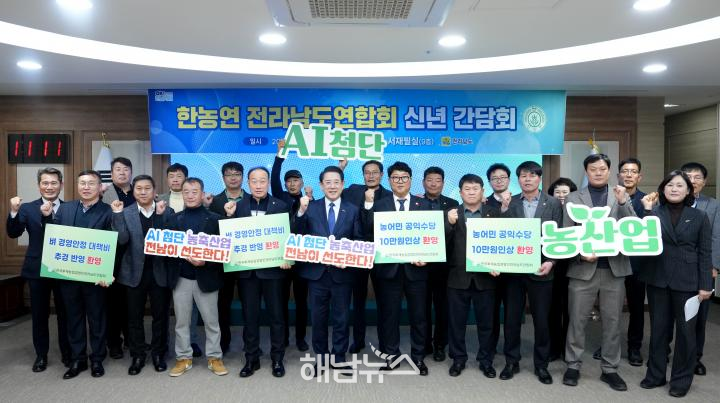 한농연 도·시군 임원진 농정발전 간담회/ 사진제공=전라남도 |
김영록 전라남도지사가 제2차 공공기관 지방이전을 앞두고 전남·광주 공동 유치 목표 공공기관을 공식 발표하며 정부의 결단을 촉구했다.
김 지사는 11일 전남도청 브리핑룸에서 기자회견을 열고 전남·광주가 전략적으로 유치해야 할 핵심 공공기관 10곳을 제시했다.
동시에 추가 30개 기관을 더해 총 40개 기관을 목표로 정부에 요구하겠다는 방침도 밝혔다.
이번 발표는 정부가 2027년부터 제2차 공공기관 이전을 본격 추진하겠다고 밝힌 데 따른 선제적 대응이다.
특히 전남·광주 행정통합 논의가 입법 단계로 접어든 상황에서, 통합 권역에 대한 공공기관 우선 이전 약속을 반드시 이행해야 한다는 점을 분명히 한 것이다.
전남도는 광주광역시와 함께 미래 발전 전략을 5개 기능 군으로 정리해 유치 방향을 설정했다.
에너지·환경, 농수산, AI 등 첨단산업, 문화예술, 사회서비스 분야가 그 축이다.
김 지사는 “공공기관 이전은 단순한 지역 안배가 아니라 산업 생태계를 완성하는 국가 전략”이라며 “전남·광주는 이미 산업 기반과 정책 역량을 갖춘 준비된 지역”이라고 강조했다.
이번에 제시된 10대 핵심 기관은 농협중앙회, 한국지역난방공사, 한국마사회, 한국환경공단, 국토교통과학기술진흥원, 한국산업기술진흥원, 한국공항공사, 수협중앙회, 한국에너지기술평가원, 한국데이터산업진흥원 등이다.
김 지사는 각 기관의 이전 필요성을 구체적으로 설명했다.
전남은 전국 최대 농업 기반을 보유한 지역으로, 이미 한국농어촌공사와 한국농수산식품유통공사 등 농생명 공공기관이 자리 잡고 있다.
농협중앙회가 이전할 경우 농업·금융·유통 기능이 집적화되며 국가 농생명 클러스터 완성에 결정적 역할을 할 수 있다는 주장이다.
에너지 분야 역시 전남의 강점이다.
재생에너지 잠재량 444GW로 전국 최고 수준이며, 도 전역이 분산에너지 특구로 지정돼 있다.
김 지사는 “AI와 반도체 산업의 핵심은 전력”이라며 “생산부터 저장, 평가, 효율화까지 에너지 전주기 생태계를 완성해야 한다.”고 밝혔다.
한국마사회의 경우 전남이 2029년까지 말(馬) 산업 기반 구축을 목표로 승마산업 생태계를 조성하고 있으나, 호남권에는 경마공원이 없어 산업 확장에 제약이 있다는 점을 강조했다.
또한 한국공항공사와 수협중앙회는 무안국제공항과 전국 최대 해양·수산 자원을 갖춘 전남의 산업 구조와 밀접하게 연결된 기관으로, 지역 전략과의 정합성이 높다는 설명이다.
김 지사는 이날 가장 강한 어조로 정부의 책임을 언급했다.
“정부는 통합특별시에 공공기관을 우선 이전하겠다고 약속했다.”며 “이제는 선언이 아니라 실행으로 보여줘야 한다.”고 말했다.
전남·광주 통합 논의가 현실화되는 가운데, 공공기관 이전은 단순한 유치 경쟁을 넘어 통합 권역의 산업 구조와 경제 지형을 재편할 핵심 변수로 떠오르고 있다.
김 지사는 “전남·광주는 준비가 끝난 지역”이라며 “정부의 전략적 결단이 국가 균형발전의 방향을 결정할 것”이라고 강조했다.
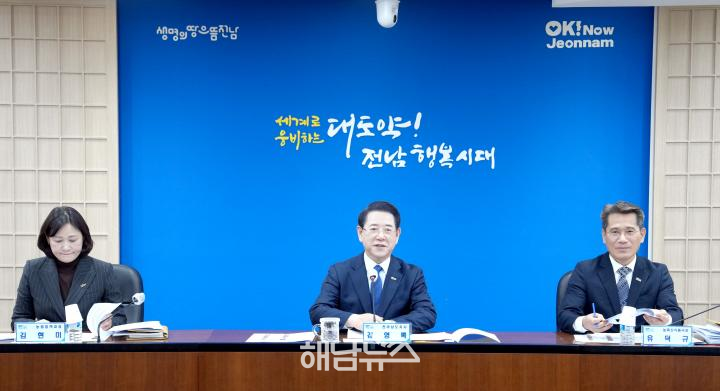 한농연 도·시군 임원진 농정발전 간담회/ 사진제공=전라남도 |
[Jeonnam = Haenam News] haenamnews@kakao.com
“Relocate 40 Public Institutions to Integrated Jeonnam–Gwangju”
Governor Kim Young-rok Presents 10 Key Target Agencies, Urges Government to Honor “Priority Relocation” Pledge
김영록 Governor of South Jeolla Province (Jeonnam) has officially announced a joint bid by Jeonnam and Gwangju to attract major public institutions ahead of the second round of public-sector relocations, calling on the central government to make a decisive commitment.
At a press conference held on the 11th at the Jeonnam Provincial Government briefing room, Governor Kim unveiled a list of 10 key public institutions that Jeonnam and Gwangju aim to strategically attract. He also stated that the region would seek the relocation of an additional 30 institutions, setting a total target of 40 agencies.
The announcement comes as a preemptive response to the government’s plan to begin the second phase of public institution relocations in 2027. In particular, with discussions on the administrative integration of Jeonnam and Gwangju now entering the legislative stage, Kim emphasized that the government must honor its pledge to give priority relocation status to the integrated region.
Jeonnam Province, in cooperation with Gwangju Metropolitan City, has identified five strategic sectors to guide its relocation efforts: energy and environment; agriculture and fisheries; advanced industries such as artificial intelligence (AI); culture and the arts; and social services.
“Relocating public institutions is not merely a matter of regional distribution,” Governor Kim said. “It is a national strategy to complete industrial ecosystems. Jeonnam and Gwangju are fully prepared regions with established industrial foundations and policy capabilities.”
The 10 key institutions proposed for relocation are:
농협중앙회 (National Agricultural Cooperative Federation)
한국지역난방공사 (Korea District Heating Corporation)
한국마사회 (Korea Racing Authority)
한국환경공단 (Korea Environment Corporation)
국토교통과학기술진흥원 (Korea Agency for Infrastructure Technology Advancement)
한국산업기술진흥원 (Korea Institute for Advancement of Technology)
한국공항공사 (Korea Airports Corporation)
수협중앙회 (National Federation of Fisheries Cooperatives)
한국에너지기술평가원 (Korea Institute of Energy Technology Evaluation and Planning)
한국데이터산업진흥원 (Korea Data Agency)
Governor Kim elaborated on the rationale for each institution’s relocation. Jeonnam is the nation’s largest agricultural region and already hosts major agro-related public institutions such as the 한국농어촌공사 (Korea Rural Community Corporation) and the 한국농수산식품유통공사 (Korea Agro-Fisheries & Food Trade Corporation). Relocating the National Agricultural Cooperative Federation would consolidate agriculture, finance, and distribution functions, completing a national agri-bio cluster, he argued.
Energy is another key strength. Jeonnam has the highest renewable energy potential in the country, estimated at 444GW, and the entire province has been designated as a distributed energy special zone. “The core of AI and semiconductor industries is electricity,” Kim said. “We must build a full-cycle energy ecosystem—from production and storage to evaluation and efficiency.”
Regarding the Korea Racing Authority, Kim noted that Jeonnam aims to establish a robust equine industry ecosystem by 2029, yet the Honam region lacks a racetrack, limiting industrial expansion. He also emphasized that the Korea Airports Corporation and the National Federation of Fisheries Cooperatives are closely aligned with Jeonnam’s industrial structure, given Muan International Airport and the province’s status as the nation’s largest marine and fisheries base.
In his strongest remarks, Governor Kim directly addressed the government’s responsibility. “The government promised priority relocation of public institutions to the integrated special city,” he said. “Now is the time to demonstrate action, not just declarations.”
As discussions on the integration of Jeonnam and Gwangju gain momentum, the relocation of public institutions is emerging as a critical factor in reshaping the industrial structure and economic landscape of the integrated region. “Jeonnam and Gwangju are fully prepared,” Kim concluded. “The government’s strategic decision will determine the direction of balanced national development.”
 해남뉴스 박충배 편집 및 논설위원 haenamnews@kakao.com