| 반도체가 인구를 부른다 광주·전남, ‘3축 반도체 클러스터’로 400만 특별시 문 연다 해남뉴스 박충배 편집 및 논설위원 haenamnews@kakao.com |
| 2026년 02월 02일(월) 11:31 |
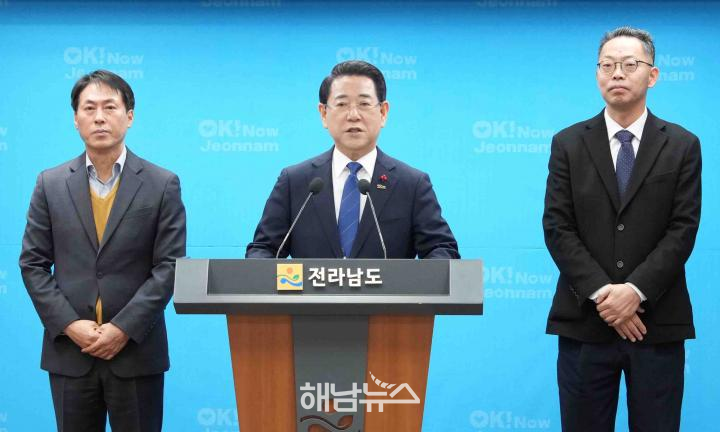 전남·광주 반도체 3축 클러스터 비전 발표 /사진제공=전라남도 |
인구 400만 전남광주특별시 대 부흥 시대를 여는 광주·전남 반도체 3축 클러스터 구축이 가시권에 들어왔다.
반도체 산업의 핵심 조건인 물·전기·인재를 동시에 갖춘 지역 경쟁력이 중앙정부와 산업계의 주목을 받으면서, 광주·전남이 국가 반도체 지형을 바꿀 전략 거점으로 급부상하고 있다.
전라남도에 따르면 최근 중앙정부로부터 반도체 산업의 ‘생명줄’인 용수 확보 가능 여부에 대한 문의가 이어졌고, 전남도는 필요량을 충족하고도 남는 공급 능력을 명확히 제시했다.
수도권의 물·전력 병목이 현실화되는 가운데, 광주·전남의 인프라 경쟁력이 다시 부각된 셈이다.
이런 흐름 속에 김영록 전라남도지사는 2일 도청 브리핑룸에서 ‘반도체로 여는 인구 400만 전남광주특별시 대부흥 시대’를 선언하며 광주·전남 반도체 3축 클러스터 비전을 공식 발표했다.
■ “핵심 열쇠는 반도체… 대통합 대 부흥을 열겠다.”
김 지사는 “기업이 오고 일자리가 늘고 청년이 머무는 구조를 만들 핵심 열쇠는 반도체 산업”이라며 “광주·전남 3축 클러스터 조성으로 전남광주특별시의 대통합 대부흥 시대를 힘차게 열겠다.”고 강조했다.
글로벌 반도체 패권 경쟁이 격화되는 상황에서, 각국은 수도권을 벗어난 지역에 반도체 생태계를 구축하고 있다.
대만은 타이중·타이난, 일본은 홋카이도·구마모토가 그 사례다.
반면 국내는 수도권 집중으로 물·전력 확보의 구조적 한계가 뚜렷하다는 지적이 이어져 왔다.
김 지사는 “지역 균형발전을 반영한 반도체 클러스터 지정과 예타 우선·면제 특례를 담은 반도체 특별법이 국회를 통과했다.”며 “이제 물·전기·인재를 모두 갖춘 광주·전남이 국가 반도체 전략의 최적지”라고 밝혔다.
■ 3축 클러스터 구상… ‘역할 분담’으로 완결형 생태계
이번 비전의 핵심은 권역별 강점을 살린 3축 분업 구조다.
광주권은 인재와 기술의 중심이다.
전남대·조선대·목포대·순천대 등 17개 대학에서 연 3만 1천 명의 반도체 인재가 배출되고, 한국에너지공대와 광주과학기술원의 Arm 스쿨이 연구 저변을 받친다.
광주 군공항 이전 부지 100만 평에는 ‘첨단 융복합산업 콤플렉스’를 조성해 글로벌 반도체 기업·대학 공동연구와 테스트베드의 핵심 거점으로 육성한다.
광주·장성 첨단산단은 첨단 패키징 클러스터로 특화해 설계부터 후 공정까지 연결한다.
전남 서부권은 생산 인프라의 핵심이다.
솔라시도 기업도시는 영암호·금호호·영산강호를 통해 반도체 팹 6기 기준 107만 톤의 용수를 안정적으로 공급할 수 있다.
전력망은 2027년 154kV, 2029년 345kV 구축이 완료되고, 태양광 5.4GW(2030), 해상풍력 12.1GW(2035) 등 총 17.5GW의 발전 인프라가 확충된다. RE100을 충족하는 값싼 전기와 무안국제공항을 통한 항공 물류도 강점이다.
전남 동부권은 소부장과 미래산업의 결절점이다.
석유화학·철강 기반의 촘촘한 소부장 기업군을 반도체 분야로 전환해, 공급–제조–완결이 한 권역에서 이뤄지는 구조를 만든다.
순천·여수·광양만권 120만 평 RE100 미래첨단산업 복합 콤플렉스에 반도체가 더해지면, 피지컬 AI 생태계와 함께 반도체(두뇌)–이차전지(심장)가 결합한 미래산업 요람이 형성된다.
■ “산업의 물길을 바꾼다… 수도권 1극 넘어 균형발전”
김 지사는 “광주와 전남은 물과 전기, 인재와 기술, 소부장과 물류를 모두 연결할 수 있는 준비된 지역”이라며 “반도체 3축 클러스터로 대한민국 산업의 물길을 돌리고, 수도권 1극 체제를 넘어 균형발전의 새 지평을 열겠다.”고 밝혔다.
광주·전남 반도체 3축 클러스터는 단순한 산업 유치가 아니라 인구·일자리·정주 여건을 동시에 끌어올리는 구조 전환을 겨냥한다.
반도체가 인구를 부르고, 인구가 도시의 미래를 지탱하는 전남광주특별시 대 부흥의 시험대가 본격적으로 열리고 있다.
Jeonnam = Haenam News]
haenamnews@kakao.com
Semiconductors Attract Population
Gwangju–Jeonnam to Open the Era of a 4-Million-People Special Metropolitan City with a ‘Three-Axis Semiconductor Cluster’
The construction of a three-axis semiconductor cluster in Gwangju and Jeonnam, which will usher in a new era of prosperity for a 4-million-population Gwangju–Jeonnam Special Metropolitan City, is now within reach.
As the region simultaneously secures the semiconductor industry’s core requirements—water, electricity, and talent—its competitiveness has drawn strong attention from the central government and industry alike. Gwangju–Jeonnam is rapidly emerging as a strategic hub capable of reshaping South Korea’s semiconductor landscape.
According to Jeonnam Province, the central government has recently made repeated inquiries regarding the availability of industrial water—the “lifeline” of semiconductor production. The province clearly demonstrated that it can supply more than the required volume, underscoring its advantage.
With water and power bottlenecks in the Seoul metropolitan area becoming increasingly evident, the infrastructure strengths of Gwangju–Jeonnam are once again in the spotlight.
Against this backdrop, Governor Kim Young-rok of Jeollanam-do on the 2nd announced the vision of “Opening the Era of a 4-Million-Population Gwangju–Jeonnam Special Metropolitan City Through Semiconductors” at a press briefing in the provincial government complex, officially unveiling the Gwangju–Jeonnam Three-Axis Semiconductor Cluster Vision.
■ “Semiconductors Are the Key… We Will Open an Era of Grand Integration and Prosperity”
Governor Kim stated, “The key to building a structure where companies arrive, jobs increase, and young people choose to stay is the semiconductor industry,” adding, “By developing the three-axis cluster, we will powerfully open an era of grand integration and prosperity for the Gwangju–Jeonnam Special Metropolitan City.”
As global competition for semiconductor leadership intensifies, countries are deliberately building semiconductor ecosystems outside their capitals. Taiwan has focused on Taichung and Tainan, while Japan has invested in Hokkaido and Kumamoto.
In contrast, South Korea’s heavy concentration in the Seoul area has exposed structural limits in securing water and electricity.
Governor Kim noted, “A special semiconductor law—reflecting balanced regional development and including preferential or exempted preliminary feasibility reviews—has passed the National Assembly,” emphasizing that “Gwangju–Jeonnam, which possesses water, power, and talent, is the optimal site for Korea’s national semiconductor strategy.”
■ Three-Axis Cluster Plan… A Complete Ecosystem Through Role Specialization
The core of the vision lies in a three-axis division of roles that leverages the strengths of each region.
The Gwangju area will serve as the center of talent and technology. Seventeen universities—including Chonnam National University, Chosun University, Mokpo National University, and Sunchon National University—produce about 31,000 semiconductor-related graduates annually. Research capacity is reinforced by the Korea Institute of Energy Technology (KENTECH) and the Arm School at Gwangju Institute of Science and Technology (GIST).
A one-million-pyeong Advanced Convergence Industry Complex will be developed on the former Gwangju military airport site as a global hub for joint research and testbeds involving semiconductor firms and universities. The Gwangju–Jangseong Advanced Industrial Complex will be specialized as an advanced packaging cluster, linking design to back-end processes.
The western Jeonnam area will be the core of production infrastructure. The Solaseado enterprise city can stably supply 1.07 million tons of industrial water, sufficient for six semiconductor fabs, from the Yeongam, Geumho, and Yeongsan reservoirs.
Power grids will be completed at 154 kV by 2027 and 345 kV by 2029, alongside expanded generation capacity—5.4 GW of solar power by 2030 and 12.1 GW of offshore wind by 2035, totaling 17.5 GW. Affordable electricity that meets RE100 requirements and air logistics via Muan International Airport further strengthen competitiveness.
The eastern Jeonnam area will act as a nexus for materials, parts, and equipment (MPE) and future industries. Dense networks of petrochemical and steel-based MPE firms can transition into semiconductor supply chains, enabling end-to-end completion—from supply to fabrication—within a single region.
If semiconductors are added to the 1.2-million-pyeong RE100 Future Advanced Industry Complex in the Suncheon–Yeosu–Gwangyang Bay area, a physical AI ecosystem will emerge, forming a cradle for future industries where semiconductors (the “brain”) and secondary batteries (the “heart”) are integrated.
■ “Redirecting the Flow of Industry… Beyond a One-Pole Capital Region to Balanced Growth”
Governor Kim concluded, “Gwangju and Jeonnam are prepared regions that can connect water and electricity, talent and technology, materials and logistics,” adding, “With the three-axis semiconductor cluster, we will redirect the flow of Korea’s industry, move beyond the capital-centric one-pole system, and open a new horizon of balanced national development.”
The Gwangju–Jeonnam three-axis semiconductor cluster is not merely an industrial attraction strategy; it targets a structural transformation that simultaneously elevates population, jobs, and quality of life.
As semiconductors draw people—and people sustain cities—the testing ground for the grand prosperity of the Gwangju–Jeonnam Special Metropolitan City is now fully underway.
 해남뉴스 박충배 편집 및 논설위원 haenamnews@kakao.com