| “사람은 도시로 간다—그 유출을 막을 대책은 있는가?” 광주·전남 통합을 추진하는 지역의원들에게 보내는 최종 질문 해남뉴스 박충배 편집 및 논설위원 haenamnews@kakao.com |
| 2026년 01월 20일(화) 13:10 |
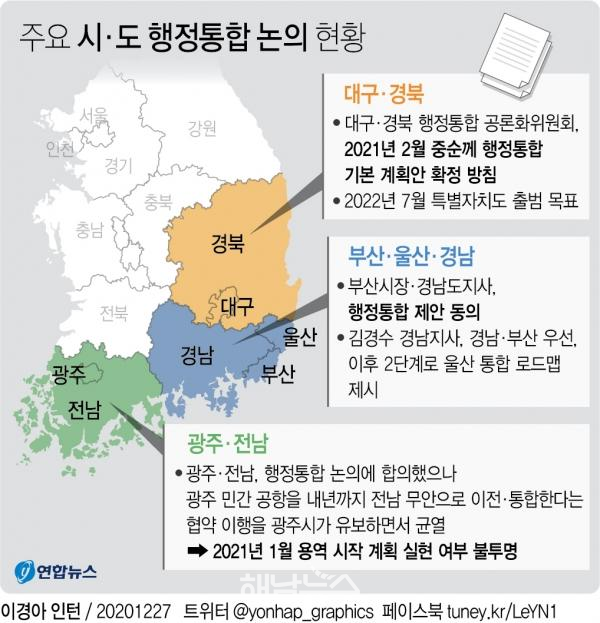 전국 시도 통합 계획도 / 사진제공=해남뉴스 |
광주·전남 행정통합이 ‘미래 전략’이라는 이름으로 추진되고 있다.
그러나 지금 이 논의에서 가장 본질적인 전제가 빠져 있다.
사람은 어디로 이동하는가, 그리고 그 이동을 되돌릴 수 있는가라는 질문이다.
인구 이동의 방향은 이미 정해져 있다.
청년과 생산인구는 대도시로 이동하고, 일자리·교육·의료·문화가 집중된 곳으로 쏠림은 가속된다.
이는 정책 실패가 아니라, 구조적 중력이다.
문제는 통합 논의가 이 현실을 전제로 설계되고 있는가다.
통합은 ‘인구 흡인력’을 더 키운다.—문제는 방향이다
광주·전남이 하나의 광역 단위가 되면, 행정·재정·산업의 중심은 더 선명해진다.
그리고 그 중심은 대도시가 된다.
통합이 곧바로 광주라는 단일 흡인 중심을 강화한다면, 해남·완도·진도 같은 군 단위 지역은 지금보다 더 빠른 속도로 인구를 잃게 된다.
이것은 가정이 아니라, 이미 다른 광역 통합과 대도시 중심 정책에서 반복된 결과다.
지역의원들에게 묻는다.
대도시로의 인구 유입이 뚜렷해질 것이라는 사실을 알고 있는가.
그렇다면, 그 유출을 막거나 되돌릴 대책을 가지고 있는가.
“통합하면 기회가 생긴다.”는 말의 공백, 통합을 지지하는 쪽은 말한다.
“광역 경쟁력이 커지면 기회가 생긴다.”고. 그러나 지역은 묻는다.
그 기회는 어디에 생기는가.
광역청사, 공공기관, 대기업 연계 산업, 연구 인프라가 대도시에 집중될 때, 군 단위 지역은 생활권이 아닌 통근권, 정주지가 아닌 배후 공간으로 전락한다.
이 구조에서 청년은 선택한다.
출퇴근이 아니라 이주를.
통근이 아니라 전출을.
통합이 이 흐름을 더 빠르게 만들 가능성에 대해, 지금의 논의는 침묵하고 있다.
인구 유출을 막는 전략 없는 통합은 ‘정책 방기’다
인구감소의 가장 큰 원인은 분명하다.
산업과 일자리 부족이다.
그 다음이 주거, 의료·돌봄이다.
대도시가 이 세 가지를 독점하는 구조를 그대로 둔 채 행정만 합치는 통합은, 사실상 “사람은 도시로 가도 어쩔 수 없다”는 선언과 다르지 않다.
그렇다면 지역의원들은 답해야 한다.
통합 이후 해남·완도·진도에 남을 수 있는 일자리는 무엇인가.
대도시로 이동하지 않아도 동등한 의료·교육·돌봄 접근권이 보장되는가.
광역 예산과 권한이 기능 분산으로 설계되는가, 아니면 중심 집중으로 흐르는가.
이 질문에 대한 답이 없다면, 통합은 전략이 아니라 포기다.
통합의 성패는 ‘인구의 방향’으로 판가름 난다.
광주·전남 통합의 성공 여부는 행정 효율이나 조직 개편으로 판단되지 않는다.
5년 뒤, 해남·완도·진도에 사람이 남아 있는가.
청년이 돌아오거나, 최소한 떠나지 않는가.
만약 통합 이후 대도시로의 인구 유입만 더 뚜렷해지고 군 단위 지역이 더 빨리 비어간다면, 그 통합은 역사적으로 이렇게 기록될 것이다.
“지방소멸을 알면서도, 막지 않은 통합.”
지역의원 여러분.
대도시로 인구가 몰릴 것이라는 사실은 이미 모두가 알고 있다.
이제 남은 질문은 하나다.
그 유출을 막을 준비가 되어 있는가.
없다면, 지금의 통합은 멈춰야 한다.
강조한다.
통합이 해답이라면, 인구의 방향부터 바꿔라.
그 답을 제시하지 못하는 통합은 지방을 살리는 정책이 아니라, 지방을 정리하는 결정일 뿐이다.
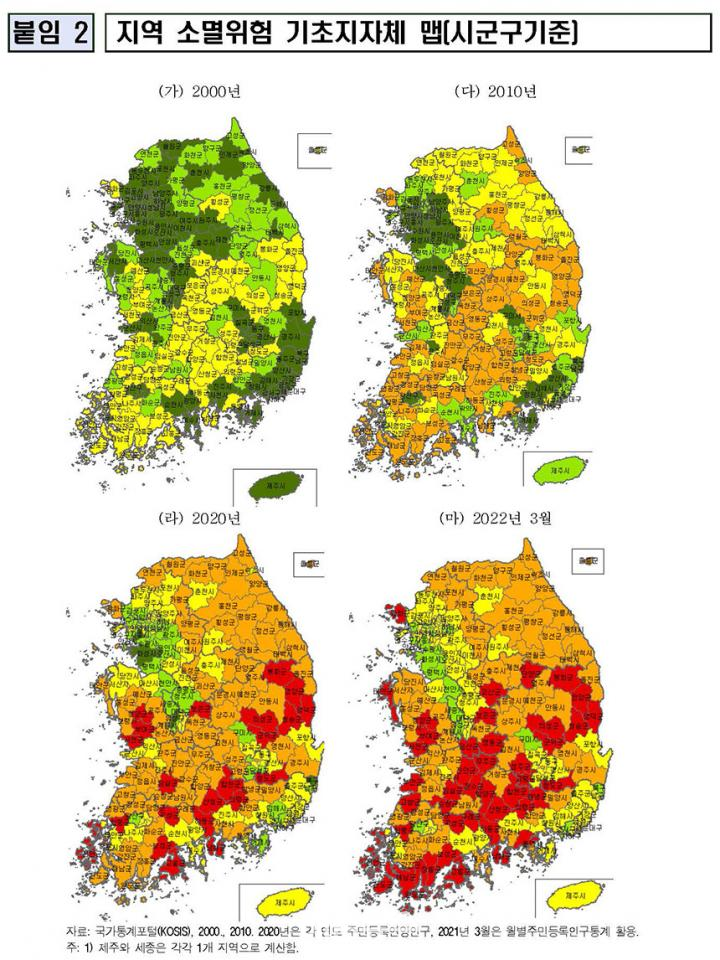 인구소멸 지방자치제 맵(시군구 기준) / 사진제공=해남뉴스 |
[Haenam = Haenam News] haenamnews@kakao.com
**“People Move to Cities — Do You Have a Plan to Stop the Outflow?”
— A Final Question to Local Assembly Members Pushing the Gwangju–Jeonnam Integration**
The administrative integration of Gwangju and Jeonnam is being promoted under the banner of a “future strategy.”
Yet the most fundamental premise is missing from this debate.
Where do people move, and can that movement be reversed?
The direction of population movement is already set.
Young people and the working-age population move toward large cities, and the concentration of jobs, education, healthcare, and culture only accelerates this flow.
This is not a policy failure in itself; it is structural gravity.
The real question is whether the integration plan has been designed with this reality as its starting point.
Integration Increases “Population Pull” — The Problem Is the Direction
If Gwangju and Jeonnam become a single metropolitan unit, the centers of administration, finance, and industry will become even clearer.
And that center will inevitably be the large city.
If integration simply strengthens Gwangju as a single gravitational core, county-level regions such as Haenam, Wando, and Jindo will lose population at a faster pace than they do now.
This is not a hypothetical scenario.
It is a result repeatedly observed in other metropolitan integrations and city-centered development policies.
So we ask local assembly members directly:
Do you recognize that population inflow into large cities will become even more pronounced?
And if so, do you have any measures to stop or reverse that outflow?
The Empty Space Behind “Integration Creates Opportunity”
Supporters of integration often say,
“Expanding metropolitan competitiveness will create opportunities.”
But local communities ask a more precise question:
Where will those opportunities be created?
When metropolitan government buildings, public institutions, large corporate-linked industries, and research infrastructure concentrate in the city, county-level regions are reduced to commuting zones rather than living spaces, to hinterlands rather than places of settlement.
Within this structure, young people make a rational choice:
not commuting, but relocation;
not temporary movement, but out-migration.
Yet the current integration debate remains silent on the possibility that this trend will only accelerate.
Integration Without a Strategy to Stop Population Outflow Is Policy Abandonment
The primary cause of population decline is clear:
a lack of industry and jobs.
Next come housing, and then healthcare and care services.
An integration that simply merges administrative systems while leaving a structure in which large cities monopolize jobs, housing quality, and medical services is effectively a declaration that
“people moving to cities is unavoidable.”
If that is not the intent, then local assembly members must answer:
What kinds of jobs will allow people to remain in Haenam, Wando, and Jindo after integration?
Will residents be guaranteed equal access to healthcare, education, and care services without having to move to a large city?
Will metropolitan budgets and authority be designed around functional decentralization, or will they inevitably flow toward central concentration?
If there are no answers to these questions, then integration is not a strategy — it is surrender.
The Success or Failure of Integration Will Be Decided by the Direction of Population
The success of Gwangju–Jeonnam integration will not be judged by administrative efficiency or organizational restructuring.
It will be judged by this:
Five years from now, will people still be living in Haenam, Wando, and Jindo?
Will young people return — or at least stop leaving?
If, after integration, population inflow into large cities becomes even stronger while county-level regions empty out more rapidly, history will record this integration in a single sentence:
“An integration that recognized regional extinction, yet failed to stop it.”
To the local assembly members:
Everyone already knows that people will continue to be drawn toward large cities.
Only one question remains.
Are you prepared to stop that outflow?
If not, this integration should be halted.
We emphasize this clearly:
If integration is truly the answer, change the direction of population first.
An integration that cannot present that answer is not a policy to save local regions —
it is a decision to quietly dismantle them.
 해남뉴스 박충배 편집 및 논설위원 haenamnews@kakao.com