| “崑崙山 大芚寺” — 대흥사는 왜 스스로를 곤륜이라 불렀는가 — 해남뉴스 박충배 편집 및 논설위원 haenamnews@kakao.com |
| 2025년 12월 16일(화) 17:23 |
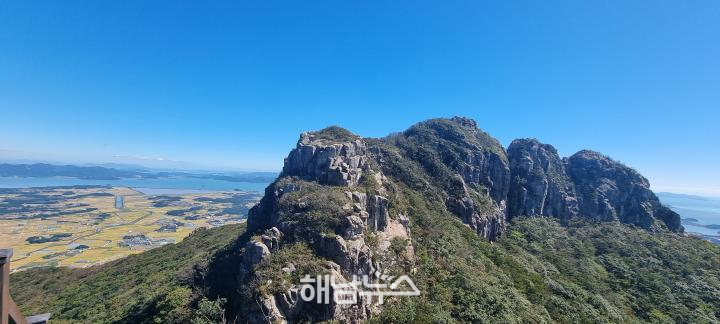 세계문화유산 대흥사 가련봉 / 사진제공=해남뉴스 |
박충배 편집/칼럼/논설
해남 두륜산 대흥사를 우리는 흔히 “남도의 큰 절”이라 부른다.
그러나 조선 후기 대흥사 승려들이 직접 남긴 기록, 『대둔사지(大芚寺志)』를 펼치는 순간 이 익숙한 인식은 단번에 흔들린다.
그 책 속에서 이 사찰은 자신을 이렇게 부른다.
“崑崙山 大芚寺.”
곤륜산 대둔사. 이 한 줄은 단순한 미사여구가 아니다.
그것은 대흥사가 스스로를 세계 속에 어떻게 위치 지었는지를 보여주는, 분명한 선언문이다.
『대둔사지』는 처음부터 “대흥사”보다 “대둔사”라는 이름을 앞세운다.
기록 곳곳에는 “해남 대둔사(大芚寺, 곧 대흥사)”라는 식의 병기가 반복된다.
이는 이 절이 이름을 몰라서가 아니라, 의도적으로 명칭의 층위를 구분했음을 뜻한다.
대흥사라는 이름이 국가와 행정의 언어라면, 대둔사는 산과 법맥, 수행의 세계를 포괄하는 자기 정체성의 이름이었다.
이 ‘대둔’이라는 명칭은 곧바로 산으로 이어진다.
『대둔사지』의 산세 묘사는 매우 독특하다.
오른쪽에는 가련봉, 왼쪽에는 두륜봉이 서 있고, 아홉 굽이의 계곡은 “해와 달이 드나드는 문”에 비유된다.
이는 아름다운 풍경을 묘사한 문장이 아니다.
두륜(頭輪)이라는 말 자체가 ‘머리’와 ‘회전·완결’을 뜻하는 글자를 결합한 상징어이며, 구곡과 일월의 이미지는 동아시아 전통에서 성산(聖山)에만 허락된 표현이다.
두륜산은 단순한 지방의 산이 아니라, 우주의 질서가 응축된 공간으로 서술된다.
이러한 공간 인식은 곧 법맥의 문제로 이어진다. 『대둔사지』에서 가장 반복적으로 강조되는 문장 중 하나는 “대둔사는 법맥이 귀결되는 곳”이라는 표현이다.
법맥은 단순한 스승과 제자의 계보가 아니다.
그것은 불교 정통성이 흘러 내려오는 생명선이며, ‘귀결된다.’는 말은 이곳이 단순한 중간 경유지가 아니라 마지막으로 모이는 중심임을 뜻한다.
대흥사는 스스로를 남도 불교의 말단이 아니라, 오히려 법맥이 완성되는 지점으로 설정하고 있다.
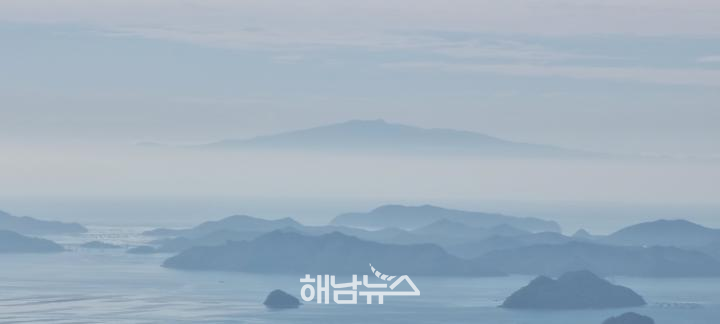 대흥사 가련봉에서 보이는 한라산 / 사진제공=해남뉴스 |
이러한 인식은 불법 전래 서사에서 절정에 이른다.
『대둔사지』는 불법이 동쪽으로 전래되어 팔도에 두루 퍼졌다고 말한 뒤, 그 가운데 첫째 되는 곳이 해남 대둔사라고 적는다.
이는 역사적 연표를 주장하는 문장이 아니다.
그것은 대흥사가 자신을 불교사의 ‘출발점’이 아니라 ‘완결점’에 배치하고 있음을 보여주는 상징적 서술이다.
불법은 북쪽에서 시작해 남쪽 끝에서 마무리되며, 그 마지막 자리가 바로 대둔사라는 것이다.
이 지점에서 곤륜산이라는 이름이 등장한다.
『대둔사지』는 중국의 곤륜산맥을 지질적으로 설명하지 않는다.
대신 곤륜을 천지의 중심, 세계 질서의 축으로 이해하는 동아시아 보편의 상징 개념으로 차용한다.
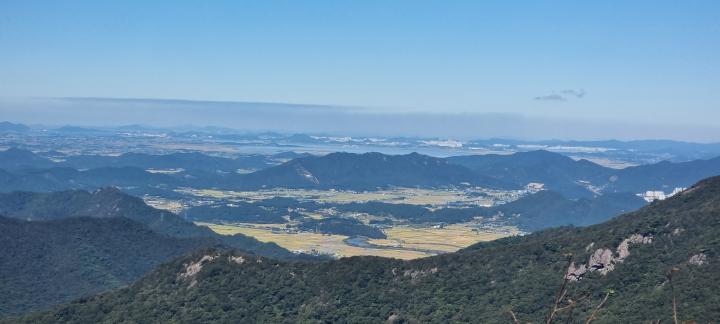 대흥사 만일재에서(두륜봉, 가련봉 사이) / 사진제공=해남뉴스 |
백두산이 한반도 산맥의 시원이라면, 두륜산은 그 기운이 완결되는 남쪽 성산이다.
곤륜은 외부의 산이 아니라, 이 구조를 설명하기 위한 우주론적 언어다.
그래서 “崑崙山 大芚寺”는 지명이 아니라 세계관의 선언이다.
이 선언은 결코 허공에 떠 있지 않았다.
서산대사 휴정의 법맥이 이곳에 모였고, 표충사가 세워져 국가와 불교의 기억을 함께 품었으며, 대흥사는 조선 후기 선과 교를 아우르는 남도 불교의 중심 도량으로 자리 잡았다.
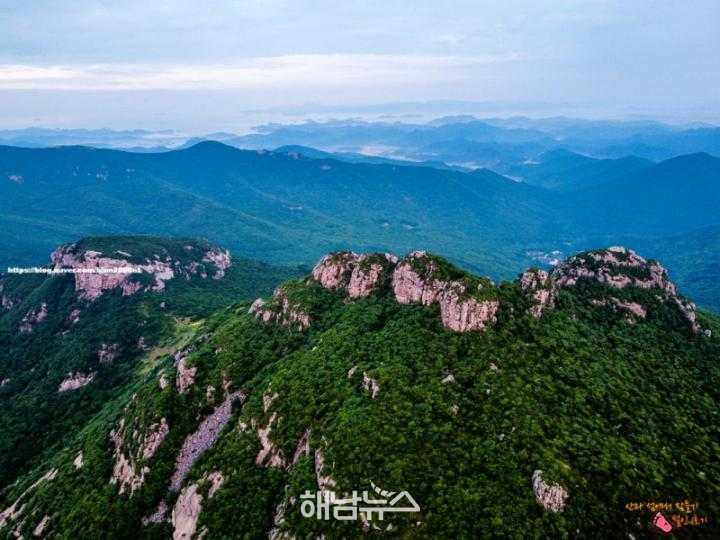 세계문화유산 대흥사 노승봉, 가련봉 / 사진제공=해남뉴스 |
문헌 속 인식은 현실의 역사로 구현되었다.
『대둔사지』는 사찰 연혁을 정리한 안내서가 아니다.
그것은 조선 후기 불교가 스스로를 어디에 두고, 이 땅의 지리를 어떻게 해석했는지를 보여주는 정신 지리학적 선언문이다.
그리고 그 선언의 핵심은 지금도 유효하다.
대흥사는 ‘땅끝의 절’이 아니다.
스스로를 세계 산맥 질서가 닫히는 곳, 법맥이 완결되는 성지로 규정한 도량이다.
이 이름을 이해하는 순간, 두륜산과 대흥사는 전혀 다른 모습으로 우리 앞에 선다.
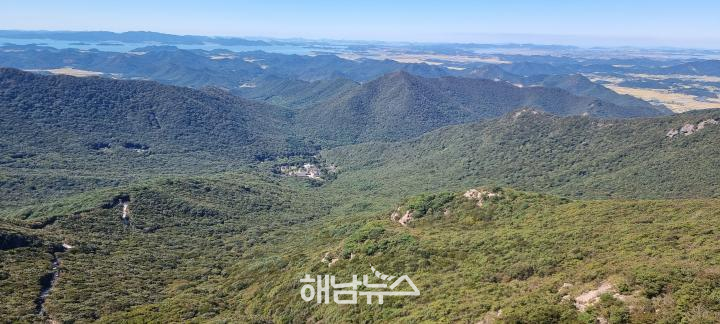 대흥사 가련봉에서 내려다 보이는 대흥사 전경 / 사진제공=해남뉴스 |
 세계문화유산 대흥수 두륜봉 구름다라 / 사진제공=해남뉴스 |
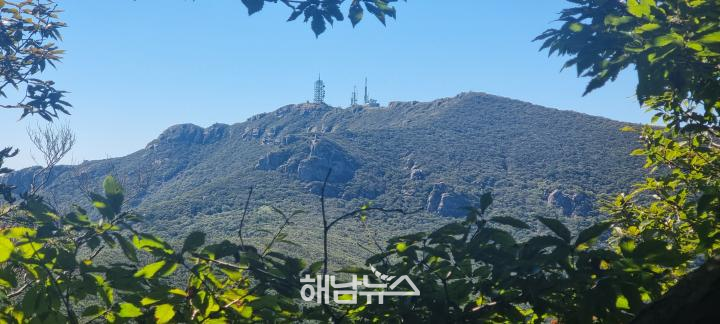 세계문화유산 대흥사 도솔봉 / 사진제공=해남뉴스 |
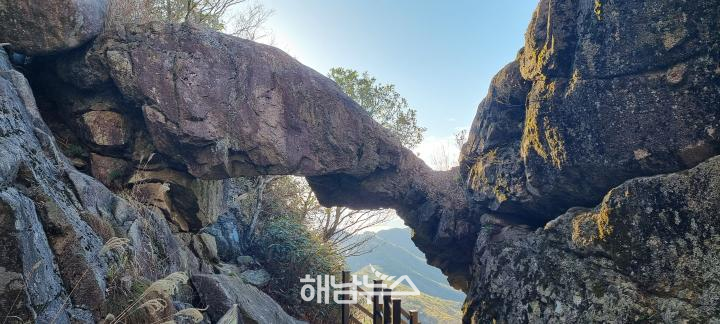 두륜봉 구름다리 / 사진제공=해남뉴스 |
[Haenam = Haenam News]
haenamnews@kakao.com
Park Chung-bae
Editor / Columnist / Editorial Writer
“Mt. Kunlun, Daedunsa”
— Why Daeheungsa Called Itself Kunlun —
We often refer to Daeheungsa Temple on Mt. Duryunsan in Haenam as “the great temple of the southern region.”
Yet the moment one opens the Daedunsa-ji (大芚寺志)—a record written directly by Daeheungsa monks in the late Joseon period—this familiar perception is immediately unsettled.
In that text, the temple calls itself by a striking name:
“崑崙山 大芚寺”
(Mt. Kunlun, Daedunsa).
Kunlun Mountain, Daedunsa.
This single line is not a decorative flourish.
It is a clear declaration of how Daeheungsa understood its own place in the world.
From the very beginning, Daedunsa-ji places the name “Daedunsa” before “Daeheungsa.”
Throughout the text appears the repeated expression:
“Daedunsa of Haenam (大芚寺, that is, Daeheungsa).”
This was not because the temple was uncertain of its name.
Rather, it reflects a deliberate distinction between layers of identity.
If Daeheungsa was the language of the state and administration,
Daedunsa was the name that encompassed the mountain, the Dharma lineage, and the world of spiritual practice itself.
The name Daedun immediately leads us to the mountain.
The description of the terrain in Daedunsa-ji is highly distinctive.
To the right stands Garyeon Peak, to the left Duryun Peak, while the nine-bending valley is likened to “a gate through which the sun and moon enter and exit.”
This is not mere landscape description.
The term Duryun (頭輪) itself combines the characters for “head” and “rotation or completion,” forming a symbolic expression.
The imagery of the nine bends and of the sun and moon belongs, in East Asian tradition, exclusively to sacred mountains.
Mt. Duryunsan is thus portrayed not as a local mountain, but as a space where the order of the universe is condensed.
This spatial perception soon leads to the issue of Dharma lineage.
One of the most frequently repeated assertions in Daedunsa-ji is that “Daedunsa is the place where the Dharma lineage converges.”
A Dharma lineage is not simply a chain of master and disciple.
It is the living current of Buddhist orthodoxy flowing through history.
To say that it “converges” here means that this is not a place of passage, but a final center where that current is gathered and completed.
Daeheungsa thus positioned itself not as a peripheral outpost of southern Buddhism, but as the very point where the lineage reached fulfillment.
This perception reaches its peak in the narrative of the transmission of Buddhism itself.
Daedunsa-ji states that Buddhism came eastward and spread throughout the Eight Provinces, and that among them, the foremost place was Daedunsa of Haenam.
This is not a claim of chronological priority.
It is a symbolic statement placing the temple not at the beginning of Buddhist history, but at its completion.
Buddhism begins in the north and concludes at the southern edge, and that final place, according to the text, is Daedunsa.
It is at this point that the name Kunlun emerges.
Daedunsa-ji does not attempt to explain the Kunlun Mountains of China in geological terms.
Instead, it invokes Kunlun as a universal East Asian symbol—the cosmic center, the axis of heaven and earth.
If Mt. Baekdu represents the origin of the Korean mountain system,
then Mt. Duryun represents the sacred southern mountain where that vital energy is brought to completion.
Kunlun, in this sense, is not an external mountain.
It is a cosmological language used to explain this structure.
Thus, “Mt. Kunlun, Daedunsa” is not a place name.
It is a worldview rendered in words.
This declaration did not remain in the realm of abstraction.
The Dharma lineage of Seosan Daesa Hyujeong converged here.
Pyochungsa Shrine was established, holding together the memory of the state and Buddhism.
Daeheungsa became, in reality, the central monastery of southern Korea where Seon and doctrinal traditions were unified during the late Joseon period.
What was articulated in texts was realized in history.
Daedunsa-ji is not a simple guidebook of temple history.
It is a declaration of spiritual geography, revealing where late Joseon Buddhism placed itself and how it interpreted the land itself.
And the core of that declaration remains valid even today.
Daeheungsa is not “a temple at the end of the land.”
It is a monastery that defined itself as the place where the order of the world’s mountain system closes, and where the Dharma lineage is brought to completion.
Once this name is understood,
Mt. Duryunsan and Daeheungsa stand before us in an entirely different light.
 해남뉴스 박충배 편집 및 논설위원 haenamnews@kakao.com