| 해남 대흥사 13대 종사 연구 ― 조선 후기 선불교 법맥 형성과 전개 ― 해남뉴스 박충배 편집 및 논설위원 haenamnews@kakao.com |
| 2025년 12월 16일(화) 14:18 |
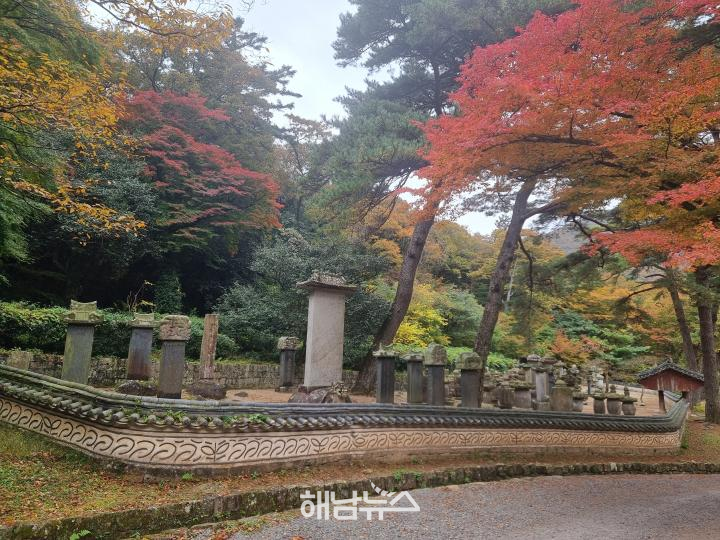 해남 대흥사 부도전 13대 존사 부도 / 사진제공=해남뉴스 |
박충배 편집/칼럼/논설
Ⅰ. 서론
해남 대흥사는 조선 후기 선불교의 핵심 법맥이 집약된 도량으로, 이른바 ‘13대 종사(大宗師)’의 계보를 통해 수행·교학·문화로 이어지는 독자적 전통을 형성하였다.
본 연구는 대흥사 13대 종사를 개별 인물 중심으로 분석함으로써, 각 종사가 법맥 전승 과정에서 담당한 기능과 역사적 의미를 규명하고자 한다.
Ⅱ. 대흥사 13대 종사 개인별 고찰
1. 풍담 의심(風潭 義心, 1592–1665)
풍담 의심은 임진왜란 이후 대흥사 선맥을 사실상 재건한 인물이다. 그는 청허 휴정의 법통을 계승하여 대흥사에 정착하였으며, 흩어진 승단을 다시 모아 수행 공동체의 중심을 세웠다.
풍담의 업적은 특정 저술이나 교학 체계보다는 도량 재건과 선풍 확립에 있다.
그가 확립한 간화선 중심 수행 노선은 이후 대흥사 종풍의 근간이 되었으며, 대흥사가 ‘호남 선불교의 본산’으로 자리 잡는 토대를 제공하였다.
2. 취여 삼우(醉如 三祐, 1622–1684)
취여 삼우는 풍담 의심 이후 대흥사의 선맥을 대중 교화 차원으로 확장시킨 인물이다.
그는 법회와 설법을 적극적으로 열어 수행을 승려 집단 내부에만 머물게 하지 않고 지역 사회와 연결시켰다.
이는 조선 후기 억불 환경 속에서도 불교가 민중 신앙과 윤리의 차원에서 기능하도록 한 중요한 시도였다.
취여의 활동은 대흥사 선풍의 사회적 기반을 넓혔다는 점에서 의의가 있다.
3. 화악 문신(和岳 文信, 1629–1707)
화악 문신은 대흥사 법맥을 전국적 선종 네트워크 속에 편입시킨 종사이다.
그는 금강산, 지리산 등 주요 산문을 유력하며 선지식들과 교류하였고, 이를 통해 대흥사의 법통을 외부로 확장하였다.
그의 업적은 특정 사상보다는 법맥의 연결과 통합에 있으며, 대흥사가 지역 사찰을 넘어 전국적 위상을 갖게 되는 데 결정적 역할을 하였다.
4. 월저 도안(月底 道安, 1638–1715)
월저 도안은 대흥사 종풍에 사상적 깊이를 부여한 인물이다.
그는 『화엄경』을 중심으로 선·교·유·도 사상을 폭넓게 이해하고 이를 조화시키려 하였다.
이러한 태도는 조선 후기 유교 지식인 사회 속에서 불교가 사유 체계로서 존속할 수 있는 논리적 기반을 제공하였다.
월저의 업적은 수행 중심 도량이었던 대흥사를 사상적 도량으로 확장시켰다는 점에 있다.
5. 설암 추붕(雪菴 秋朋, 1651–1706)
설암 추붕은 학승적 성격이 두드러진 종사로, 불교 사상과 수행 이론을 문헌으로 정리하였다.
그는 수행 체험을 기록하고 교학적으로 체계화함으로써, 선불교가 단절되지 않고 후대에 전승될 수 있는 토대를 마련하였다.
그의 작업은 대흥사 전통이 구전 중심에서 기록 중심으로 이행하는 전환점이라 평가할 수 있다.
6. 환성 지안(喚惺 智安, 1664–1729)
환성 지안은 선 수행의 엄격함을 강조한 종사이다.
금강산 순례 수행을 통해 자신의 수행을 심화하였으며, 도량 내부에서도 계율과 정진을 중시하는 분위기를 조성하였다.
그는 교학의 확산 속에서 수행이 느슨해질 위험을 경계하며, 대흥사의 선풍을 다시 수행 중심으로 환원시켰다.
7. 벽하 대우(碧霞 大友, 1676–1763)
벽하 대우의 가장 큰 업적은 제자 양성이다.
그는 개인적 깨달음보다 수행 공동체의 지속성을 중시하였고, 안정적인 선원 운영을 통해 다수의 후학을 길러냈다.
이로써 대흥사는 일시적 명성이 아닌 장기적 법맥 유지를 가능하게 하였다.
8. 설봉 회정(雪峰 會定, 1678–1738)
설봉 회정은 언어와 이론에 의존하는 불교를 비판하며, 간화선의 철저한 실천을 강조하였다. 그는 선문답과 묵언 수행을 통해 ‘언어 이전의 깨달음’을 중시하였고, 이는 대흥사 수행 전통의 순수성을 유지하는 역할을 했다.
9. 호암 체정(虎岩 體淨, 1687–1748)
호암 체정은 대흥사 법맥을 외부 사찰로 확산시킨 대표적 인물이다. 그는 해인사와 통도사 등지에 주석하며 대흥사의 선풍을 전국적으로 전파하였다.
이를 통해 대흥사는 특정 지역의 본산을 넘어 한국 선불교 전체에 영향을 미치는 도량으로 자리매김하였다.
10. 상월 새봉(尙月 薪峯, 1687–1767)
상월 새봉은 저술이나 교화보다는 묵언과 좌선으로 일관한 수행자였다.
그는 말없이 수행으로 모범을 보임으로써 대흥사 수행자의 인격적 표상이 되었다.
그의 존재는 대흥사 선맥이 단지 사상 체계가 아니라 삶의 태도임을 상징한다.
11. 함월 해원(含月 海源, 1691–1770)
함월 해원은 법맥 정리와 전법 활동에 주력한 종사이다.
그는 대흥사 계보를 체계적으로 정리하고, 제자들에게 이를 명확히 전승함으로써 법통의 정통성을 강화하였다.
그의 역할은 ‘계보 관리자’로서의 성격이 강하다.
12. 연담 유일(蓮潭 有一, 1720–1799)
연담 유일은 조선 후기 대표적 화엄학자로, 대흥사 강원 체계를 확립하였다.
그는 선과 교를 조화시키는 학문적 기반을 마련하고 수많은 강백을 배출하였다.
이를 통해 대흥사는 수행 도량을 넘어 학문 도량으로서도 최고 수준에 이르렀다.
13. 초의 의순(草衣 意恂, 1786–1866)
초의 의순은 대흥사 13대 종사의 흐름을 문화로 완성시킨 인물이다.
그는 『동다송』을 통해 차 문화를 수행과 사유의 영역으로 끌어올렸으며, 다산 정약용·추사 김정희 등과의 교류를 통해 불교를 조선 후기 지성사와 연결하였다.
초의의 활동은 대흥사 선맥이 종교의 경계를 넘어 문화적 전통으로 확장되었음을 보여준다.
Ⅲ. 결론
대흥사 13대 종사는 단순한 고승 열전이 아니라, 조선 후기 선불교가 어떻게 재건되고, 제도화되며, 학문과 문화를 통해 완성되었는지를 보여주는 집단적 역사이다.
각 종사는 서로 다른 역할을 수행하며 하나의 연속적 구조를 형성하였고, 그 결과 대흥사는 한국 불교사에서 독보적인 위치를 차지하게 되었다.
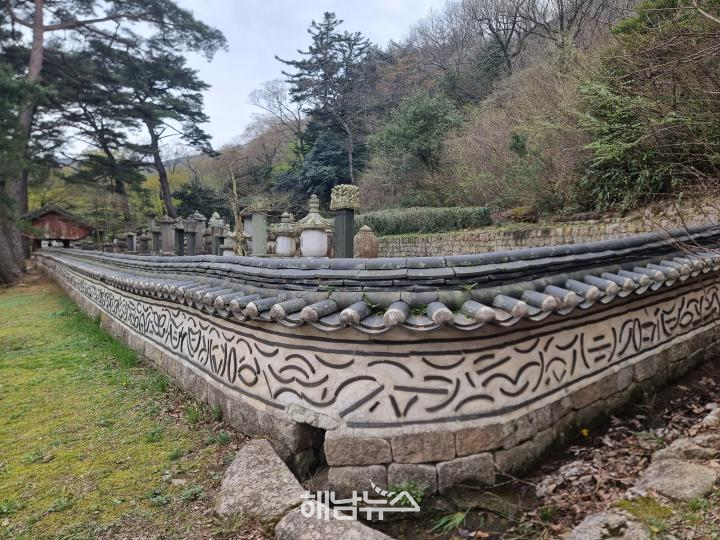 해남 대흥사 부도전 13대 존사 부도 / 사진제공=해남뉴스 |
[Haenam = Haenam News]
haenamnews@kakao.com
Park Chung-bae
Editor / Columnist / Commentary
A Study of the Thirteen Patriarchs of Daeheungsa Temple in Haenam
— The Formation and Development of the Seon Buddhist Lineage in the Late Joseon Period —
I. Introduction
Daeheungsa Temple in Haenam functioned as a central locus in which the core lineage of Seon Buddhism during the late Joseon period was consolidated. Through the lineage of the so-called Thirteen Patriarchs (Daejongsa, 大宗師), the temple established a distinctive tradition that evolved from spiritual practice to doctrinal scholarship and, ultimately, to cultural expression.
This study seeks to analyze the thirteen patriarchs of Daeheungsa on an individual basis in order to clarify the specific roles each figure played in the transmission of the Dharma lineage and to elucidate their historical significance within the broader development of Korean Buddhism.
II. Individual Studies of the Thirteen Patriarchs of Daeheungsa
1. Pungdam Uisim (風潭 義心, 1592–1665)
Pungdam Uisim was the figure who effectively reconstructed the Seon lineage of Daeheungsa in the aftermath of the Imjin War (Japanese invasions of Korea). Having inherited the Dharma lineage of Cheongheo Hyujeong, he settled at Daeheungsa and reorganized the dispersed monastic community, restoring the temple as a center of collective practice.
Pungdam’s achievements lie not in specific doctrinal writings but in the reconstruction of the monastery and the establishment of its Seon orientation. The Ganhwa Seon-centered practice system he instituted became the foundation of Daeheungsa’s religious character and enabled the temple to emerge as the principal stronghold of Seon Buddhism in the Honam region.
2. Chwiyeo Samu (醉如 三祐, 1622–1684)
Following Pungdam Uisim, Chwiyeo Samu expanded Daeheungsa’s Seon lineage into the sphere of popular religious engagement. Through the active organization of Dharma assemblies and sermons, he prevented Seon practice from remaining confined within the monastic elite and instead connected it to the broader local community.
In the context of late Joseon’s anti-Buddhist climate, this approach allowed Buddhism to function as a source of moral guidance and popular faith. Chwiyeo’s activities are significant in that they broadened the social foundation of Daeheungsa’s Seon tradition.
3. Hwaak Munsin (和岳 文信, 1629–1707)
Hwaak Munsin integrated Daeheungsa’s lineage into the nationwide Seon Buddhist network. He traveled extensively to major monastic centers such as Geumgangsan and Jirisan, engaging in exchanges with prominent Seon masters.
Rather than advancing a distinctive doctrinal system, his principal contribution lay in linking and consolidating lineages. Through his efforts, Daeheungsa transcended its status as a regional temple and attained national recognition within Korean Seon Buddhism.
4. Woljeo Doan (月底 道安, 1638–1715)
Woljeo Doan endowed Daeheungsa’s tradition with philosophical depth. Centering his studies on the Avataṃsaka Sūtra (Huayan Sutra), he sought to harmonize Seon, doctrinal Buddhism, Confucianism, and Daoism.
This intellectual orientation provided Buddhism with a logical foundation that allowed it to persist as a system of thought within a Confucian-dominated society. Woljeo’s contribution lies in transforming Daeheungsa from a practice-oriented monastery into a center of philosophical reflection.
5. Seolam Chubung (雪菴 秋朋, 1651–1706)
Seolam Chubung was a scholar-monk who systematized Buddhist doctrine and theories of practice through written texts. By recording experiential insights and organizing them doctrinally, he established a foundation for the transmission of Seon Buddhism beyond oral instruction.
His work marks a turning point in Daeheungsa’s tradition, shifting it from an orally transmitted lineage toward a documented intellectual heritage.
6. Hwanseong Jian (喚惺 智安, 1664–1729)
Hwanseong Jian emphasized the strict discipline of Seon practice. Through pilgrimage and intensive training at Geumgangsan, he deepened his own practice and fostered an atmosphere of rigorous observance of precepts and meditation within Daeheungsa.
In response to the increasing emphasis on doctrinal learning, he cautioned against the relaxation of practice and redirected the temple’s orientation toward ascetic rigor and meditative discipline.
7. Byeokha Daewoo (碧霞 大友, 1676–1763)
The principal achievement of Byeokha Daewoo lay in the training of disciples. Prioritizing the sustainability of the monastic community over individual enlightenment, he ensured stable operation of the meditation halls and nurtured numerous successors.
Through his efforts, Daeheungsa secured long-term continuity of its Dharma lineage rather than temporary prominence.
8. Seolbong Hoejeong (雪峰 會定, 1678–1738)
Seolbong Hoejeong criticized Buddhism’s reliance on language and theoretical constructs, emphasizing instead the rigorous practice of Ganhwa Seon. Through Seon dialogues and silent meditation, he stressed “awakening prior to language,” thereby preserving the purity of Daeheungsa’s meditative tradition.
9. Hoam Chejeong (虎岩 體淨, 1687–1748)
Hoam Chejeong played a decisive role in disseminating Daeheungsa’s lineage beyond its home region. By serving as abbot at major temples such as Haeinsa and Tongdosa, he transmitted Daeheungsa’s Seon tradition nationwide.
As a result, Daeheungsa emerged not merely as a regional center but as a temple exerting influence across Korean Seon Buddhism as a whole.
10. Sangwol Saebong (尙月 薪峯, 1687–1767)
Sangwol Saebong devoted himself almost exclusively to silent meditation and seated practice, avoiding public preaching or literary production. By embodying the ideal of practice through action rather than words, he became a model of monastic character within Daeheungsa.
His presence symbolized that the temple’s lineage was not only an intellectual system but a lived ethical and spiritual discipline.
11. Hamwol Haewon (含月 海源, 1691–1770)
Hamwol Haewon concentrated on organizing and transmitting the Dharma lineage. By systematizing genealogical records and ensuring their accurate transmission to disciples, he reinforced the legitimacy and continuity of Daeheungsa’s lineage.
His role may be characterized as that of a custodian and administrator of the Seon genealogical tradition.
12. Yeondam Yuil (蓮潭 有一, 1720–1799)
Yeondam Yuil was a leading Huayan scholar of the late Joseon period and established the scholastic curriculum of Daeheungsa’s monastic academy. By harmonizing Seon practice with doctrinal study, he produced numerous eminent lecturers (gangbaek).
Through his leadership, Daeheungsa achieved the highest standing not only as a meditation center but also as an institution of Buddhist learning.
13. Choui Uisun (草衣 意恂, 1786–1866)
Choui Uisun brought the lineage of the thirteen patriarchs to completion by extending it into the cultural realm. Through his work Dongdasong (Ode to Eastern Tea), he elevated tea culture into a medium of practice and contemplation.
His exchanges with figures such as Dasan Jeong Yak-yong and Chusa Kim Jeong-hui connected Buddhism with the intellectual currents of late Joseon society. Choui’s activities demonstrate how Daeheungsa’s Seon lineage transcended religious boundaries and evolved into a broader cultural tradition.
III. Conclusion
The thirteen patriarchs of Daeheungsa represent not merely a series of eminent monks but a collective historical process illustrating how Seon Buddhism in the late Joseon period was reconstructed, institutionalized, and ultimately completed through scholarship and culture.
Each patriarch fulfilled a distinct role within this continuum, forming a coherent and cumulative structure. As a result, Daeheungsa secured a unique and enduring position within the history of Korean Buddhism.
 해남뉴스 박충배 편집 및 논설위원 haenamnews@kakao.com